$
Jury Verdict
$ 10 Million
Medical Malpractice
Luzerne County

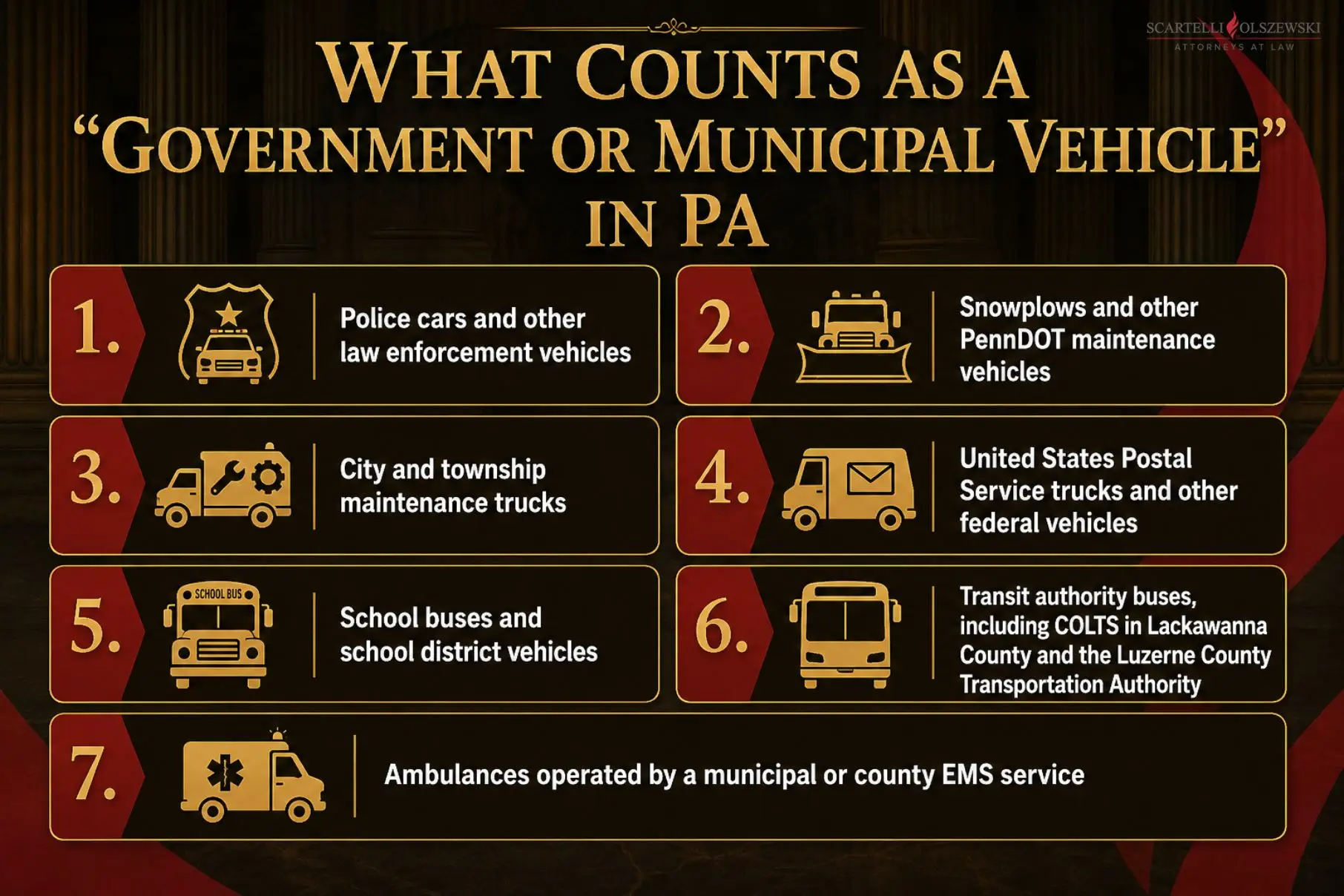
A snowplow clips your car on a Scranton side street. A police cruiser runs a red light in Wilkes-Barre and hits you square in the intersection. In that moment, your case works differently from an ordinary crash.
Pennsylvania gives most crash victims two years to file a lawsuit. But, a claim against a government or municipal vehicle runs on a separate, much shorter clock: a written notice of claim within six months of the crash, filed with the correct agency, or your right to compensation can be barred even though the two-year deadline has not run out.
Scartelli Olszewski, P.C., has represented Northeastern Pennsylvania crash victims since 2001, including claims against government vehicles and public agencies. Call (570) 346-2600 and tell us what happened. Our car accident lawyers in Pennsylvania identify the responsible agency, calculate your notice deadline, and file the required notice on your behalf.
Key Takeaways
A government or municipal vehicle is any vehicle owned or operated by a state agency, county, city, township, school district, or transit authority. That definition covers a wider range of everyday vehicles than most people expect.
A private contractor driving its own truck under a government contract, such as a paving company working a PennDOT job, does not automatically fall under these rules. Whether a contractor counts as a government actor depends on the specific contract and how much control the agency kept over the work. Which NEPA County Has More Car Crashes? breaks down how often Lackawanna and Luzerne County crashes involve these kinds of vehicles.
You have six months from the date of the crash to give written notice of your claim, under 42 Pa.C.S. § 5522(a). This deadline applies whether the vehicle belongs to the Commonwealth, a county, or a local municipality, and it runs separately from Pennsylvania’s two-year statute of limitations for filing the lawsuit itself. Missing the six-month notice can bar your claim permanently, even with a full two years still left on the standard clock.
For claims against local government units (cities, counties, school districts), Pennsylvania law pauses the six-month clock for up to 90 days if your injuries left you incapacitated or unable to give notice. It does not apply to claims against the Commonwealth itself, such as a PennDOT or State Police vehicle, where the clock runs without that adjustment. The clock resumes once you can act, and 90 days is the maximum pause.
The law also protects you if the agency already knew what happened. Under 42 Pa.C.S. § 5522(a)(1)(iii), missing the formal written notice is not automatically fatal to your claim when the government unit already had actual or constructive notice of the crash through its own records, such as an incident report its own employee filed.
Yes. Pennsylvania law generally shields state and local governments from lawsuits. Still, both levels of government carve out an exception for the negligent operation of a motor vehicle. State agencies fall under the Sovereign Immunity Act, while cities, counties, townships, and school districts fall under the Political Subdivision Tort Claims Act.
Key requirements for government vehicle accident claims:
Both exceptions require one core fact: the vehicle had to be in the possession and control of a government employee at the time of the crash.
Outside those narrow situations, a negligent driver behind the wheel of a police car, snowplow, or transit bus creates the same kind of tort claim a private driver would, just with a shorter notice window attached.
Pennsylvania’s notice requirement is stringent. Your written notice must identify who you are, when and where the crash happened, who treated you, and what it cost you.
| Required Detail | What to Include |
|---|---|
| Your name and address | Full legal name and current residential address. |
| Date, time, and location of the crash | Exact date, approximate time, and the street, intersection, or roadway where it happened. |
| Treating physician’s name and address | The name and office address of the doctor or facility that treated you first. |
| Itemized damages | A breakdown of medical bills to date, vehicle repair or replacement costs, and lost wages, with supporting documentation where available. |
If a state-owned vehicle was involved, Pennsylvania law also requires notifying the Office of the Attorney General in addition to the responsible agency. Gathering the evidence your injury claim needs early, including the police report, medical bills, and repair estimates, makes it far easier to complete this stringent notice correctly the first time.
Where your notice goes depends on which government unit owned the vehicle, and Scranton, Wilkes-Barre, and the surrounding counties each route to a different office. City-owned vehicles typically route to that city’s law department or solicitor, and county-owned vehicles route to the county solicitor’s office.
A crash involving a state-owned vehicle, such as a PennDOT truck or a State Police cruiser, follows a separate track. Notice must go to the specific Commonwealth agency that owns the vehicle and to the PA Office of Attorney General. Auto accidents involving state vehicles can also be reported through the Pennsylvania Department of General Services. Getting this routing wrong does not extend your six-month window; it only burns the time you have left while the correct office gets notified.
Pennsylvania caps what you can recover from a government defendant, and the cap depends on whether you are suing a state agency or a local government. Claims against a Commonwealth agency, such as PennDOT, are capped at $250,000 per claimant and $1,000,000 in the aggregate under 42 Pa.C.S. § 8528(b). Claims against a local government, such as a city, county, township, or school district, are capped at $500,000 total per occurrence under 42 Pa.C.S. § 8553, without a separate per-claimant limit.
| Defendant Type | Per-Claimant Cap | Governing Statute |
|---|---|---|
| Commonwealth agency (state vehicles, PennDOT) | $250,000 (capped at $1,000,000 in the aggregate) | 42 Pa.C.S. § 8528(b) |
| Local government (city, county, township, school district) | No individual cap, but $500,000 total per occurrence | 42 Pa.C.S. § 8553 |
These caps apply on top of the usual categories of personal injury damages, including medical expenses, lost earnings, and pain and suffering. A catastrophic injury can produce medical bills and lost income well above these limits, which is exactly when identifying every liable party, not just the government defendant, matters most to your total recovery.
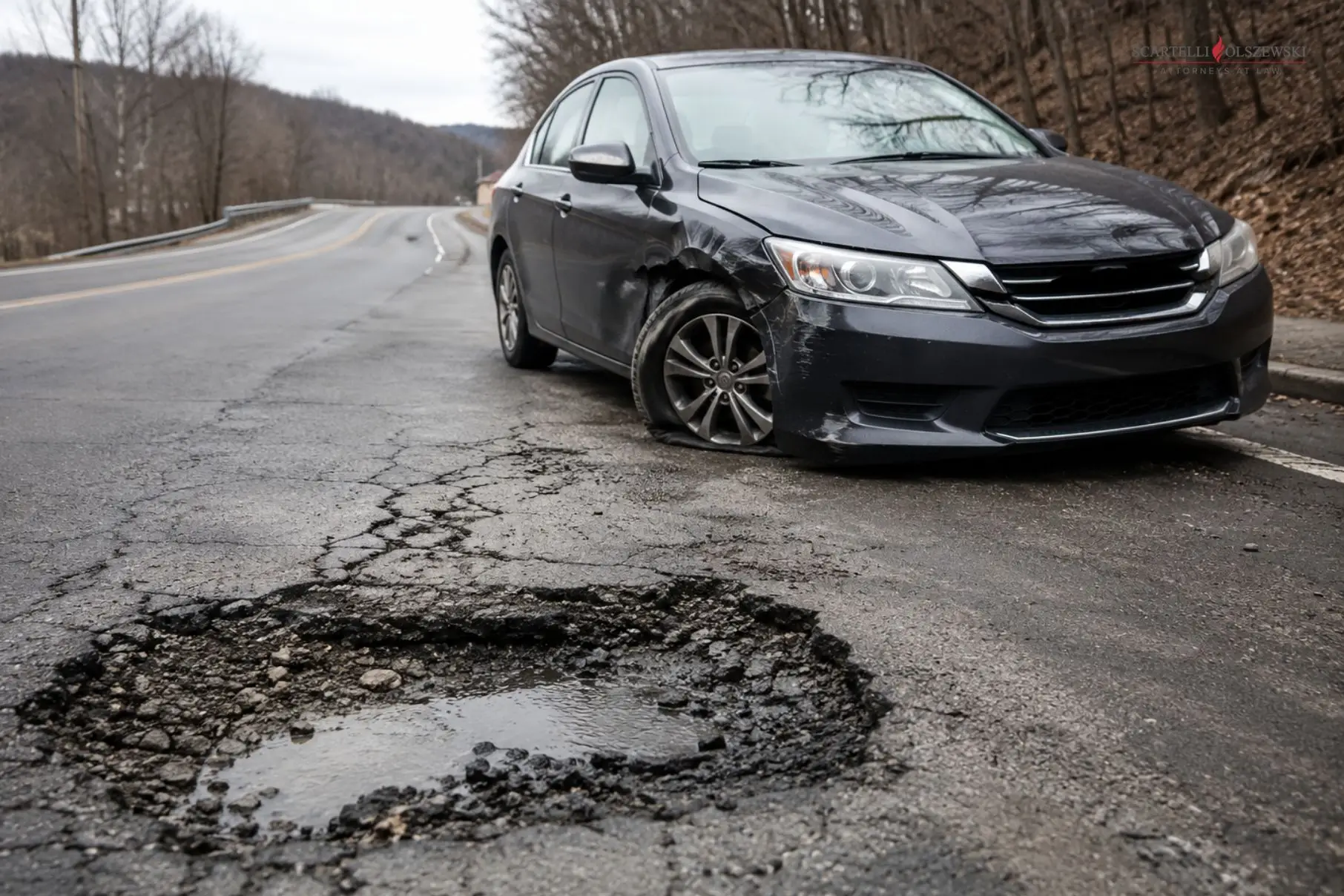
A crash or injury caused by a pothole, missing guardrail, or malfunctioning traffic signal falls under a different exception than a crash caused by a government vehicle. Dangerous road conditions are covered by the real estate and highway exceptions to sovereign immunity, not the vehicle liability exception.
The same six-month notice deadline and the same damage caps apply, but the facts you need to prove are different: instead of showing a government employee drove negligently, you need to show the government knew or should have known about the dangerous condition and failed to fix it.
If a poorly maintained road, not a government vehicle, caused your crash, tell us that when you call at (570) 346-2600 so we can build the right kind of case from the start.
Call an attorney anyway. For local government claims, the 90-day incapacity pause or the constructive notice exception (such as an official police report filed by the agency) can preserve a claim. For state government claims, showing a reasonable excuse for late notice may allow your case to move forward. An attorney needs to review your exact timeline and government records before anyone can tell you the door is closed.
An unidentified vehicle, including a government vehicle that left the scene, still leaves you options. Your own uninsured motorist coverage can respond the same way it would in any hit-and-run accident case, and identifying the vehicle through witness accounts, dashcam footage, or municipal fleet records can still support a direct claim against the responsible agency once it is identified.
The government’s vehicle liability exception does not shield the other driver. If you caused the crash, you face the same negligence claim you would from a private driver, and the government’s insurer or self-insurance program handles the claim the same way a private insurer would.
Most claims name the government agency, not the individual employee. The agency carries the insurance that pays a judgment. An employee faces personal liability in rare cases involving willful misconduct outside official duties. A negligent municipal driver causing a crash creates an agency claim because the agency, not the driver, holds the coverage.
Yes. Pennsylvania’s comparative negligence rule reduces your compensation by your percentage of fault, and this rule applies equally to private drivers and government agencies. You recover nothing if you are found more than 50 percent at fault. The damage caps apply on top of any fault reduction.
No, federal vehicles follow the Federal Tort Claims Act instead of Pennsylvania’s state notice law. You have two years to file an administrative claim with the responsible federal agency, then only six months to file suit after the agency denies your claim, under 28 U.S.C. § 2401(b). A crash with a postal truck, a federal law enforcement vehicle, or a military transport follows this federal track, not the six-month state deadline.
No law requires you to hire an attorney to file a notice of claim, and you have the legal right to draft and submit it yourself. However, the notice still requires precise factual details, proper statutory service, and delivery to the correct government offices on the first attempt. An incomplete or misrouted notice can permanently bar your claim once the six-month window expires.
A claim against a government or municipal vehicle gives you far less time to act than an ordinary crash claim, and the notice requirements leave little room for error. Scartelli Olszewski, P.C., tracks your notice deadline, files within the applicable damage caps, and handles the procedural rules that apply to government defendants.
Our Scranton and Wilkes-Barre teams handle these claims throughout Northeastern Pennsylvania, from PennDOT vehicles to city and county fleets.
Call us at (570) 346-2600 for a free consultation or schedule online. We work on a contingency fee, so you pay nothing unless we recover compensation for you.
Attorney Advertising. This article provides general information about Pennsylvania law and is not legal advice. Past results do not guarantee a similar outcome; every case depends on its own facts.

Rachel D. Olszewski, an attorney at Scartelli Olszewski, P.C., is a dedicated advocate for clients who have suffered unjust harm. Following the legacy of her esteemed family members, Rachel specializes in personal injury, medical malpractice, and criminal defense. She is actively involved in professional associations and serves on the board of the Luzerne County Bar Association Charitable Foundation. Rachel is admitted to practice in Pennsylvania state courts and the U.S. District Court for the Middle District of Pennsylvania.
Linked In - https://www.linkedin.com/in/olszewskirachel/
I don't think I could have picked a better team to represent my case. My situation was unique and extremely complicated but it was handled with the utmost care and professionalism. The firm's strong and organized representation ultimately brought great results and helped reconcile a tragic event.
- Jeremy S.
Was wrongly accused of a very serious Felony 3 account and hired Peter Paul Olszewski. The entire firm of Scartelli Olszewski worked tirelessly to have the Pike County Assistant District Attorney as well as the District Magistrate Judge Dismiss the charges! Very pleased with the outcome of this Law Firm and recommend this Law Firm.
- Kerry S.Dealing with the attorneys over at Scartelli Olszewski was nothing short of satisfactory. Through the entire 4 year process we had, I was constantly kept updated and cared for. More than doing their job, they truly care for their clients which I felt off the first meeting with Melissa. Both my family and I are forever thankful for them!
- Noah T.Riding in someone else's car when it crashes leaves you hurt, confused, and often afraid to ask the one question...
Read MoreYour car accident case is worth your economic damages plus pain and suffering, filtered through three Pennsylvania rules: the 51%...
Read More
No. In almost every case, you should not give a recorded statement to the other driver's insurance company after a...
Read MoreAfter an accident, who you hire matters. We've spent years fighting for families just like yours – and we're ready to fight for you.

Wilkes Barre Office (Appointment Only)
Scartelli Olszewski, P.C.
7 Public Square
Wilkes-Barre, PA 18701