

$
Jury Verdict
$ 10 Million
Medical Malpractice
Luzerne County


Riding in someone else’s car when it crashes leaves you hurt, confused, and often afraid to ask the one question that actually matters: who do you sue? As an injured passenger in Pennsylvania, you can sue your driver, the other driver, or both. In each case, you are suing the responsible party and their insurance responds, not their personal bank account. That holds even when the driver is a family member or close friend.
What complicates your claim isn’t who you sue, but how much you recover. Pennsylvania’s insurance rules dictate whether your coverage is limited or full tort, how comparative fault is assigned among all parties, and how long you have to act. These are exactly the kinds of judgment calls a Pennsylvania car accident lawyer sorts out for you. Below, we break down liability, insurance priority rules, tort elections, and filing deadlines in Lackawanna and Luzerne counties.
Key Takeaways
As an injured passenger, you can typically pursue a claim or lawsuit against the driver of the vehicle you were in, the driver of any other vehicle involved, both drivers together, or a third party whose negligence contributed to the crash.
Identifying every liable party is how you maximize what you can recover, especially when one driver’s insurance is not enough to cover your injuries.
| Who You Can Sue | When It Applies |
|---|---|
| Your driver | Their negligence, such as speeding, distraction, or running a stop sign, caused or contributed to the crash. |
| The other driver | Another motorist’s negligence caused or contributed to the crash. |
| Both drivers | Fault is shared or disputed between two or more drivers. |
| An employer | The at-fault driver was working at the time, such as a delivery, rideshare, or sales route. |
| A vehicle or parts manufacturer | A defect, like failed brakes or a faulty airbag, caused or worsened the crash. |
| A government entity | A poorly maintained road, a missing sign, or a broken traffic signal contributed to the crash. |
If your driver was working through a platform like Uber or Lyft at the time of the crash, the insurance picture gets more layered. Our guide on how to sue as a Pennsylvania rideshare accident victim breaks down which policy actually applies. Our Scranton car accident lawyer and Wilkes-Barre car accident lawyer teams investigate every potential defendant in NEPA crashes, not just the obvious one.
A lawsuit still names your driver as the defendant, but their insurance company, not your friend or family member personally, pays for your damages up to the policy limit. Pennsylvania has never adopted a guest statute that would block that claim.
Many passengers hesitate here more than anywhere else in this process. Decades ago, some states passed guest statutes that barred passengers from suing a driver who gave them a free ride, largely to prevent collusive insurance claims between family members. Pennsylvania is one of the states that never enacted one. Insurance companies set premiums based on at-fault accidents on record, not on who technically submitted the claim, so the insurance company, not your relative’s bank account, pays for your injuries.
Most passengers assume the car they were riding in pays their medical bills first. Under Pennsylvania’s actual priority-of-benefits rule (75 Pa.C.S. § 1713), that’s backwards. If you carry your own auto policy, or live with a family member who does, your policy pays your initial medical bills first, even though you weren’t driving and weren’t at fault.
Here is the real order of coverage in Pennsylvania:
| Step | Source | What It Covers | Applies Regardless of Fault? |
|---|---|---|---|
| 1 | Your own auto policy’s PIP (or a resident family member’s policy) | Initial medical bills and lost wages up to your PIP limit | Yes (No-fault) |
| 2 | The host vehicle’s PIP (your driver’s policy) | Medical bills up to their PIP limit (only applies if you have no household auto policy) | Yes (No-fault) |
| 3 | The at-fault driver’s bodily injury liability | Remaining medical bills, full lost wages, and pain & suffering (if full tort or an exception applies) | No (Requires proving fault) |
| 4 | Uninsured/underinsured motorist (UM/UIM) (Yours or the host vehicle’s) | Fills the gap if the at-fault driver has no insurance or not enough coverage | No (Requires proving the driver lacked adequate coverage) |
This priority order applies specifically to first-party medical benefits (PIP). Pain and suffering and lost-wage claims beyond what PIP covers still run through the at-fault driver’s liability coverage under the fault-based process described elsewhere on this page.
Yes. If two or more drivers share fault for the crash, Pennsylvania law lets you name all of them in the same claim or lawsuit rather than picking one driver and hoping you guessed right.
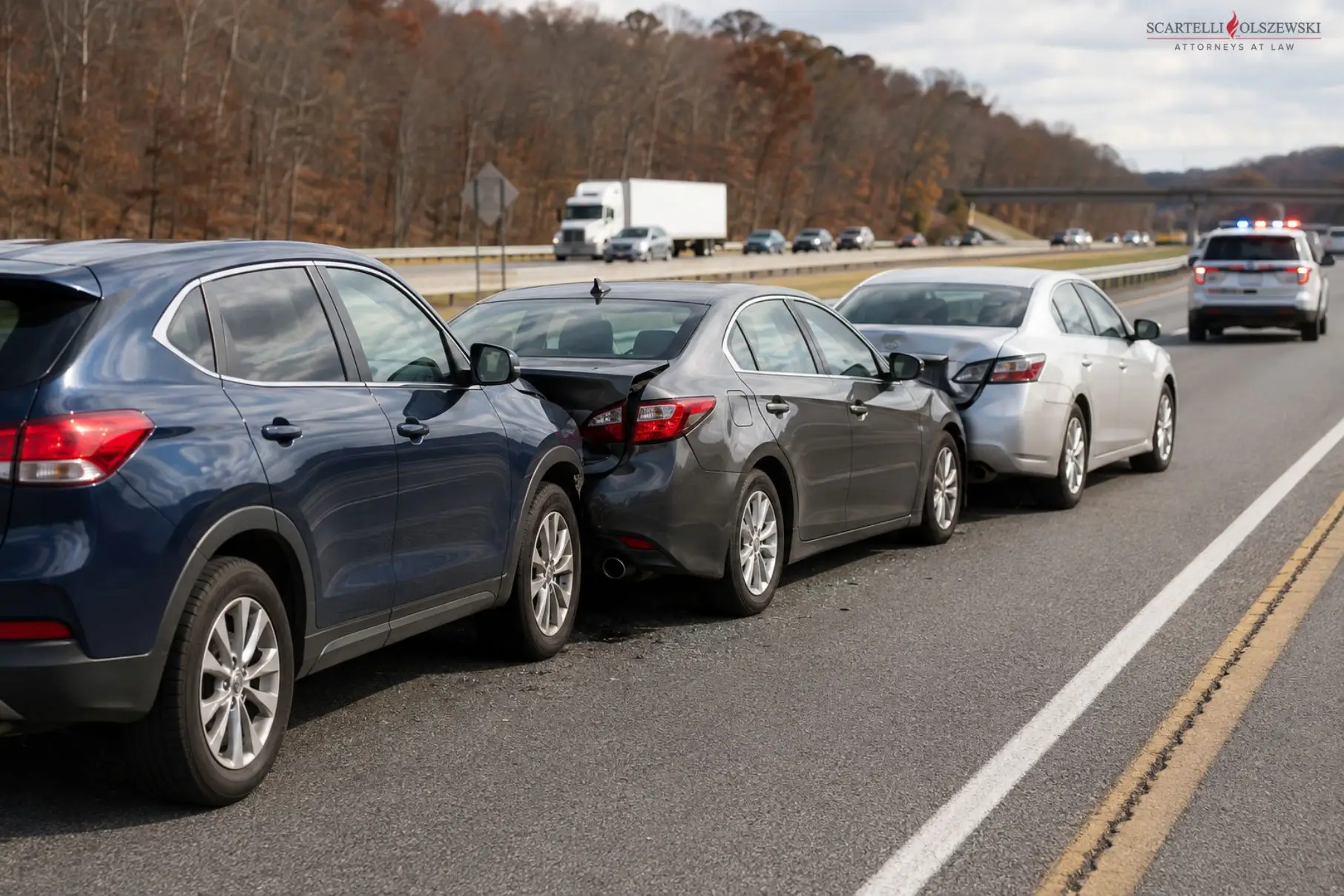
Naming every potentially liable driver protects you from a scenario where each driver’s insurer points the finger at the other, leaving you with nothing from either. Multi-vehicle chain-reaction crashes make this especially important. A pileup on I-81 or I-380 can leave three or four drivers each partly responsible, and naming only one risks leaving compensation on the table once fault gets reassigned.
Whether you can recover money for pain and suffering, not just medical bills, depends on Pennsylvania’s tort election system, and whose policy controls that election can vary by situation.
Full tort coverage preserves an unrestricted right to sue for pain and suffering. Limited tort coverage saves money on premiums but restricts that right unless your injuries meet Pennsylvania’s serious injury threshold, defined under 75 Pa.C.S. § 1702 as death, serious impairment of body function, or permanent serious disfigurement. Even under limited tort, several exceptions restore full rights, including when the at-fault driver was convicted of DUI or entered the ARD program, was uninsured, or was driving a vehicle registered outside Pennsylvania, and when you were a pedestrian, cyclist, or riding in a commercial vehicle such as a bus or rideshare.
For the fuller comparison of the two coverage types, see what full tort coverage gets you. Whose tort election actually controls your claim (yours, your driver’s, or a household policy) depends on the specific policies involved. This is worth confirming with an attorney early, rather than assuming.
As an injured passenger, you can pursue a claim or lawsuit against the driver of the vehicle you were in, the other driver of any other vehicle involved, both drivers together, or a third party whose negligence contributed to the crash. You can typically recover:
Pennsylvania places no cap on economic or non-economic damages in car accident cases, so the ceiling on what you can recover is set by the facts of your case rather than a statutory limit. Our overview of the different types of personal injury damages walks through economic, non-economic, and punitive categories in more depth.
You generally have two years from the date of the crash to file a personal injury lawsuit in Pennsylvania, and only six months to file a notice of claim if a government vehicle or road defect was involved.
Under 42 Pa.C.S. § 5524, most personal injury claims, including passenger injury claims, must be filed within two years of the crash. Miss that deadline and you lose the right to recover, regardless of how strong your case is. If a government vehicle, such as a municipal truck, or a poorly maintained state road contributed to the crash, you have as little as six months to file a formal notice of claim, a deadline many injured passengers never learn about until it has already passed.
Car accident lawsuits arising in Lackawanna County are filed in the Lackawanna County Court of Common Pleas at 200 North Washington Avenue in Scranton. Luzerne County cases are filed in the Luzerne County Court of Common Pleas at 200 North River Street in Wilkes-Barre. For the full breakdown of Pennsylvania’s filing deadlines, including exceptions for minors, see Pennsylvania’s filing deadlines for injury claims.
There is no fixed number. Compensation depends on the severity of your injuries, your medical bills, lost wages, whether you carry full tort or limited tort coverage, and how clearly fault can be established against the driver or drivers involved.
Pennsylvania requires drivers to carry Personal Injury Protection, often called first-party benefits, which typically pays your initial medical bills regardless of who was at fault, up to your policy’s limit. This is separate from any pain and suffering claim you may pursue later.
Most passenger injury claims resolve through an insurance settlement rather than an actual courtroom trial, and injury attorneys typically work on contingency, meaning you owe nothing unless compensation is recovered. For anything beyond a minor bump, a free consultation costs you nothing to find out where you stand.
In rare cases, yes. This can happen if you grabbed the wheel, distracted the driver, or knowingly rode with someone too impaired to drive. Under PA’s comparative negligence rule (42 Pa.C.S. § 7102), fault reduces your payout proportionally but bars recovery entirely if you are found 51 percent or more at fault.
“Small enough to care, large enough to win.”
Pennsylvania gives you two years to file most car accident claims and as little as six months for government claims. Evidence disappears faster than deadlines approach. The first call is free, and there is no pressure to retain.
At Scartelli Olszewski, P.C., attorney Melissa Scartelli and our car accident team live here, work here, and raise our families in Northeastern Pennsylvania. When you walk into our offices, you are not a case number. We know these roads, these courts, and these insurance adjusters, and that is why local representation matters in Northeastern Pennsylvania cases.
Call (570) 346-2600, or start your free consultation online. Get a Pennsylvania auto accident lawyer on your side.
I don't think I could have picked a better team to represent my case. My situation was unique and extremely complicated but it was handled with the utmost care and professionalism. The firm's strong and organized representation ultimately brought great results and helped reconcile a tragic event.
- Jeremy S.
Was wrongly accused of a very serious Felony 3 account and hired Peter Paul Olszewski. The entire firm of Scartelli Olszewski worked tirelessly to have the Pike County Assistant District Attorney as well as the District Magistrate Judge Dismiss the charges! Very pleased with the outcome of this Law Firm and recommend this Law Firm.
- Kerry S.Dealing with the attorneys over at Scartelli Olszewski was nothing short of satisfactory. Through the entire 4 year process we had, I was constantly kept updated and cared for. More than doing their job, they truly care for their clients which I felt off the first meeting with Melissa. Both my family and I are forever thankful for them!
- Noah T.A snowplow clips your car on a Scranton side street. A police cruiser runs a red light in Wilkes-Barre and...
Read MoreYour car accident case is worth your economic damages plus pain and suffering, filtered through three Pennsylvania rules: the 51%...
Read More
No. In almost every case, you should not give a recorded statement to the other driver's insurance company after a...
Read MoreAfter an accident, who you hire matters. We've spent years fighting for families just like yours – and we're ready to fight for you.

Wilkes Barre Office (Appointment Only)
Scartelli Olszewski, P.C.
7 Public Square
Wilkes-Barre, PA 18701