


$
Jury Verdict
$ 10 Million
Medical Malpractice
Luzerne County
No. In almost every case, you should not give a recorded statement to the other driver’s insurance company after a car accident in Pennsylvania, and you are not legally required to. Your own insurer is different: your policy likely contains a cooperation clause, but Pennsylvania law limits how far it can be enforced against you.
The adjuster’s call often comes within the first day or two, before an MRI or an orthopedic exam can show what’s actually wrong with you. A careless phrase in that call carries more weight in Pennsylvania than it would in a state where your own no-fault coverage pays regardless of fault, since Pennsylvania bars recovery entirely once you’re found 51 percent or more at fault.
Here is what that call actually requires of you, what it does not, and what to say instead. If the call has already happened, a Pennsylvania car accident lawyer at Scartelli Olszewski, P.C. can review what you said before you talk to the insurer again.
Key Takeaways
The answer depends on which insurance company is asking. You are not required to give a recorded statement to the other driver’s insurance company. Your own insurance policy likely requires some cooperation.
You have no legal obligation to give a recorded statement to the at-fault driver’s insurer. There is no Pennsylvania statute, and no contract, that requires it. You have no relationship with that company at all. That adjuster works for the other driver’s insurer, not for you, and a recorded statement given a day or two after a crash on Route 307 or the I-81/I-84 interchange, before an MRI or an orthopedic exam, gives that insurer material to work with before your injuries are fully documented. You can decline entirely, and doing so has no bearing on the strength of your claim.
Most Pennsylvania auto policies include a cooperation clause requiring you to assist your insurer’s investigation of your claim. That clause does not give your insurer an automatic right to void your coverage the moment you decline to be recorded.
Under Pennsylvania law, your insurer can only defeat coverage if it shows that your conduct actually prejudiced its investigation. This means your insurer would have to show that your choice of a written statement over a recorded one, or a short delay to consult an attorney, actually harmed its investigation before it could deny your claim on that basis alone. If your insurer threatens denial over a recorded statement alone, that threat is worth a second opinion before you assume it holds up.
Two rights matter more than most people realize, and neither one gets mentioned by most law firm blogs on this topic.
The adjuster needs your consent to record you at all. Pennsylvania is an all-party consent state under the Wiretapping and Electronic Surveillance Control Act, 18 Pa.C.S. § 5703. Every participant in the call has to consent before it can legally be recorded. An adjuster who records without telling you, or who keeps recording after you say no, is not just being pushy. They are creating a recording that Pennsylvania law does not allow them to make.
You can have an attorney on the call or decline until you have one. Nothing in a standard auto policy requires you to face a trained adjuster alone. If your own insurer insists on a recorded statement, ask that your attorney be present, or that the statement wait until you have spoken with one. A short delay to get advice is not a breach of your cooperation clause.
Adjusters are trained to ask friendly, open-ended questions that sound routine and are anything but. Understanding how insurance companies avoid paying claims makes these patterns easier to spot before they cost you money.
You are not required to go silent, and going silent can itself create friction with your own insurer. The goal is to stick to facts you are certain of, in writing where possible, and to let documentation carry the weight instead of your memory of a chaotic moment.
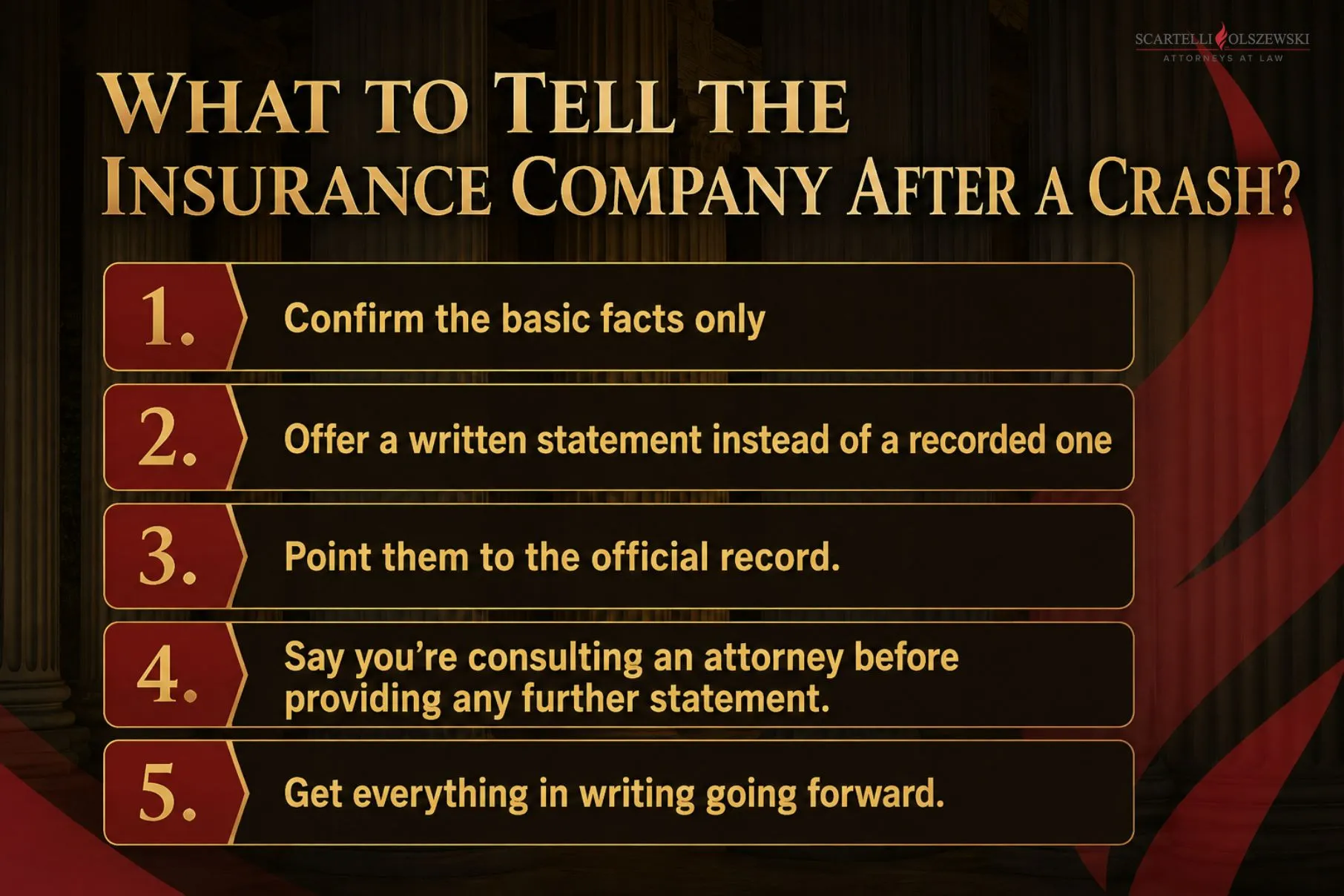
If the call already happened, it is not the end of your claim. It is a reason to act quickly, not a reason to give up.
Contact an attorney before you say anything further to either insurer. An attorney can review what you actually said against the police report and your medical records, and address inconsistencies before the adjuster builds a denial around them rather than after. Our guide on what not to do after a car crash covers the other early missteps worth checking against, and understanding full tort versus limited tort coverage matters here, since your tort election affects what a single damaging phrase can cost you.
Yes. An Examination Under Oath, or EUO, is a formal, sworn proceeding, usually conducted with an attorney present for the insurer, typically used in first-party claims such as uninsured motorist or underinsured motorist coverage. A recorded statement is informal by comparison and usually happens over the phone within days of the crash. If your own insurer requests an EUO rather than a casual recorded statement, treat it as a legal proceeding and have your own attorney present.
Often within the first day or two, sometimes faster if the report was filed the day of the crash. Adjusters move quickly because your injuries are least documented at that point, and your account is least guarded.
No. Declining a recorded statement to the at-fault driver’s insurer, or asking to provide a written statement to your own insurer instead, is a normal and common step. It does not imply fault, and under Pennsylvania’s cooperation-clause standard, your insurer would have to show that the delay or format actually harmed its investigation before it could treat either request as a lack of cooperation.
Tell them, once, that you are represented or are speaking with an attorney, and that further contact should go through counsel. If an adjuster continues pressuring you after that, it becomes something your attorney should document and address directly with the insurance company.
Peter Paul Olszewski, Jr. served as Luzerne County District Attorney and as a Judge on the Court of Common Pleas before he started representing injured people. He spent years as a prosecutor and a judge weighing which statements held up and which fell apart under scrutiny, and that same instinct for spotting a weak account applies just as well to a recorded statement an adjuster is building a file around. Melissa A. Scartelli, founder and a Board Certified Civil Trial Advocate since 2011, has practiced in Lackawanna and Luzerne County courtrooms since 1988, holding insurers to what Pennsylvania law actually requires.
If an adjuster has already called, or you expect one to, our Scranton car accident lawyer or Wilkes-Barre car accident lawyer can review what you said before you say anything further. Call 570-346-2600 or start your free consultation online. The consultation is free, and there is no obligation to retain us to get a straight answer about what that call requires of you.
I don't think I could have picked a better team to represent my case. My situation was unique and extremely complicated but it was handled with the utmost care and professionalism. The firm's strong and organized representation ultimately brought great results and helped reconcile a tragic event.
- Jeremy S.
Was wrongly accused of a very serious Felony 3 account and hired Peter Paul Olszewski. The entire firm of Scartelli Olszewski worked tirelessly to have the Pike County Assistant District Attorney as well as the District Magistrate Judge Dismiss the charges! Very pleased with the outcome of this Law Firm and recommend this Law Firm.
- Kerry S.Dealing with the attorneys over at Scartelli Olszewski was nothing short of satisfactory. Through the entire 4 year process we had, I was constantly kept updated and cared for. More than doing their job, they truly care for their clients which I felt off the first meeting with Melissa. Both my family and I are forever thankful for them!
- Noah T.A snowplow clips your car on a Scranton side street. A police cruiser runs a red light in Wilkes-Barre and...
Read MoreRiding in someone else's car when it crashes leaves you hurt, confused, and often afraid to ask the one question...
Read MoreYour car accident case is worth your economic damages plus pain and suffering, filtered through three Pennsylvania rules: the 51%...
Read MoreAfter an accident, who you hire matters. We've spent years fighting for families just like yours – and we're ready to fight for you.

Wilkes Barre Office (Appointment Only)
Scartelli Olszewski, P.C.
7 Public Square
Wilkes-Barre, PA 18701