


$
Jury Verdict
$ 10 Million
Medical Malpractice
Luzerne County


 Millions Recovered
Millions won for victims, including Luzerne County's largest medical malpractice verdict.
 Certified Trial Advocacy
Led by one of few female Board Certified Trial Advocates in Pennsylvania.
 Zero Upfront Cost
You don't pay a penny out of pocket, we only get paid when you do.
 Years of Experience
100+ combined years of experience in personal injury, medical malpractice, and criminal defense.
When a loved one is suffering from a brain injury, it can be especially challenging for you and your family to care for them, and the injury itself can be difficult to prove because a person with a brain injury may show no external signs and appear “normal” to others. In some cases, even medical professionals cannot immediately determine that a brain injury has occurred, and the losses mount while the injury goes undetected. Scartelli Olszewski, P.C. handles serious traumatic brain injury cases across Lackawanna County, and this work is part of the practice run by our Scranton personal injury attorneys from our office at 411 Jefferson Avenue, minutes from the Lackawanna County Court of Common Pleas at 200 N. Washington Avenue, Scranton, PA 18503. Call (570) 346-2600 for a free, confidential case review.
Brain injury cases are also among the most complex personal injury claims, and that is the first thing a new client should understand. The injury is often invisible on a standard scan, the symptoms can surface days later, insurers dispute both causation and severity, and the true cost is a lifetime of care that has to be projected by experts rather than read off a bill. That complexity is exactly why the lawyer you choose matters.
The firm is led by Melissa A. Scartelli, founder, president, and Board Certified Civil Trial Advocate by the National Board of Trial Advocacy, with former Luzerne County District Attorney and Judge Peter Paul Olszewski, Jr. on the team. Our firm’s record includes a $10 million verdict.
Past results do not guarantee similar outcomes. Every case is different.
Traumatic brain injuries happen across Northeastern Pennsylvania every year, with motor vehicle crashes, falls, and workplace incidents accounting for most cases. The major Lackawanna County corridors where serious-injury crashes occur include I-81, I-380, I-84, and Route 6. The most severely injured patients are stabilized at Geisinger Community Medical Center, a Pennsylvania-accredited trauma center at 1800 Mulberry Street in Scranton. The imaging, neurology consults, and treatment records from those first hours become the foundation of any later brain injury claim.
A traumatic brain injury, or TBI, happens because of a sudden, external force to the head, and it ranges from a mild concussion to a severe, life-altering injury. The most common causes include:
Brain injuries fall into several categories, and the type drives both the medical workup and the proof a TBI claim requires. The most common diagnoses include:
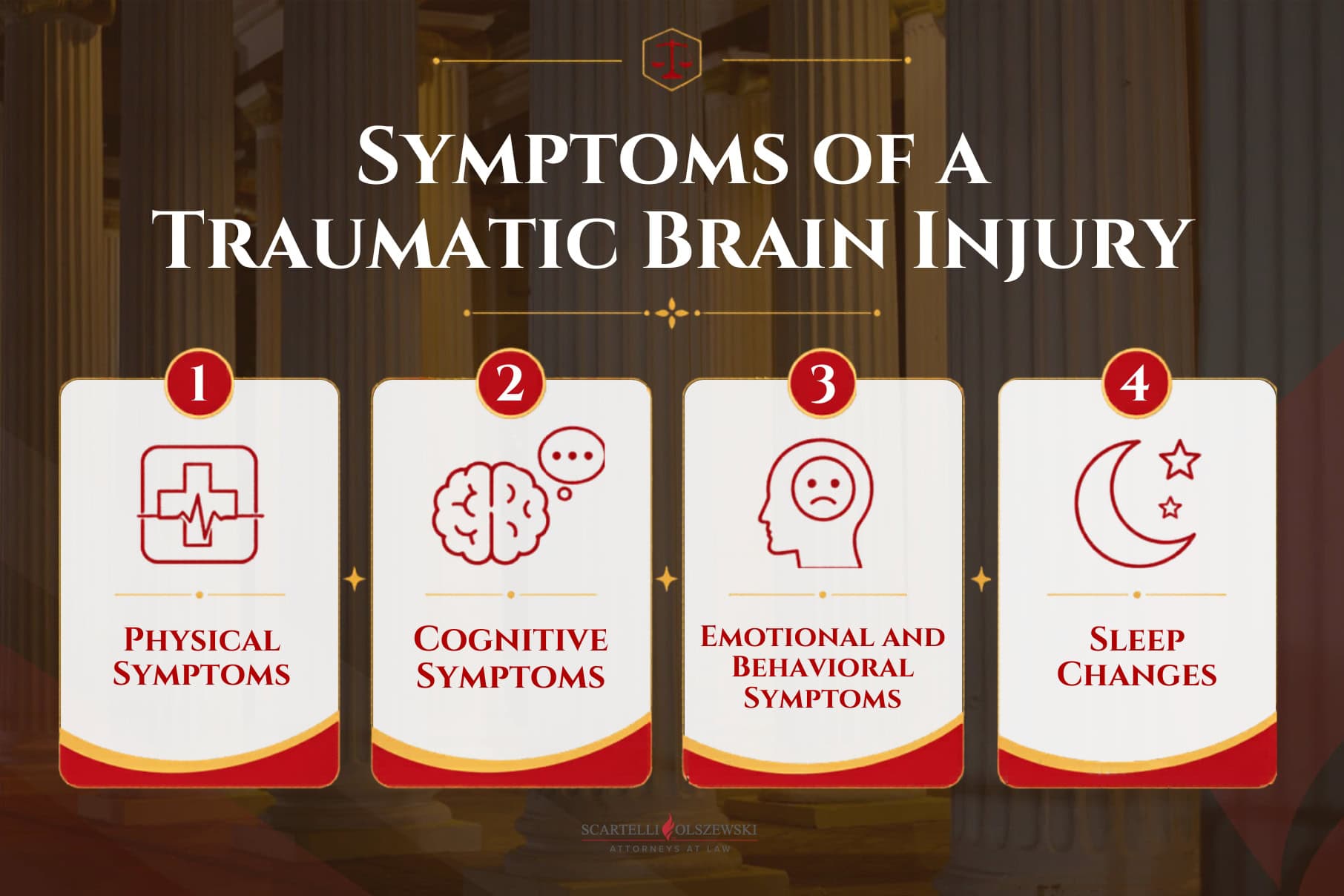
The symptoms can appear hours or even days after the accident, and a normal CT scan does not rule out a serious injury. Watch for and document:
A loss of consciousness is not required for a serious brain injury. Many people with a significant TBI never black out, which is one reason these injuries are missed and undertreated.
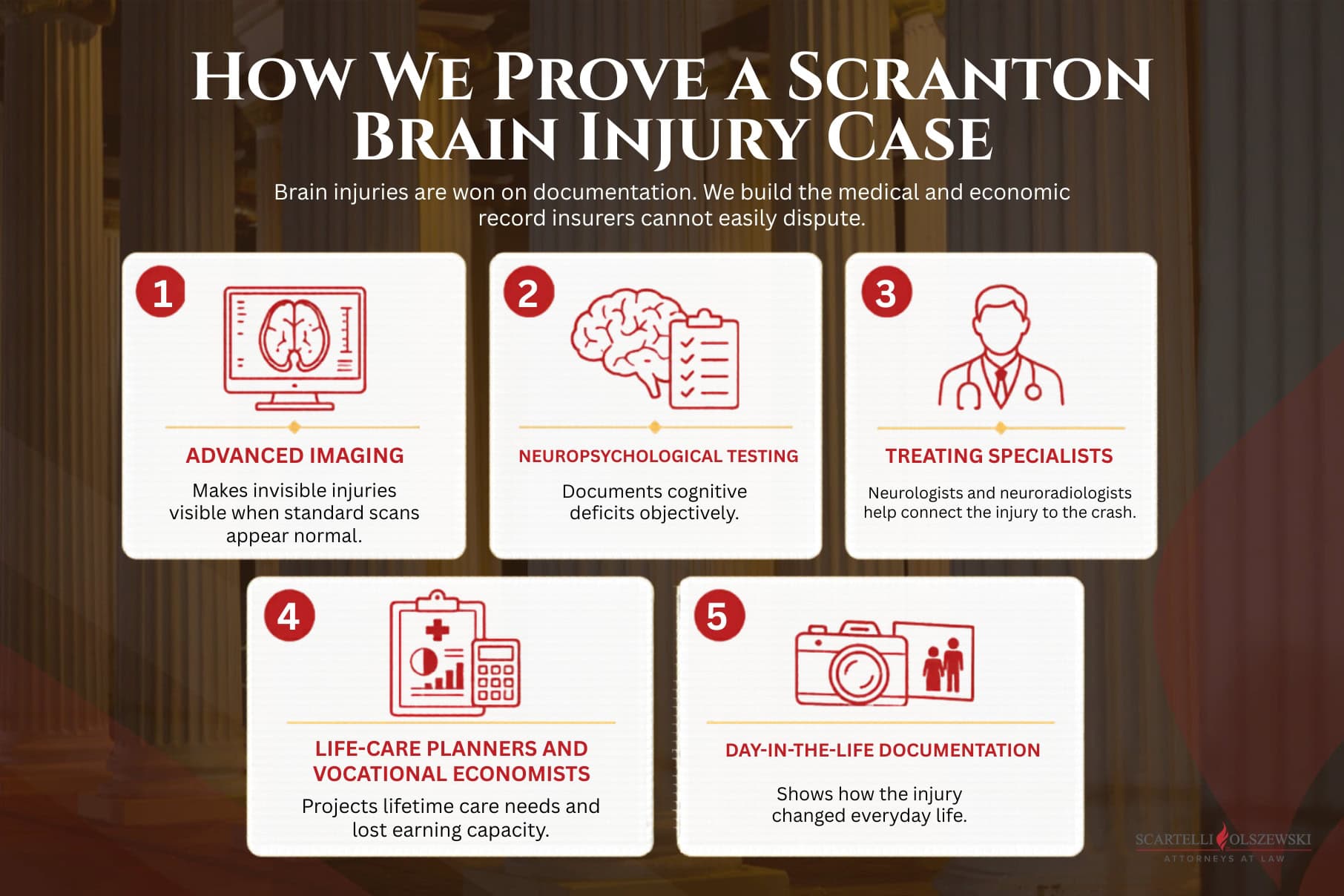
Brain injuries are won on documentation, and the firm builds the medical and economic record that insurers cannot easily dispute. Our proof methodology includes:
The first step in building your case is to preserve evidence, and what to preserve depends on how the injury happened. If the injury was in a vehicle crash, photograph the vehicles, the road conditions, and the traffic controls. If it was a fall, document the property defect, the lighting, and the surface. In every case, preserve the clothing you were wearing, seek medical care the same day, request a copy of the police or incident report, and note the names of any witnesses. Doing this alone can be difficult when you are injured, which is why having a Scranton brain injury attorney involved early matters.
A moderate or severe TBI can permanently change a person’s ability to work, to manage daily activities, and to relate to family and friends. Some people develop post-concussion syndrome, in which headaches, dizziness, and cognitive problems persist for months or longer, and repeated head trauma is associated with chronic traumatic encephalopathy. Because these effects can last a lifetime, we project the full future cost of medical care in Pennsylvania rather than settling for the immediate bills.
A claim recovers two categories of damages, and Pennsylvania does not cap compensatory damages.
|
“Melissa and her team worked hard to give us our life back.” ★★★★★ Sara Bert Terysen · Google Review “The very first time my husband and I walked into Scartelli Olszewski we felt at home and like part of the family. Melissa and her team worked hard to give us our life back and for that we will be forever grateful.” |
Call us at (570) 346-2600 or schedule a free consultation.
Pennsylvania law gives you two years from the date of injury to file most brain injury claims under 42 Pa.C.S. § 5524, and missing the deadline permanently bars the claim. Because TBI symptoms can surface later, the discovery rule may apply where the injury could not reasonably have been known at first, though Pennsylvania interprets that rule narrowly. If a government entity is involved, a written notice of claim is generally due within six months under 42 Pa.C.S. § 5522(a). Other personal injury claims carry different filing deadlines, so confirm the one that applies to your case before time runs out.
Standard CT and MRI scans miss many mild and moderate brain injuries. We use neuropsychological testing and advanced imaging such as diffusion tensor imaging, along with testimony from treating specialists, to document an injury the routine scans do not show.
That is common with brain injuries. Pennsylvania’s discovery rule can preserve your right to file where the injury could not reasonably have been known at first, but the rule is applied narrowly, so it is important to see a doctor and a lawyer promptly.
Two years from the date of injury under 42 Pa.C.S. § 5524. A claim involving a government entity generally requires written notice within six months under 42 Pa.C.S. § 5522(a).
There is no fixed figure. Value depends on the severity of the injury, the lifetime cost of care, lost earning capacity, and the available insurance. Pennsylvania does not cap compensatory damages, so the value is set by your actual losses.
Yes. Under Pennsylvania’s modified comparative negligence rule at 42 Pa.C.S. § 7102, you can recover unless you are 51 percent or more at fault, which is the bar that ends recovery, and your recovery is reduced by your share. As an example, if a jury finds you 20 percent at fault and your damages are $500,000, you recover $400,000.
Nothing upfront. We work on a contingency fee basis under Pa.R.P.C. 1.5(c), and you pay an attorney fee only if we recover for you. We advance the cost of the neurologists, neuropsychologists, life-care planners, and imaging a brain-injury case requires.
A brain injury can reshape a family’s life, and the right lawyer works with you to understand the liability and damages, investigate, gather proof, and pursue full compensation. Call (570) 346-2600 or visit our Scranton office at 411 Jefferson Avenue. We also represent brain injury clients in Luzerne County through our Wilkes-Barre brain injury lawyers at our Public Square office.
Past results do not guarantee similar outcomes. Every case is different.
I don't think I could have picked a better team to represent my case. My situation was unique and extremely complicated but it was handled with the utmost care and professionalism. The firm's strong and organized representation ultimately brought great results and helped reconcile a tragic event.
- Jeremy S.
Was wrongly accused of a very serious Felony 3 account and hired Peter Paul Olszewski. The entire firm of Scartelli Olszewski worked tirelessly to have the Pike County Assistant District Attorney as well as the District Magistrate Judge Dismiss the charges! Very pleased with the outcome of this Law Firm and recommend this Law Firm.
- Kerry S.Dealing with the attorneys over at Scartelli Olszewski was nothing short of satisfactory. Through the entire 4 year process we had, I was constantly kept updated and cared for. More than doing their job, they truly care for their clients which I felt off the first meeting with Melissa. Both my family and I are forever thankful for them!
- Noah T. Melissa A. Scartelli
Founder & President
Melissa A. Scartelli
Founder & President
Melissa is a respected Pennsylvania trial attorney, firm founder, and board-certified civil trial advocate recognized for compassionate client service, major case results, and longstanding Super Lawyers honors. Deeply active in the legal community and local institutions, she continues to champion injured clients alongside her family-led legal team.
After an accident, who you hire matters. We've spent years fighting for families just like yours – and we're ready to fight for you.