


$
Jury Verdict
$ 10 Million
Medical Malpractice
Luzerne County

Your car accident case is worth your economic damages plus pain and suffering, filtered through three Pennsylvania rules: the 51% comparative negligence bar, your full tort or limited tort election, and the at-fault driver’s insurance limits. No statewide average captures that math. At Scartelli Olszewski, P.C., our car accident results range from a $650,000 settlement to a $1 million jury verdict.
If you were hurt in Scranton, Wilkes-Barre, or anywhere else in Northeastern Pennsylvania, here is that math in the order it actually gets applied, followed by what a Pennsylvania car accident lawyer checks before naming a real number.
Key Takeaways
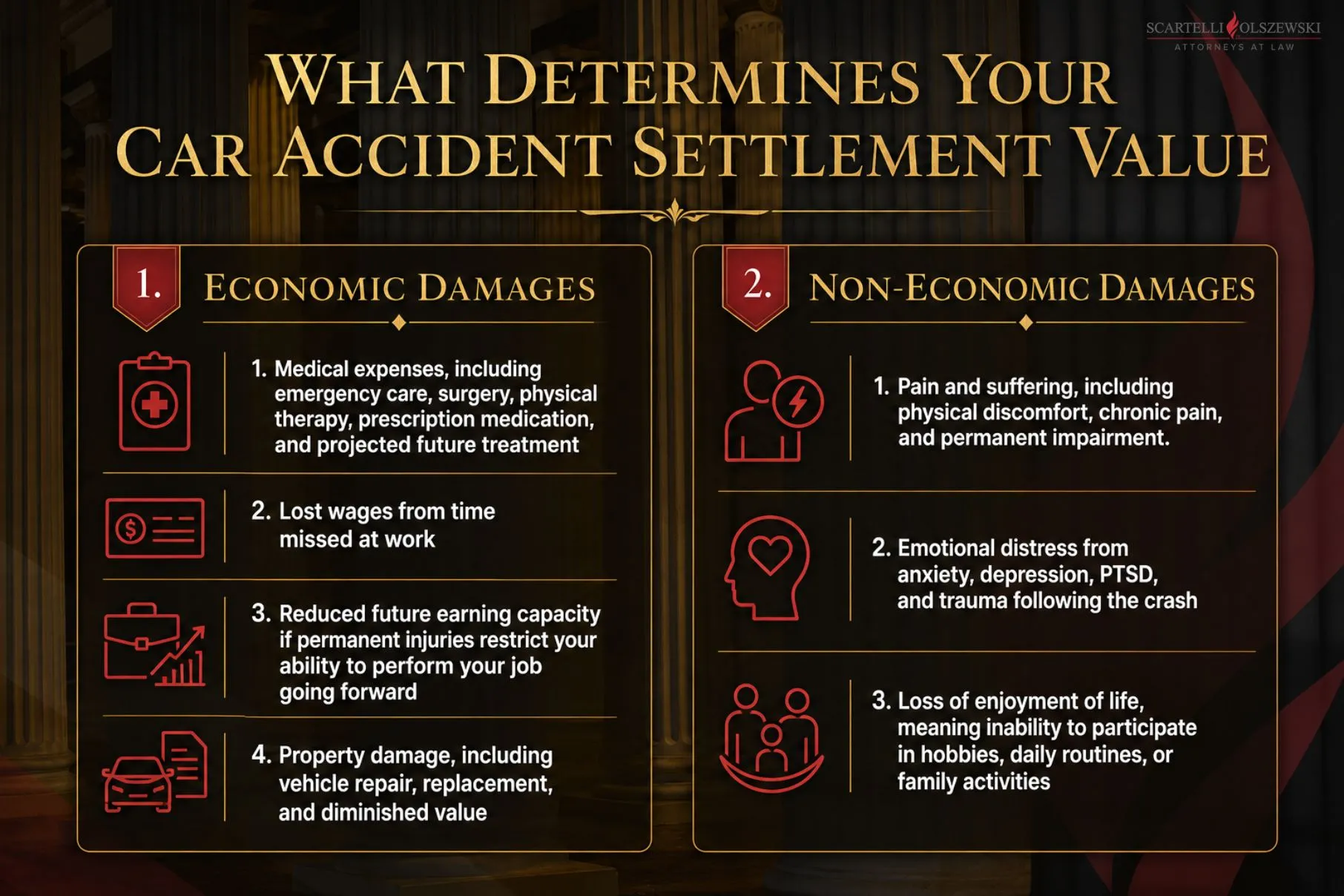
Every car accident settlement is built from two categories of damages.
1. Economic Damages: The losses you can prove with bills, receipts, and pay stubs:
2. Non-Economic Damages: Cover the harder-to-quantify impact of the crash on your life:
In serious injury cases, non-economic damages often make up the largest portion of the total payout. However, how much you can recover is directly dictated by Pennsylvania’s insurance rules and the specific facts of your case.
Insurance adjusters and attorneys generally use one of two methods to put a number on pain and suffering.
Neither method is required by law. Insurance adjusters apply their own internal guidelines when they calculate an initial offer, and those guidelines are not public, which is one reason it can be difficult to independently verify whether an offer reflects the true value of a claim.
Pennsylvania has its own rules that directly raise or lower your number, regardless of how severe your injuries are.
Before any of the rules below can apply, someone has to establish who was at fault and how much. A case backed by a police report, traffic camera footage, and witness statements is worth more than one where fault is disputed, because clear evidence removes the insurance company’s ability to argue about what happened. This evidence is also what determines the fault percentage used in the comparative negligence rule below.
Pennsylvania follows a modified comparative negligence rule under 42 Pa.C.S. § 7102. You can still recover compensation even if you were partly at fault, as long as your share of fault does not reach 51%. Your payout is reduced by your percentage of fault. If your damages total $100,000 and you were found 20% at fault, you recover $80,000. If you are found 51% or more at fault, you recover nothing.
Pennsylvania is a choice no-fault state. When you bought your auto insurance, you selected either full tort or limited tort coverage under 75 Pa.C.S. § 1705, and that choice affects what you can recover today.
Even a clear-cut, high-value case has a practical ceiling: the at-fault driver’s insurance policy. Pennsylvania’s minimum required coverage is $15,000 per person and $30,000 per accident in bodily injury liability, plus $5,000 in first-party medical benefits. If your damages exceed the at-fault driver’s policy limits, your own underinsured motorist (UIM) coverage becomes the source of any additional recovery, which is why reviewing your own policy matters as much as reviewing theirs.
There is no single average that means anything for your case. A statewide number blends minor fender-benders with catastrophic, multimillion-dollar verdicts into one figure that describes neither situation.
Your case isn’t an average of every Pennsylvania car a ccident. Its value comes from your specific injuries, your medical bills, your tort election, and the insurance coverage actually available.
Case results vary enormously by fact pattern. Our own results include a $650,000 car accident settlement and a $1 million car accident verdict, proof that even outcomes from the same firm, in the same practice area, span a wide range. An attorney reviewing your specific facts can tell you where yours is likely to land. A statewide chart can’t. Past results do not guarantee a similar outcome in your case.
Insurance adjusters are trained to open with a low number, and understanding how insurance companies avoid paying claims helps you recognize the tactic before it works on you. That first offer is a starting point designed to test whether you will settle before you understand the full extent of your injuries or the true value of your claim, not a reflection of what your case is actually worth.
Once you accept a settlement and sign a release, your case is closed permanently, even if your injuries turn out to be worse than expected or require additional treatment down the road. Before accepting anything, confirm that your medical treatment is complete or that future care costs are accounted for, get a written itemization of what the offer covers, and talk to an attorney who can tell you whether the number reflects your case’s real value.

For many people weighing whether to call a lawyer, the honest answer depends on how much is genuinely in dispute. A minor, undisputed fender-bender with a quick recovery may resolve reasonably well without one. Once injuries require ongoing treatment, fault is contested, or an insurance company is slow-walking your claim, hiring an attorney is the stronger move.
A few steps protect your case value regardless of which path you choose:
If your crash happened in Lackawanna or Luzerne County, local claims practice matters too. Cases here are filed in the Lackawanna County Court of Common Pleas or the Luzerne County Court of Common Pleas, and insurance carriers adjust their offers based on which local firms they know are prepared to take a case to trial. Why local representation matters in Northeastern Pennsylvania cases covers this in more detail.
At Scartelli Olszewski, P.C., we work on a contingency fee, so how a personal injury attorney gets paid only comes out of what we recover for you.
You generally have two years from the date of the crash to file a personal injury lawsuit under 42 Pa.C.S. § 5524. If a government vehicle or a government entity’s negligence contributed to your crash, that deadline shrinks to six months to file a written notice of claim under 42 Pa.C.S. § 5522. Missing either deadline typically bars your case entirely, regardless of how strong the evidence is. See our full breakdown of Pennsylvania’s filing deadlines.
Simple cases with clear liability and a quick recovery often settle within 6 to 12 months. Cases involving surgery, disputed fault, or long-term treatment commonly take 18 months to 3 years, largely because settling before your treatment is complete risks leaving future medical costs uncovered. Cases that proceed to trial typically take two years or longer.
Yes, as long as your share of fault does not reach 51%. Under Pennsylvania’s modified comparative negligence rule, your recovery is reduced by your percentage of fault. For example, a $100,000 case with 30% fault assigned to you results in a $70,000 recovery. At 51% fault or higher, you recover nothing.
Limited tort restricts your right to recover pain and suffering unless your injury meets Pennsylvania’s serious injury threshold or a statutory exception applies. Those exceptions include crashes involving a driver convicted of DUI or admitted into the ARD program, an uninsured driver, a vehicle registered out of state, or injuries to a pedestrian or cyclist. Medical bills and lost wages remain recoverable under limited tort regardless.
Our firm works on a contingency fee basis, meaning the fee is a percentage of whatever is recovered, and there is no upfront cost. If there is no settlement or verdict, there is no fee. Ask any attorney you are considering to explain their exact percentage and how case expenses are handled before you sign anything.
The only way to know what your Pennsylvania car accident case is worth is to have it evaluated by someone who knows how these factors apply to your specific facts. Scartelli Olszewski, P.C., has represented injured drivers across Northeastern Pennsylvania, including Scranton and Wilkes-Barre, since 2001.
Call 570-346-2600 or start your free consultation online. The consultation is free, and there is no obligation to retain us. One call is all it takes to get a straight answer about what your case is worth.
I don't think I could have picked a better team to represent my case. My situation was unique and extremely complicated but it was handled with the utmost care and professionalism. The firm's strong and organized representation ultimately brought great results and helped reconcile a tragic event.
- Jeremy S.
Was wrongly accused of a very serious Felony 3 account and hired Peter Paul Olszewski. The entire firm of Scartelli Olszewski worked tirelessly to have the Pike County Assistant District Attorney as well as the District Magistrate Judge Dismiss the charges! Very pleased with the outcome of this Law Firm and recommend this Law Firm.
- Kerry S.Dealing with the attorneys over at Scartelli Olszewski was nothing short of satisfactory. Through the entire 4 year process we had, I was constantly kept updated and cared for. More than doing their job, they truly care for their clients which I felt off the first meeting with Melissa. Both my family and I are forever thankful for them!
- Noah T.A snowplow clips your car on a Scranton side street. A police cruiser runs a red light in Wilkes-Barre and...
Read MoreRiding in someone else's car when it crashes leaves you hurt, confused, and often afraid to ask the one question...
Read More
No. In almost every case, you should not give a recorded statement to the other driver's insurance company after a...
Read MoreAfter an accident, who you hire matters. We've spent years fighting for families just like yours – and we're ready to fight for you.

Wilkes Barre Office (Appointment Only)
Scartelli Olszewski, P.C.
7 Public Square
Wilkes-Barre, PA 18701