
$
Jury Verdict
$ 10 Million
Medical Malpractice
Luzerne County

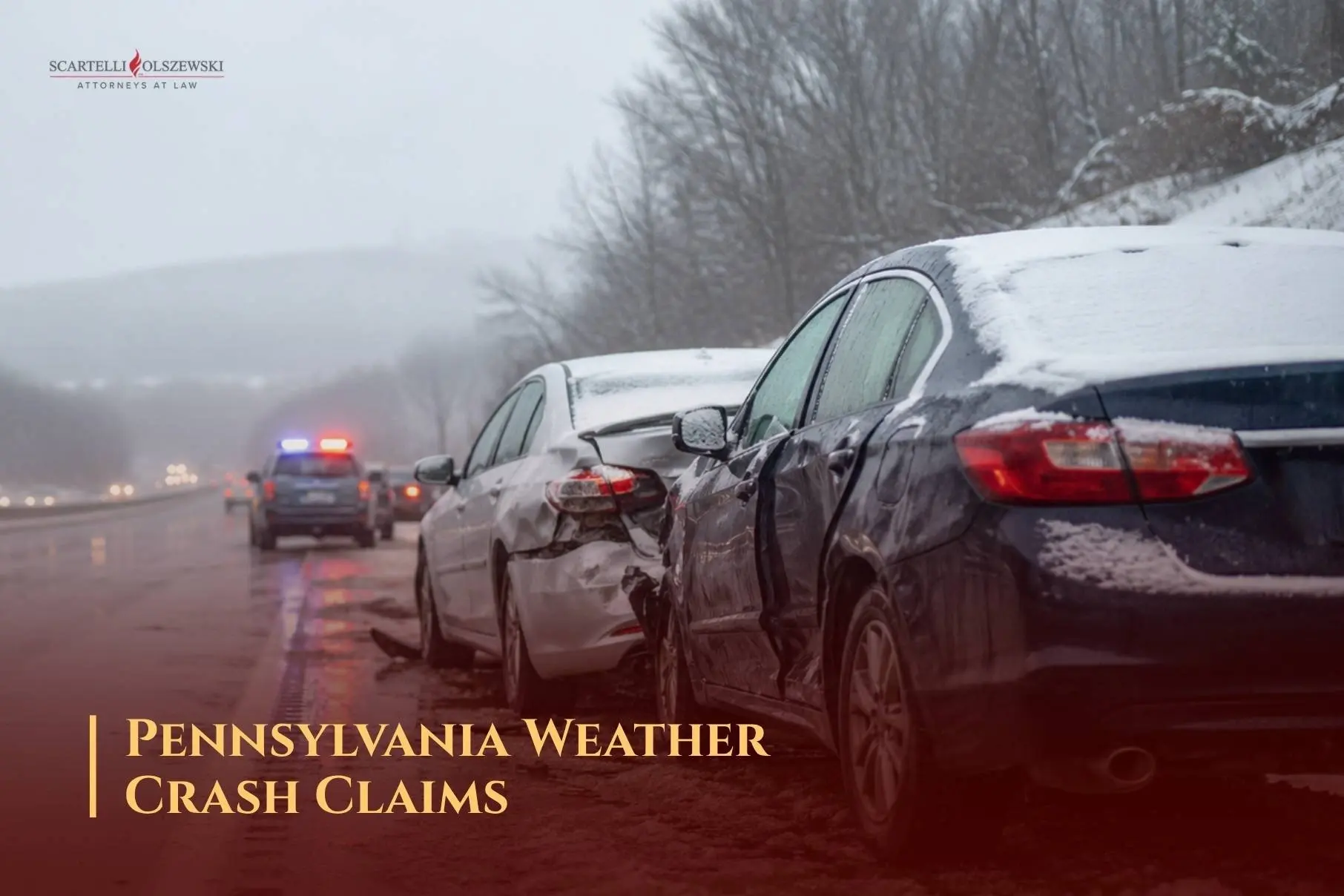
Yes, weather has a major impact on car accident lawsuits in Pennsylvania. It changes how fault is determined, how insurance companies defend claims, and how much compensation you can recover. What it does not do is excuse the driver who caused your crash.
Pennsylvania law holds every driver to a continuing duty: adjust your speed, increase your following distance, and operate your vehicle safely for whatever conditions the road presents. A driver who fails that duty and causes a crash in snow, ice, or fog is still liable for the resulting injuries. This article explains what the law says, how insurers use weather against you, and what evidence our Pennsylvania car accident lawyers use to protect your recovery.
No. Bad weather does not remove a driver’s legal responsibility in Pennsylvania. A driver who causes a crash in snow, ice, rain, or fog remains liable if they fail to adjust their driving to the conditions.
Pennsylvania law measures driver conduct against what a reasonable person would have done under the same circumstances, including the weather. Driving at 55 mph on an ice-covered I-81 can be negligent even when 55 is the posted limit. The question courts and insurance adjusters examine is not “was there bad weather?” It is “Did the driver operate their vehicle reasonably given the road and weather at that time and place?”
Pennsylvania’s “drive for conditions” standard requires every driver to adjust speed, following distance, and vehicle operation to match current road and weather hazards, independently of any posted speed limit. A driver who continues at highway speed through a snowstorm, leaves headlights off in dense fog, or follows another vehicle at normal distances on wet pavement has breached that standard regardless of what the limit reads.
Black ice is a particular problem on I-81 through Lackawanna County, on the elevated mountain-grade stretches of I-84, and along US-6 across Monroe and Wayne Counties. Pennsylvania courts treat it as a foreseeable winter hazard. Drivers operating on roads where temperatures are at or below freezing are expected to anticipate reduced traction and reduce speed accordingly.
Failing to clear snow and ice from a vehicle before driving is not just a traffic violation in Pennsylvania. In a lawsuit, it is direct evidence that the driver chose to operate a vehicle in a condition that created foreseeable danger to everyone on the road.
Rain causes thousands of crashes in Pennsylvania each year, particularly on aging highway surfaces throughout Lackawanna and Luzerne Counties, where standing water accumulates. The first rain after a dry period is often the most dangerous: oil and debris rise to the surface before washing away, reducing traction sharply in the opening minutes of a storm. A driver who hydroplanes and strikes another vehicle cannot use the hydroplane as an automatic defense. Speed, tire condition, and awareness of wet road conditions all factor into whether the loss of control was avoidable.
Dense fog is a documented hazard in NEPA’s river valleys and mountain passes, including sections of I-380 through the Pocono Plateau, the Susquehanna River lowlands near Wilkes-Barre, and the ridge approaches along I-84. When visibility drops, Pennsylvania law requires both headlights and a reduced speed. A driver who fails to use headlights in fog or rain and then causes a crash faces a statutory violation with a direct bearing on fault.
The Sudden Emergency defense allows a driver to claim that an unexpected, unavoidable crisis caused the crash. While Pennsylvania courts do recognize this defense in rare instances, such as encountering an isolated patch of black ice on an otherwise clear day, it rarely succeeds for standard winter conditions in Northeastern Pennsylvania.
Drivers in Scranton, Wilkes-Barre, and across Lackawanna and Luzerne Counties are legally expected to anticipate winter hazards. When sub-freezing temperatures, snow squalls, or river valley fog are present, local conditions are foreseeable by definition. A driver who fails to slow down on Route 6 or I-81 cannot simply blame normal NEPA winter weather to escape liability.
The defense holds only in genuinely unforeseeable circumstances: a structural road failure with no prior warning, or a weather event so extreme that no reasonable person could have prepared for it. Standard NEPA winter driving conditions do not meet that bar.
Pennsylvania uses a modified comparative fault rule under 42 Pa.C.S. § 7102: you can recover compensation if you are 50% or less at fault. If your fault exceeds 50%, you recover nothing, regardless of how seriously you were injured.
Here is how that plays out in practice. You sustained $100,000 in medical bills and lost income after a crash in a snowstorm on Route 6 near Tunkhannock. The other driver was speeding for the conditions. Their insurer then argues you were following too closely given the weather. If an adjuster assigns 20% of the fault to you, your recovery drops to $80,000. If that percentage reaches 51%, you recover nothing.
Insurers do not need to prove their driver was blameless. They need to load enough shared-conditions blame onto you to push your percentage past 50%. Bad weather gives them the raw material to do it. Our Pennsylvania car accident lawyers challenge those arguments with documented evidence before they shape the initial fault determination.
Insurance companies use bad weather as a liability tool: specifically, to inflate your share of fault toward the 51% threshold where they owe you nothing.
After a weather-related crash, an adjuster opens a file and begins building a case for shared road conditions. A recorded statement request arrives early, ideally before you have legal representation, with questions designed to establish that you were aware of the weather and drove anyway. Those answers become evidence for the fault-sharing argument.
The “act of God” framing is a related tactic. An adjuster frames the storm, the ice, or the fog as an external force no driver could have controlled. Pennsylvania courts reject that argument when any driver fails to adjust to foreseeable conditions, but it still shapes early claims decisions before an attorney is involved.
Weather crash evidence disappears fast. The next snowplow changes the road surface. A temperature rise removes the ice. Move quickly.
Driver negligence in bad weather takes specific, documented forms. Courts and insurance adjusters examine each one independently of the weather itself, because each represents a choice the driver made before the crash.
The most common forms of driver negligence in Pennsylvania weather-related crashes include:
Each of these creates an independent path to a negligence finding that does not depend on the weather to hold up in litigation.
Weather-related car accident cases are decided by evidence that documents both road conditions and driver behavior at the specific time and location of the crash. The more time-stamped and specific that evidence is, the stronger your case.
Eight types of evidence drive fault determination in these cases: National Weather Service records, PennDOT salt and plow dispatch logs, the police report, dashcam and traffic camera footage, vehicle event data recorder output, witness statements, expert accident reconstruction, and vehicle maintenance records. For a full walkthrough of how each one is gathered and used, see our guide on proving fault in a bad weather car accident.
Immediately after a weather-related car accident in Pennsylvania, protect your health and your legal claim:
Early legal guidance preserves evidence and prevents insurance companies from shaping the fault narrative before you understand what it costs you.
The average settlement for a car accident in Pennsylvania depends on injury severity, total medical costs, lost income, and the fault percentage assigned to each driver. Fractures, spinal injuries, and traumatic brain injuries resolve at higher values than soft tissue cases. A free case review gives you a case-specific figure.
Almost never without consulting an attorney. Initial offers rarely reflect the full value of the claim and typically do not account for future medical needs or long-term impacts. Once accepted, you cannot come back for more.
Yes, as long as you were not more than 50 percent at fault. Pennsylvania reduces your award by your percentage of blame. If you were 20% at fault, you get 80% of the damages. But if you are 51 percent or more at fault, you recover nothing.
A road defect can make PennDOT, a municipality, or a construction company liable for your car crash in Pennsylvania. Liability depends on which entity maintained that road. Government claims carry notice deadlines as brief as six months, far shorter than the standard two-year statute of limitations. Contact an attorney immediately.
You now understand what Pennsylvania law requires, how insurance companies exploit weather in fault disputes, and what evidence decides your case. The next step is a conversation.
As a Scranton car accident lawyer, Melissa Scartelli is a Board Certified Civil Trial Advocate, certified by the National Board of Trial Advocacy, a credential held by fewer than 5% of Pennsylvania attorneys. With more than 35 years of protecting injured people in Scranton and throughout northeastern Pennsylvania, our legal team at Scartelli Olszewski, P.C. takes weather-related car accident cases on contingency: no fee unless we recover compensation for you.
If you have been injured in weather-related car accidents in Luzerne County, you can talk with our Wilkes-Barre car accident lawyer.
Call (570) 346-2600. Tell us what happened. We tell you what your case is worth, at no charge, in a single conversation.
“Small Enough to Care, Large Enough to Win”
I don't think I could have picked a better team to represent my case. My situation was unique and extremely complicated but it was handled with the utmost care and professionalism. The firm's strong and organized representation ultimately brought great results and helped reconcile a tragic event.
- Jeremy S.
Was wrongly accused of a very serious Felony 3 account and hired Peter Paul Olszewski. The entire firm of Scartelli Olszewski worked tirelessly to have the Pike County Assistant District Attorney as well as the District Magistrate Judge Dismiss the charges! Very pleased with the outcome of this Law Firm and recommend this Law Firm.
- Kerry S.Dealing with the attorneys over at Scartelli Olszewski was nothing short of satisfactory. Through the entire 4 year process we had, I was constantly kept updated and cared for. More than doing their job, they truly care for their clients which I felt off the first meeting with Melissa. Both my family and I are forever thankful for them!
- Noah T.A snowplow clips your car on a Scranton side street. A police cruiser runs a red light in Wilkes-Barre and...
Read MoreRiding in someone else's car when it crashes leaves you hurt, confused, and often afraid to ask the one question...
Read MoreYour car accident case is worth your economic damages plus pain and suffering, filtered through three Pennsylvania rules: the 51%...
Read MoreAfter an accident, who you hire matters. We've spent years fighting for families just like yours – and we're ready to fight for you.

Wilkes Barre Office (Appointment Only)
Scartelli Olszewski, P.C.
7 Public Square
Wilkes-Barre, PA 18701