


$
Jury Verdict
$ 10 Million
Medical Malpractice
Luzerne County


 Millions Recovered
Millions won for victims, including Luzerne County's largest medical malpractice verdict.
 Certified Trial Advocacy
Led by one of few female Board Certified Trial Advocates in Pennsylvania.
 Zero Upfront Cost
You don't pay a penny out of pocket, we only get paid when you do.
 Years of Experience
100+ combined years of experience in personal injury, medical malpractice, and criminal defense.
One fall on a wet floor, an icy parking lot, or a broken step can mean a broken hip, a spinal injury, or a head injury that keeps you out of work for months – or longer. Pennsylvania law gives you two years from the date of your fall to file a claim. That window closes whether you act or not.
When the fall happened because a property owner ignored a hazard they knew about, you have the right to hold them accountable. Scartelli Olszewski, P.C. has fought premises liability cases in Lackawanna County since 2001. Our office at 411 Jefferson Avenue sits minutes from the Lackawanna County Court of Common Pleas – and we know that courthouse.
Call (570) 346-2600 today for a free case review. We’ll tell you within minutes whether you have a case worth pursuing.
The firm is led by Melissa A. Scartelli, founder, president, and Board Certified Civil Trial Advocate by the National Board of Trial Advocacy, with former Luzerne County District Attorney and Judge Peter Paul Olszewski, Jr. on the team. Our firm’s record includes a $10 million verdict and a $1 million premises liability recovery.
Past results do not guarantee similar outcomes. Every case is different.
According to the Centers for Disease Control and Prevention (CDC), falls send approximately 3 million older adults to emergency departments each year, and they are the leading cause of both fatal and non-fatal injuries in that age group. In a city with Scranton’s winters and an aging population, that risk is heightened on icy walkways, in aging buildings, and in the high-traffic retail centers across Lackawanna County.
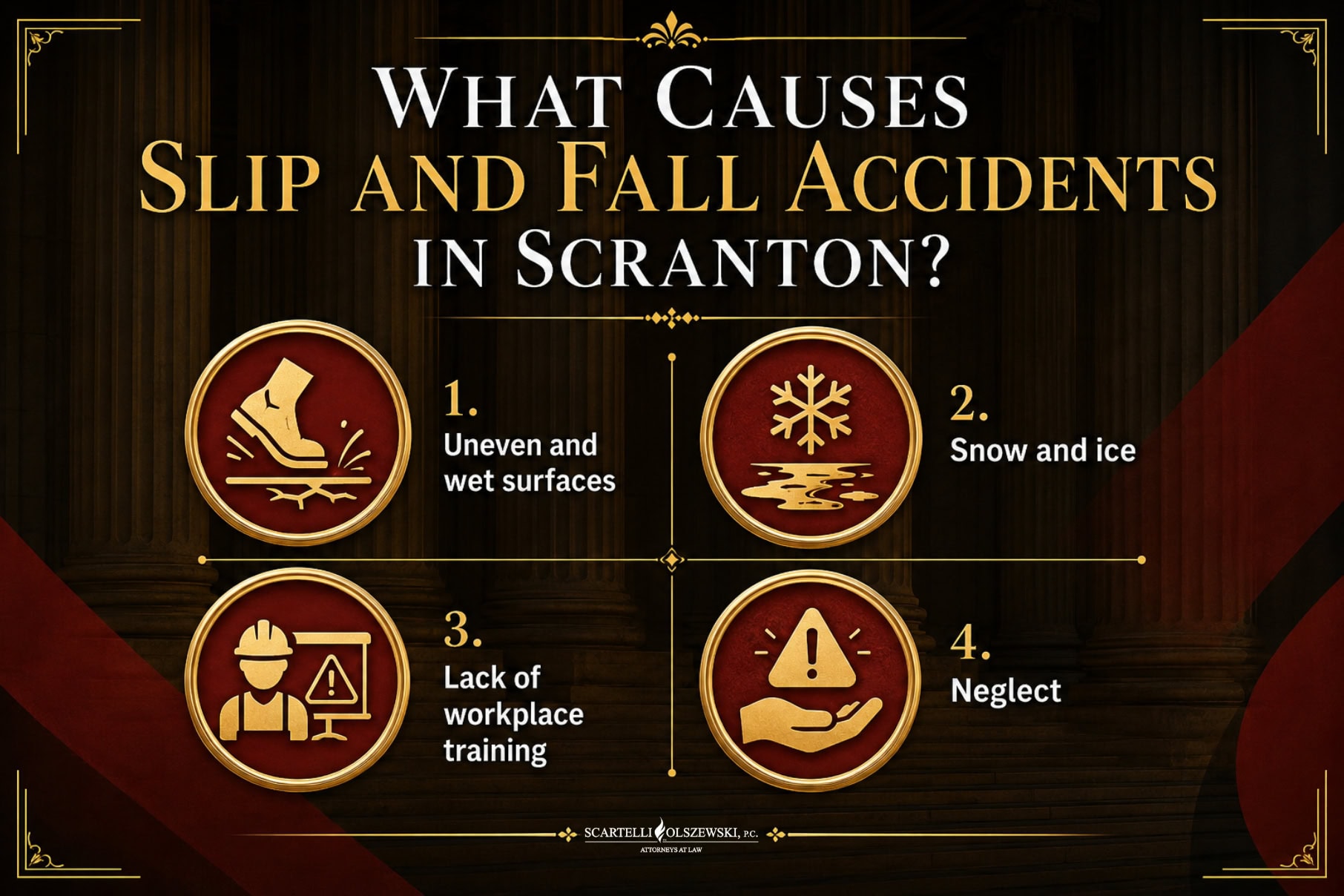
Most premises claims in Lackawanna County trace back to a hazard the property owner knew about or should have found.
What these hazards share is that someone should have cleaned or repaired them, and where a hazard cannot be immediately fixed, the property owner must warn guests and customers. A property owner who does not even place a warning sign can be held liable for the injuries the hazard causes.
Scranton averages well over 40 inches of snow a year, and the single most important rule in a winter fall case is the hills and ridges doctrine. The doctrine protects a property owner from liability for the generally slippery conditions that come with a Pennsylvania winter unless the injured person can prove three things: that snow or ice had accumulated in ridges or elevations that unreasonably obstructed travel, that the owner knew or should have known of that condition, and that the accumulation was the cause of the fall.
The doctrine has two important limits that often decide these cases. It does not apply when the ice was a localized, isolated patch rather than the result of a general storm, and it does not apply when the dangerous condition was an unnatural accumulation caused by the owner’s own negligence, such as a clogged downspout, a broken gutter, or runoff that refreezes across a walkway. We investigate weather records, drainage, and maintenance history to determine whether the doctrine bars a claim or whether an exception removes it.
Slip and fall claims can be filed when you are injured on another person’s or entity’s property, and depending on the facts, more than one party may be responsible.
Your status on the property matters. Pennsylvania sets the duty owed to you for why you were there. An invitee, such as a customer or shopper, is owed the highest duty: the owner must inspect for hazards, fix them, and warn of dangers. A licensee, such as a social guest, is owed a duty to be warned of known dangers. A trespasser is generally owed only a duty that the owner not cause willful or wanton harm. Most slip and fall clients are invitees, the strongest position, because a business that failed to inspect for or remove a hazard breached the highest duty the law imposes.
There are three, and each affects how a person lands and which injuries follow.
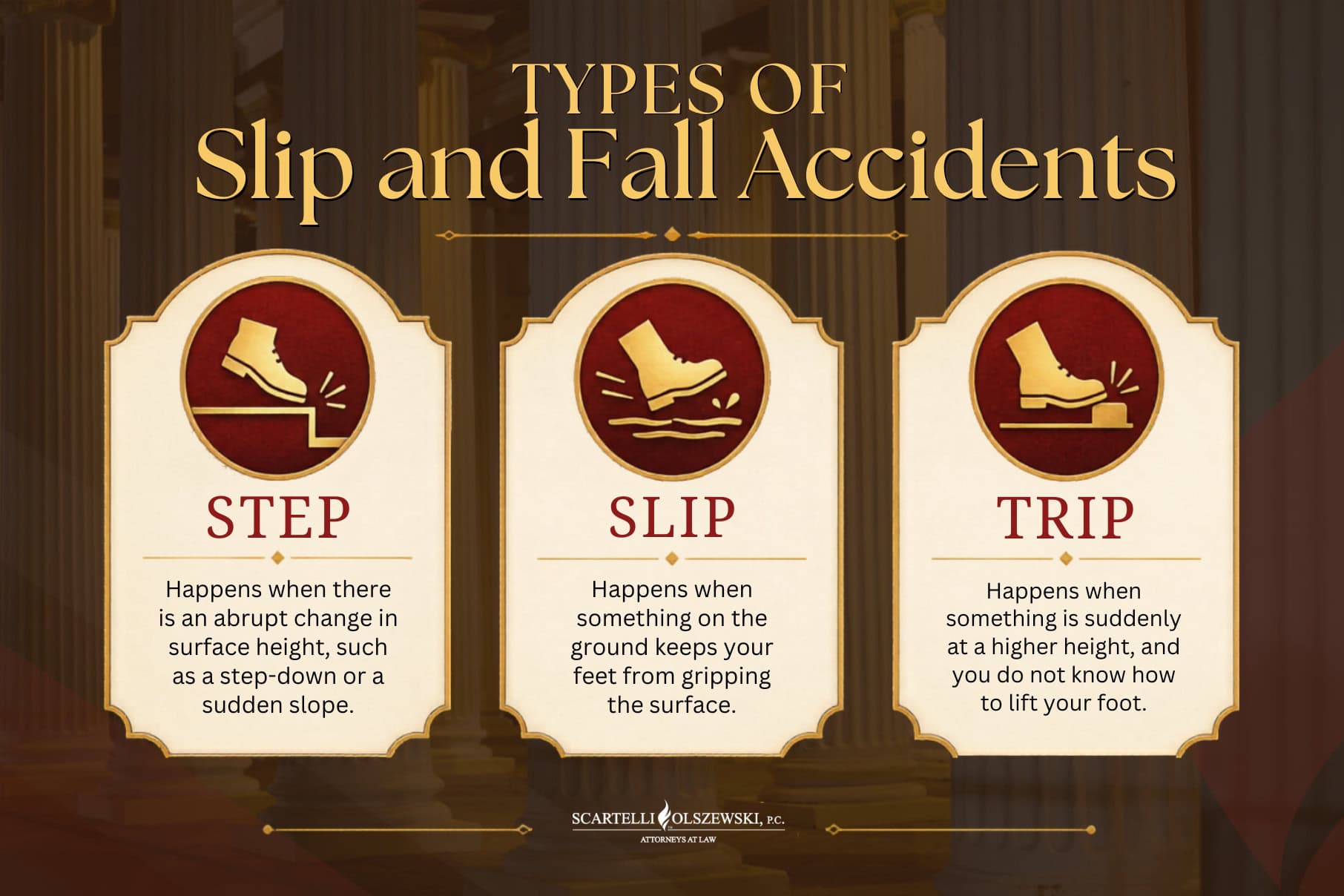
Regardless of type, a fall can cause broken bones, sprains, fractures, concussions, paralysis, cuts and lacerations, brain damage, and in the worst cases, death. Step-and-fall accidents send a person down hard onto the knees, spine, ankles, shins, neck, skull, shoulders, and pelvis, while trip-and-fall accidents usually pitch a person forward onto the hands, head, skull, knees, and shins.
There is no single average, because value depends on the severity of the injury, the medical care required, time lost from work, the permanence of any disability, and the available insurance. Pennsylvania does not cap compensatory damages in a slip and fall case.
For a detailed case evaluation, you can contact our personal injury lawyers in Scranton.
Yes. Under Pennsylvania’s modified comparative negligence rule at 42 Pa.C.S. § 7102, you can recover unless you are 51 percent or more at fault, which is the bar that ends recovery, and your award is reduced by your share. As an example, if a jury finds you 20 percent at fault and your damages are $100,000, you recover $80,000. Property insurers routinely try to shift blame onto the injured person to trigger that bar, and we counter with photographs, surveillance footage, and maintenance records.
These statutes of limitations on personal injury claims in Pennsylvania are strict, so it is best to call promptly.
Premises cases turn on evidence that is in the property owner’s control and disappears fast, so the value of a lawyer is in moving quickly and specifically. We:
| “A very difficult case. Every step of the process exceeded our expectations.”★★★★★ Joseph Adams · Google ReviewMelissa Scartelli and her entire team did an exceptional job with our very difficult case. They are driven, competent, timely, experienced, and compassionate. Their experts were exceptional. Melissa’s research and deposition skills are absolutely outstanding. Her entire staff worked diligently under her direction and delivered amazing results. The whole process exceeded our expectations. I would highly, highly recommend their law firm. |
Falls cluster where foot traffic is heaviest, and winter conditions are hardest to manage: the retail centers like the Marketplace at Steamtown downtown, Viewmont Mall in Dickson City, and the Shoppes at Montage in Moosic; apartment complexes across the city; and the municipal sidewalks around downtown Scranton, where a fall can trigger the six-month government-notice rule. Seriously injured victims in Lackawanna County are often treated at Geisinger Community Medical Center on Mulberry Street, Lackawanna County’s only accredited Level II trauma center (Pennsylvania Trauma Systems Foundation), and we gather those medical records as the backbone of the claim.
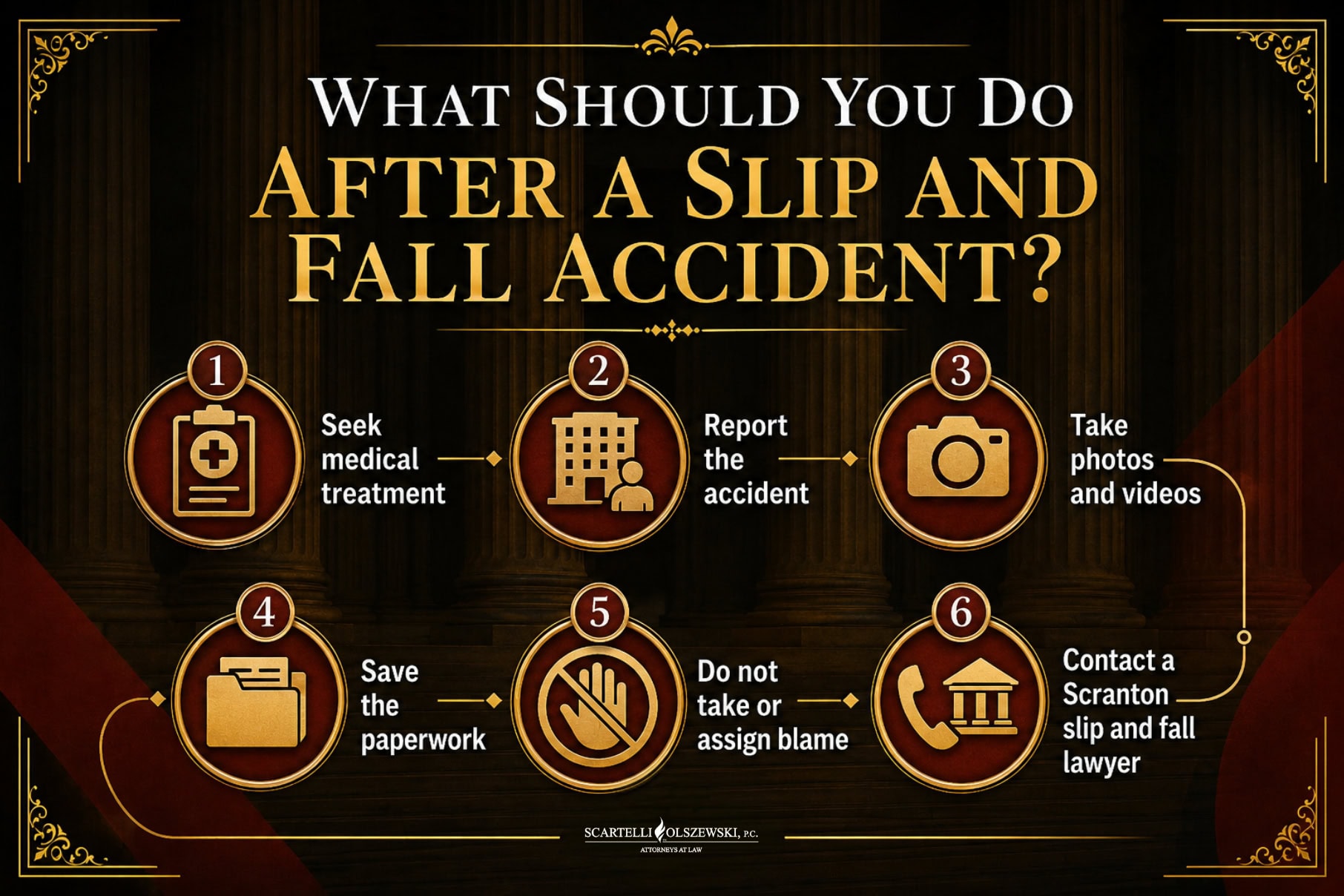
Get medical care the same day, report the fall and request a written incident report, photograph the hazard and your injuries, collect witness information, and call a lawyer before giving any statement to the property’s insurer. If you’re not sure what questions to ask when you call, here are six questions to ask your Pennsylvania slip and fall attorney before you decide who to hire.
You must show the owner knew or should have known about the hazard and failed to fix it or warn you, and that the hazard caused your fall and injury.
Two years from the date of the fall under 42 Pa.C.S. § 5524. A fall on government property generally requires written notice within six months under 42 Pa.C.S. § 5522(a).
Yes, under 42 Pa.C.S. § 7102, unless you are 51 percent or more at fault. Your recovery is reduced by your percentage of fault.
It protects owners from liability for generally slippery winter conditions unless you can show ridges or elevations of ice that unreasonably obstructed travel, the owner’s knowledge, and causation. It does not apply to a localized ice patch or to ice that the owner’s own negligence created.
Sometimes, but a claim against a government entity generally requires written notice within six months under 42 Pa.C.S. § 5522(a), which is far shorter than the standard two-year deadline.
Nothing upfront. We work on a contingency fee basis, and you pay an attorney fee only if we recover for you.
A serious fall can leave you unable to work and buried in hospital bills, all because someone was negligent in maintaining their property. If you or a loved one was hurt on another party’s property, call (570) 346-2600 or visit our Scranton office at 411 Jefferson Avenue. We also help injured clients in Luzerne County through our Wilkes-Barre slip and fall attorney practice at our Public Square office.
Past results do not guarantee similar outcomes. Every case is different.
I don't think I could have picked a better team to represent my case. My situation was unique and extremely complicated but it was handled with the utmost care and professionalism. The firm's strong and organized representation ultimately brought great results and helped reconcile a tragic event.
- Jeremy S.
Was wrongly accused of a very serious Felony 3 account and hired Peter Paul Olszewski. The entire firm of Scartelli Olszewski worked tirelessly to have the Pike County Assistant District Attorney as well as the District Magistrate Judge Dismiss the charges! Very pleased with the outcome of this Law Firm and recommend this Law Firm.
- Kerry S.Dealing with the attorneys over at Scartelli Olszewski was nothing short of satisfactory. Through the entire 4 year process we had, I was constantly kept updated and cared for. More than doing their job, they truly care for their clients which I felt off the first meeting with Melissa. Both my family and I are forever thankful for them!
- Noah T. Melissa A. Scartelli
Founder & President
Melissa A. Scartelli
Founder & President
Melissa is a respected Pennsylvania trial attorney, firm founder, and board-certified civil trial advocate recognized for compassionate client service, major case results, and longstanding Super Lawyers honors. Deeply active in the legal community and local institutions, she continues to champion injured clients alongside her family-led legal team.
After an accident, who you hire matters. We've spent years fighting for families just like yours – and we're ready to fight for you.