



$
Jury Verdict
$ 10 Million
Medical Malpractice
Luzerne County

 Millions Recovered
Millions won for victims, including Luzerne County's largest medical malpractice verdict.
 Certified Trial Advocacy
Led by one of few female Board Certified Trial Advocates in Pennsylvania.
 Zero Upfront Cost
You don't pay a penny out of pocket, we only get paid when you do.
 Years of Experience
100+ combined years of experience in personal injury, medical malpractice, and criminal defense.
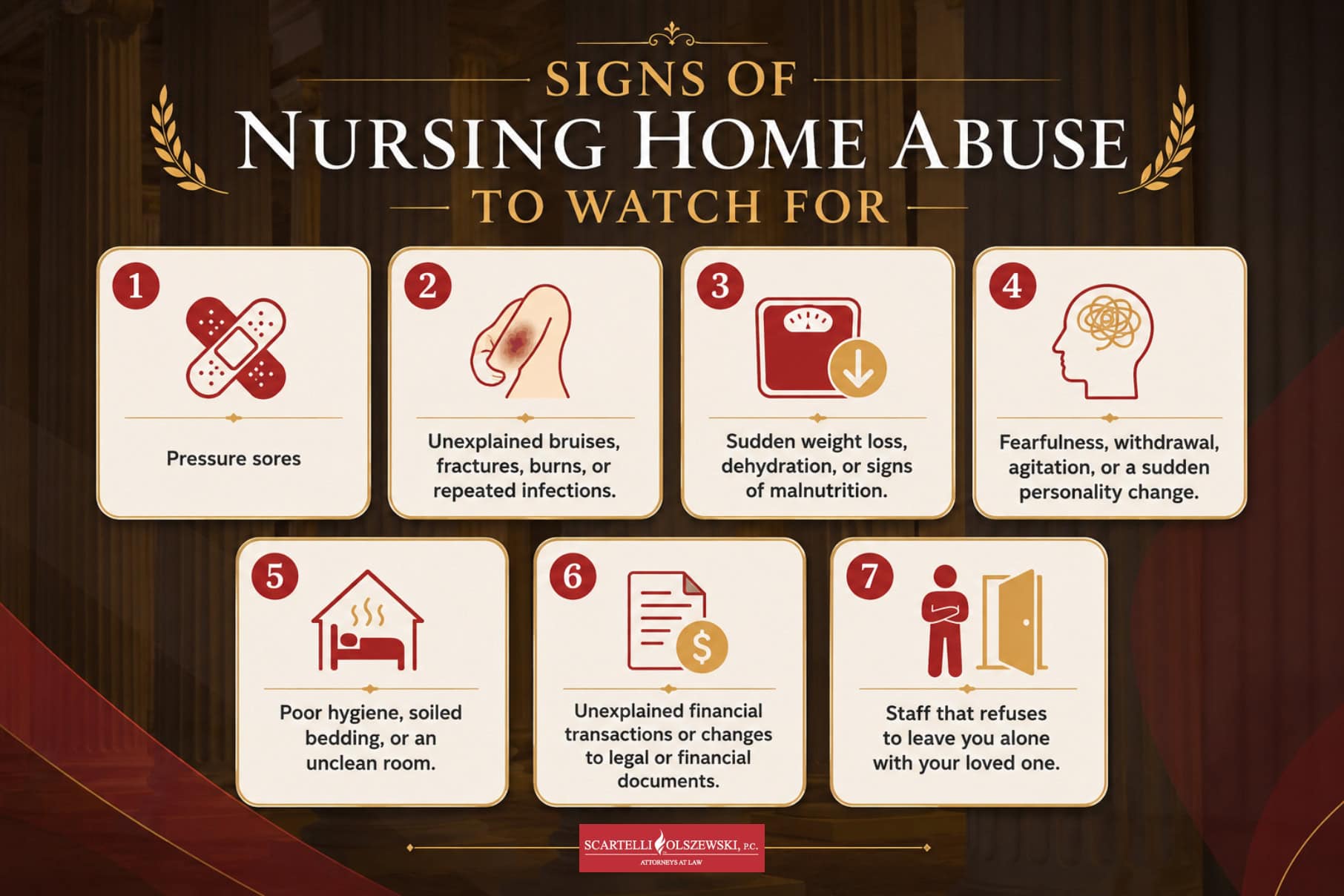
When you move a parent or spouse into a nursing home, you are trusting that facility to provide the care your loved one can no longer manage alone. That trust is too often broken. Research compiled by the National Center on Elder Abuse estimates that about 1 in 10 Americans age 60 and older has experienced some form of elder abuse. Pressure sores, unexplained falls, malnutrition, medication errors, and sudden financial or behavioral changes are not the normal course of aging; they are frequently signs that a facility failed in its duty.
Scartelli Olszewski, P.C., holds Lackawanna County facilities accountable for abuse and neglect from our Scranton office at 411 Jefferson Avenue, minutes from the Lackawanna County Court of Common Pleas at 200 N. Washington Avenue.
Nursing home cases are one part of a broader elder-injury practice handled by our Scranton personal injury attorneys.
Call (570) 346-2600 for a free, confidential case review, and if your loved one is in immediate danger, contact the facility’s administrator and the authorities first.
Both are actionable, and the distinction matters to how a case is proven. Abuse is the intentional infliction of harm, including physical, sexual, emotional, and financial abuse. Neglect is the failure to provide the care a resident needs, including food, water, hygiene, supervision, and medical attention. Most cases we see involve neglect rather than deliberate cruelty, and neglect is usually a symptom of the failures described in the next section.
A single advanced pressure sore or an unexplained fracture is reason enough to investigate.
Not sure if what you’re seeing rises to the level of a legal claim? That’s exactly what a free consultation is for. Tell us what you’ve noticed. No obligation, no pressure, no upfront cost.
Most harm in a nursing home, assisted living facility, retirement home, or long-term care facility traces back to business and staffing failures rather than a single bad actor. The recurring causes we investigate are understaffing that leaves too few aides for too many residents, inadequate training and supervision of the staff who are present, poor screening that puts unqualified or dangerous employees in contact with vulnerable people, high turnover that erodes continuity of care, and financial pressure on for-profit operators that cuts care to protect margins. Each of these is documentable in the facility’s own records, which is why staffing schedules and personnel files matter as much as the medical chart.
Abuse and neglect concentrate among the residents least able to report it. Those at highest risk include residents with dementia or other cognitive impairment, residents with limited mobility who depend on staff for repositioning and toileting, residents with language barriers, and, most consistently, residents who have no family member visiting regularly to notice changes. If your loved one falls into one of these groups, regular unannounced visits and a careful eye on their condition are the best early warning system.

Before or after placing a loved one, you can look up any Medicare- or Medicaid-certified facility on the federal Care Compare tool at medicare.gov, which rates each nursing home on health inspections, staffing levels, and quality measures. A low staffing score or a history of inspection deficiencies is not only a warning for families; it is evidence of a pattern that supports a later claim.
We pull the full inspection and rating history when we investigate a facility. In Lackawanna County, facilities such as Allied Services Skilled Nursing Center (303 Smallacombe Drive, Scranton) and Mountain View Care and Rehabilitation Center (2309 Stafford Avenue, Scranton) have documented federal deficiency citations on file with CMS, viewable through the ProPublica Nursing Home Inspect database and Medicare’s Care Compare tool. A deficiency history is not just a warning sign for families considering a facility; it is evidence of a pattern that supports a negligence claim once harm has occurred.
Every resident in a Medicare or Medicaid-certified nursing home is protected by the federal Nursing Home Reform Act, which requires facilities to keep residents free from abuse and neglect, provide care that preserves their health and dignity, and maintain enough nursing staff to actually deliver that care. These aren’t aspirational standards; they’re binding federal requirements enforced through inspection, deficiency citations, and loss of federal funding.
Pennsylvania adds another layer. The Older Adults Protective Services Act, 35 P.S. § 10225.101 et seq., requires facilities to report suspected abuse, investigate it, and conduct criminal background checks on employees before they’re allowed contact with residents. A facility that skipped a background check on the aide who harmed your loved one didn’t just make a hiring mistake; it broke the law.
When a facility violates these standards, that violation is evidence of negligence. It doesn’t automatically win the case, but it gives a jury a clear line between what the law required and what the facility actually did.
For a living resident, a claim may be brought by the resident directly, if competent; by an agent acting under the resident’s durable power of attorney; or by a court-appointed legal guardian.
When a resident has died, a durable power of attorney terminates at death. At that point, only the personal representative of the estate, the executor named in a will or an administrator appointed by the court, has the authority to file. Under 42 Pa.C.S. § 8301, the personal representative brings the wrongful death claim on behalf of the statutory beneficiaries: the surviving spouse, children, or parents of the deceased, in that order. A survival action under 42 Pa.C.S. § 8302 runs through the estate itself. Siblings, grandparents, and unmarried partners do not have standing under Pennsylvania’s wrongful death statute, regardless of the closeness of the relationship. We help families determine who has standing and obtain the appointment needed to proceed.
|
“Always in the loop. Never left to wonder.” ★★★★★ Sheila J. · Google Review “I had the pleasure of having Attorney Rachel Olszewski on my case. She was great. She always, always, always, kept me in the loop as to what was going on, and consulted me on everything before any decisions were made. She always asked me how I was feeling and explained everything in layman’s terms. Anyone who I spoke to in the office when I called was always professional and courteous. I was lucky enough to have my case move rather quickly. I would recommend this law office to anyone looking for kindness, compassion and caring as they deal with a tough part of their lives. The law office of Scartelli Olszewski, P.C. will get the job done!” |
Many nursing homes include an arbitration clause in admission paperwork in an attempt to move any future dispute out of court and into private arbitration. Families should understand what federal regulations actually require — and where the real grounds for challenge sit.
Under 42 C.F.R. § 483.70(n), a Medicare or Medicaid-certified facility cannot require a resident to sign an arbitration agreement as a condition of admission or continued care. That prohibition survived the 2019 revision to CMS’s long-term care regulations and remains in force. The facility must explain the agreement clearly, confirm that the resident understands it, and present it as entirely voluntary. Federal regulations also require every compliant arbitration agreement to include an explicit 30-day window during which the resident or their representative can rescind it in writing, under § 483.70(n)(3). If that rescission right is missing from the agreement, that is itself a regulatory violation.
Pre-dispute binding arbitration agreements are permitted under current federal law, provided they meet those conditions. A signed agreement can still be challenged on several grounds: it was presented as a condition of admission, it was signed by someone without legal authority to bind the resident, or its terms are unconscionable under Pennsylvania contract law. We review the full admission file in every case and assess enforceability before any dispute proceeds.
These cases are won in the facility’s own records. We obtain and analyze the residents’ care plans, nursing and shift notes, the Minimum Data Set assessments the facility is federally required to keep, medication administration records, incident and fall reports, staffing schedules, and the state inspection and survey findings on file with the Pennsylvania Department of Health. Patterns in those records, understaffed shifts, skipped repositioning, and ignored fall-risk flags tell the real story, and we pair them with medical and life-care experts to prove both what happened and what it will cost.
Where the harm stems from a physician’s order or a violated care plan, the case can overlap with the work of our Scranton medical malpractice lawyers.
|
“A very difficult case. Every step of the process exceeded our expectations.” ★★★★★ Joseph Adams · Google Review “Melissa Scartelli and her entire team did an exceptional job with our very difficult case. They are driven, competent, timely, experienced, and compassionate. Their experts were exceptional. Melissa’s research and deposition skills are absolutely outstanding. Her entire staff worked diligently under her direction and delivered amazing results. The whole process exceeded our expectations. I would highly, highly recommend their law firm.” |
Pennsylvania does not cap compensatory damages in these cases. A claim can recover the cost of additional medical care and rehabilitation, the cost of moving the resident to a safe facility, restitution for financial exploitation, and, for the resident, pain and suffering compensation in Pennsylvania, emotional distress, disfigurement, and loss of dignity and quality of life. Where neglect causes death, the family may recover funeral costs and their own losses through a wrongful death claim. The line between ordinary negligence and reckless misconduct that supports punitive damages matters here, because punitive damages may be available where a facility falsified records or knowingly operated with dangerously inadequate staff.
Facilities sometimes argue that a resident’s own condition, fragile skin, a history of falls, or a refusal of care caused the harm rather than a staffing failure. Pennsylvania’s modified comparative negligence statute at 42 Pa.C.S. § 7102 limits how far that defense can go. A resident can still recover damages unless their own negligence is found to exceed 50 percent of total fault; at 51 percent or more, recovery is barred. A cognitively impaired resident who could not manage their own repositioning or supervision cannot reasonably be assigned the majority fault for a facility’s failure to provide that care. We anticipate the blame-shifting defense and answer it with the facility’s own staffing records and care plans.
Most nursing home abuse and neglect claims must be filed within two years under 42 Pa.C.S. § 5524, and a wrongful death claim runs the same two years from the date of death under the same statute. The discovery rule may apply where the harm, such as the cause of an infection or a hidden injury, could not reasonably have been known at first. These statutes of limitations on personal injury claims in Pennsylvania are strict, and because records can be altered and witnesses move on, it is best to act promptly.
Nothing upfront. We work on a contingency fee basis under Pa.R.P.C. 1.5(c) and advance the case costs, so the family pays an attorney fee only if we recover. We represent residents of skilled nursing facilities, assisted living communities, memory care units, and long-term care hospitals across Lackawanna and Luzerne counties.
Still have questions? Call (570) 346-2600 or read the FAQs below. If your situation is urgent, call now; the intake team is available around the clock.
Yes. When a nursing home resident dies from neglect, 2 claims are available in Pennsylvania. The personal representative of the estate files a wrongful death claim under 42 Pa.C.S. § 8301 on behalf of the surviving spouse, children, or parents. The personal representative files a survival action under 42 Pa.C.S. § 8302 on behalf of the estate, recovering what the resident suffered between the injury and death. Both claims are typically filed together. The statute of limitations runs 2 years from the date of death under 42 Pa.C.S. § 5524.
Federal law requires nursing homes to retain resident records for at least 5 years from the date of discharge, or for a minor, until the resident reaches age 21, whichever is longer (42 C.F.R. § 483.70(i)). Pennsylvania state regulations follow federal minimums. In practice, staffing schedules, incident reports, and Minimum Data Set assessments, the records that matter most in an abuse case, sit in the facility’s files during that window. Requesting records early protects against loss or alteration. We send a formal preservation demand to the facility at the start of every case.
Yes. The same legal framework that applies to skilled nursing facilities covers assisted living communities, memory care units, and long-term care hospitals in Pennsylvania. Residents in assisted living and memory care have protections under Pennsylvania’s Older Adults Protective Services Act, 35 P.S. § 10225.101 et seq., and state licensing regulations at 55 Pa. Code Chapter 2800. We handle nursing home negligence claims across all long-term care settings in Lackawanna and Luzerne counties, not only traditional nursing homes.
Nursing home facilities document everything from the moment an incident occurs. Their insurers are often notified the same day. The families who move first hold more leverage over what that record says and what it omits.
Scartelli Olszewski, P.C., has handled nursing home negligence and elder abuse cases in Lackawanna and Luzerne counties since 2001. When you call, you reach attorneys who know these facilities, know the Lackawanna County Court of Common Pleas, and have argued medical negligence before the Pennsylvania Supreme Court.
The first call is free. There is no fee unless we recover. We are available 24 hours a day.
Call (570) 346-2600 or visit us at 411 Jefferson Avenue, Scranton. Families in Luzerne County can reach our nursing home abuse lawyers in Wilkes-Barre at 7 Public Square.
Past results do not guarantee similar outcomes.
I don't think I could have picked a better team to represent my case. My situation was unique and extremely complicated but it was handled with the utmost care and professionalism. The firm's strong and organized representation ultimately brought great results and helped reconcile a tragic event.
- Jeremy S.
Was wrongly accused of a very serious Felony 3 account and hired Peter Paul Olszewski. The entire firm of Scartelli Olszewski worked tirelessly to have the Pike County Assistant District Attorney as well as the District Magistrate Judge Dismiss the charges! Very pleased with the outcome of this Law Firm and recommend this Law Firm.
- Kerry S.Dealing with the attorneys over at Scartelli Olszewski was nothing short of satisfactory. Through the entire 4 year process we had, I was constantly kept updated and cared for. More than doing their job, they truly care for their clients which I felt off the first meeting with Melissa. Both my family and I are forever thankful for them!
- Noah T. Melissa A. Scartelli
Founder & President
Melissa A. Scartelli
Founder & President
Melissa is a respected Pennsylvania trial attorney, firm founder, and board-certified civil trial advocate recognized for compassionate client service, major case results, and longstanding Super Lawyers honors. Deeply active in the legal community and local institutions, she continues to champion injured clients alongside her family-led legal team.
After an accident, who you hire matters. We've spent years fighting for families just like yours – and we're ready to fight for you.