


$
Jury Verdict
$ 10 Million
Medical Malpractice
Luzerne County


 Millions Recovered
Millions won for victims, including Luzerne County's largest medical malpractice verdict.
 Certified Trial Advocacy
Led by one of few female Board Certified Trial Advocates in Pennsylvania.
 Zero Upfront Cost
You don't pay a penny out of pocket, we only get paid when you do.
 Years of Experience
100+ combined years of experience in personal injury, medical malpractice, and criminal defense.
A Scranton trucking case is won or lost on evidence that starts disappearing within hours of the crash. Electronic logging device data, event data recorder downloads, dashcam video, dispatch communications, driver qualification files, and drug and alcohol test records can all be lost or “cycled out” in days unless preserved by formal demand. The carrier’s defense counsel knows this. Major commercial carriers run rapid response programs that put investigators on scene within hours of a serious crash, building the company’s defense while victims are still in the trauma bay. By the time most injured people think to call a lawyer, the clock is already running against them.
In 2024, Pennsylvania recorded 110,765 reportable traffic crashes statewide, with 66,950 people injured and 1,127 killed, according to PennDOT’s Pennsylvania Crash Facts and Statistics 2024. Lackawanna County sits at the convergence of I-81, I-84, I-380, and the Pennsylvania Turnpike Northeast Extension (I-476). The growth of regional warehousing and distribution along the I-81 corridor has produced sustained heavy commercial traffic through Scranton, Dunmore, Jessup, Olyphant, and Pittston.
Scartelli Olszewski, P.C. is led by Melissa A. Scartelli, founder, president, and Board Certified Civil Trial Advocate by the National Board of Trial Advocacy.
Call our Scranton office at (570) 346-2600 or visit 411 Jefferson Avenue, Scranton, PA 18510 for a free, confidential case review. We are minutes from the Lackawanna County Court of Common Pleas at 200 N. Washington Avenue where Scranton-area trucking cases are filed.
Proven Results in Pennsylvania Trucking and Auto Cases:
See our full case results, read what our clients have said, or meet our attorneys.
Past results do not guarantee a similar outcome. Every case is unique and the value of any claim depends on its specific facts.
Trucking cases are usually worth more than passenger-vehicle cases for two reasons. First, the underlying injuries are more severe; an 80,000-pound tractor trailer striking a 4,000-pound passenger vehicle produces forces that drive catastrophic harm. Second, federal financial responsibility minimums require commercial carriers to maintain coverage well above ordinary auto policy limits.
No Cap on Compensatory Damages
Pennsylvania does not cap economic or non-economic damages in trucking cases. You can recover the full value of your losses.
Federal Minimum Liability Coverage
Under 49 C.F.R. § 387.9, motor carriers transporting non-hazardous freight in interstate commerce must maintain at least $750,000 in liability coverage. Carriers transporting certain hazardous materials must maintain $5,000,000. Carriers transporting oil must maintain $1,000,000. Many large carriers carry coverage well above these minimums. The size of the policy stack drives what is available to recover, but it is the strength of the case that determines what is paid.
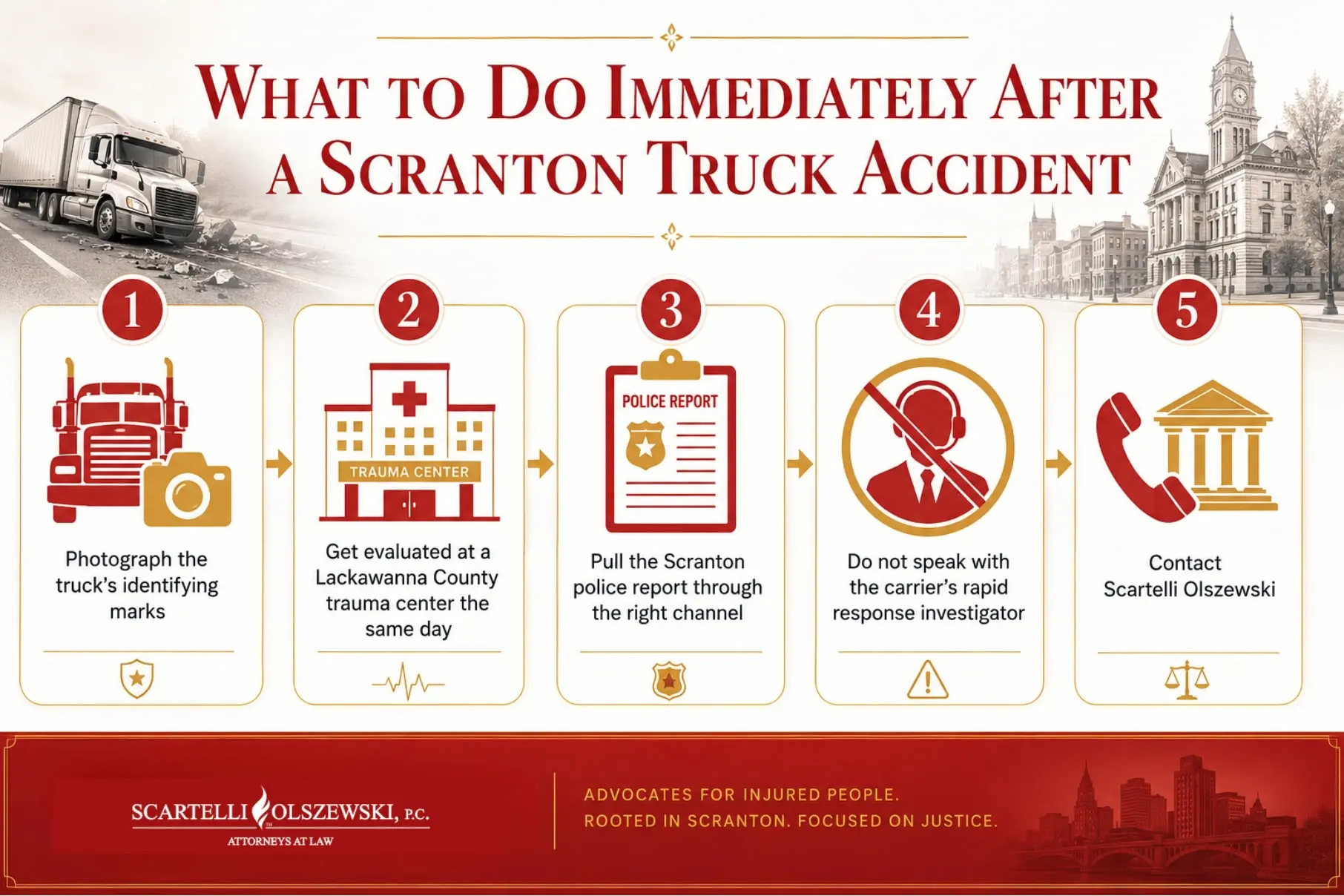
The general scene-response checklist (911, medical, photos, witness contact, no recorded statement, no social media) lives on our what to do at the scene of a truck accident in Pennsylvania page. The cross-cutting what to do after a car accident walkthrough applies to crashes generally. A few items are specific to Scranton-area trucking cases:
Photograph the truck’s identifying marks. USDOT and MC numbers, company markings on the cab and trailer, the trailer license plate, and visible cargo. These identify the motor carrier, the lessor, and the cargo loader, all of whom may be defendants.
Get evaluated at a Lackawanna County trauma center the same day. Geisinger Community Medical Center on Mulberry Street is a Pennsylvania Trauma Systems Foundation Level II accredited trauma center serving the county. Regional Hospital of Scranton and Moses Taylor Hospital operate 24/7 emergency departments. Internal injuries, TBI, and spinal damage often have delayed symptoms that the same-day record protects.
Pull the Scranton police report through the right channel. See our walkthrough on securing a police report after a car accident in Scranton, PA.
Do not speak with the carrier’s rapid response investigator. Major carriers dispatch investigators to the scene of catastrophic crashes, sometimes before police clear the roadway. They look for a recorded statement or an early release. There are other things to avoid doing after a crash that can hurt your case.
Contact Scartelli Olszewski. We send formal preservation letters to the carrier, lessor, broker, and cargo loader within hours, and engage an accident reconstructionist if the facts warrant it.
From minute one, we handle the adjuster. Call (570) 346-2600 for a free case review.
Nothing upfront. We work on a contingency fee basis under Pa.R.P.C. 1.5(c). You pay no attorney fees unless we recover compensation for you. We advance all case costs, including expert witness fees, accident reconstruction, ELD and EDR downloads, FMCSA records work, and court filings.
If we do not win, you owe us nothing.
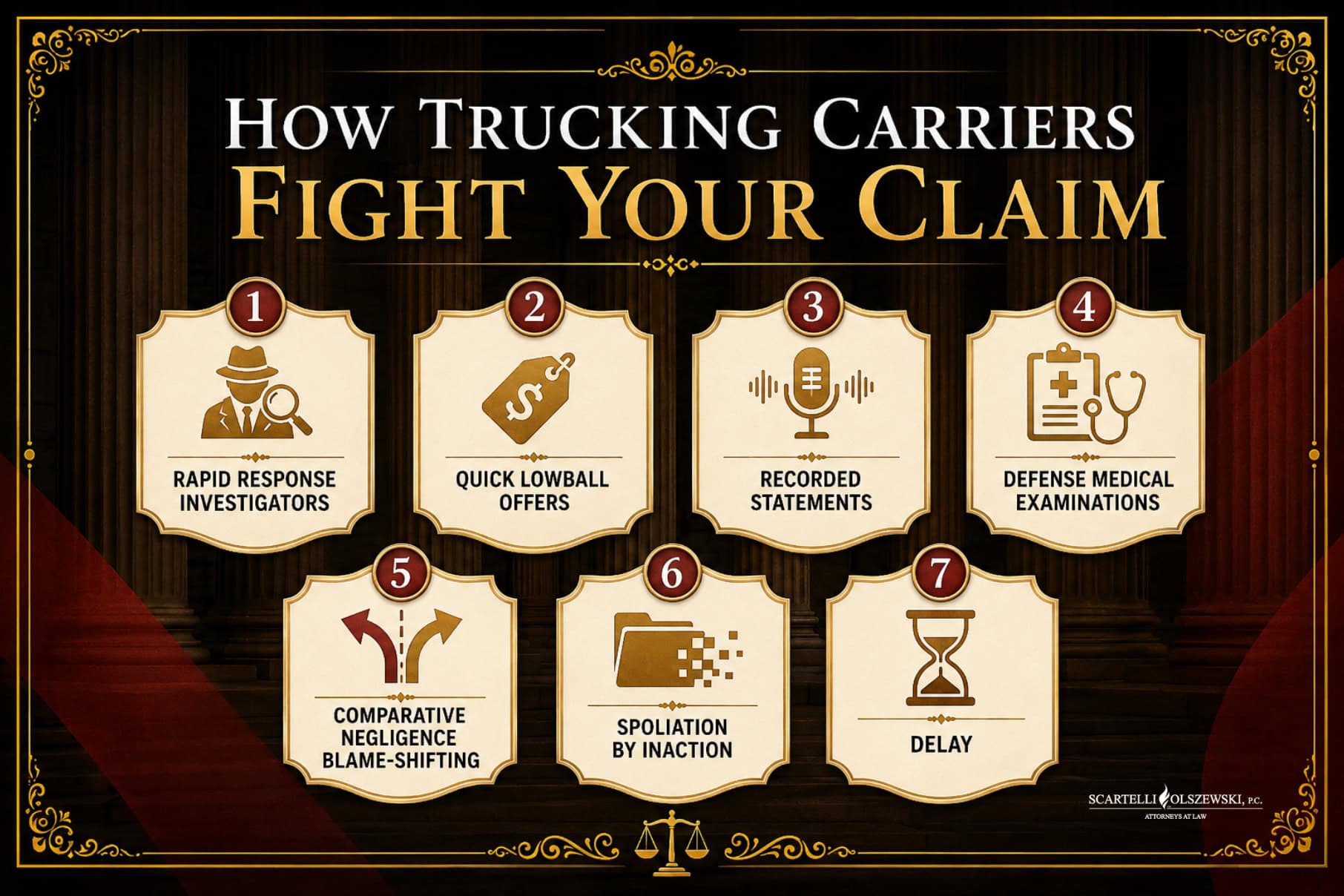
Understanding how carriers avoid paying claims helps you avoid common traps. Trucking carriers and their excess insurers run a more sophisticated defense than ordinary auto insurers because the policy stack is bigger and the exposure is real.
When insurers cross the line into bad faith, meaning they unreasonably deny valid claims, misrepresent policy terms, or refuse to pay what they owe, Pennsylvania law allows a separate bad faith claim under 42 Pa.C.S. § 8371 with additional damages beyond the original loss. We pursue those claims when the facts support them.
Trucking cases usually involve several potential defendants beyond the driver. Identifying every party responsible for the crash is how we maximize recovery and prevent defendants from pointing fingers at one another to escape accountability.
To recover compensation, you must prove the driver and (where applicable) the carrier and other defendants were negligent. Pennsylvania law requires four elements:
We gather the evidence to prove fault on each element: police reports, sworn witness statements, traffic camera footage, dashcam video, ELD records, EDR downloads, driver qualification files, drug and alcohol test results, dispatch communications, trip envelopes, weigh station records, and accident reconstruction expert testimony. Trucking carriers challenge one or more elements in every case. We anticipate their arguments and build evidence to defeat them.
Pennsylvania law imposes strict deadlines on personal injury claims. Missing them permanently bars your claim, regardless of how strong the evidence is.
The 2-year statute is the outer limit. The practical deadline is much earlier. ELD data, dashcam video, and EDR downloads are perishable in days, not years. We move immediately.
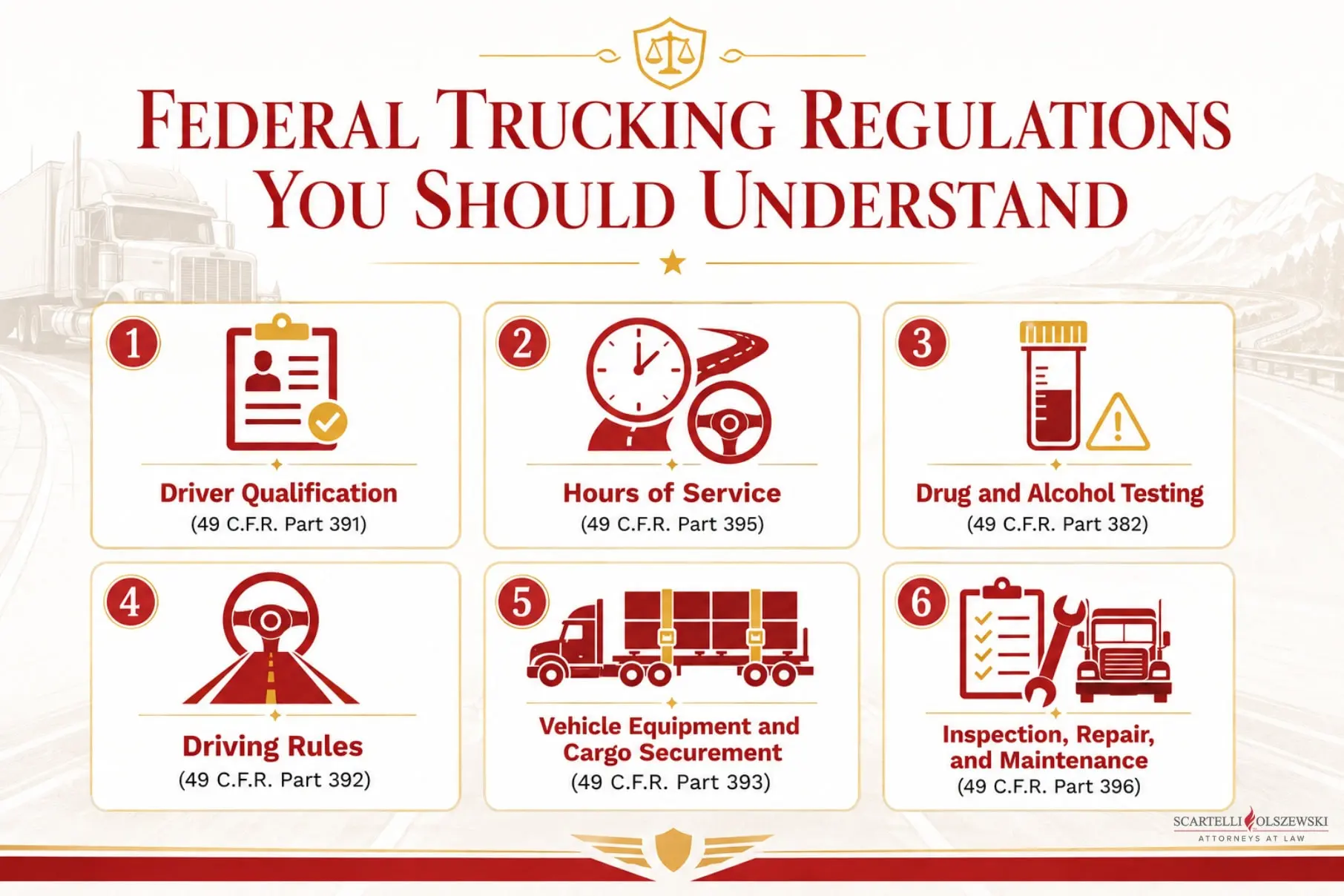
Federal Motor Carrier Safety Administration (FMCSA) regulations under 49 C.F.R. Parts 350 through 399 govern most aspects of interstate trucking operations. Violations are powerful evidence in a civil case.
Driver Qualification (49 C.F.R. Part 391). Carriers must verify driver qualifications, prior employment, medical certification, and motor vehicle records before placing a driver behind the wheel. Hiring or retaining an unqualified driver supports a negligent hiring claim.
Hours of Service (49 C.F.R. Part 395). Property-carrying drivers may drive a maximum of 11 hours after 10 consecutive hours off duty, within a 14-hour on-duty window, with 60/70-hour limits over 7/8 consecutive days. Driving outside these limits, or operating without a compliant ELD, supports negligence and negligence per se claims. Falsified logs are a common pattern.
Drug and Alcohol Testing (49 C.F.R. Part 382). Pre-employment, random, post-accident, reasonable suspicion, and return-to-duty testing programs are mandatory. Drivers and carriers that bypass the program, mishandle a positive result, or return a driver to duty without follow-up testing face direct exposure.
Driving Rules (49 C.F.R. Part 392). Includes the federal handheld phone ban under § 392.82 (texting prohibition under § 392.80 for CMV drivers). Cell phone records subpoenaed in a trucking case can prove a Part 392 violation at the moment of impact.
Vehicle Equipment and Cargo Securement (49 C.F.R. Part 393). Brake systems, tires, lighting, mirrors, coupling devices, and cargo securement requirements. Equipment failures and shifted cargo each support distinct theories of liability.
Inspection, Repair, and Maintenance (49 C.F.R. Part 396). Pre-trip and post-trip inspections, periodic inspections, and maintenance records. Deferred maintenance and skipped inspections produce documentable patterns the carrier cannot explain away once we have the records.
Trucking causes recur across cases. Identifying the cause drives the discovery plan and the theory of liability. We have covered the underlying patterns across our blog: see common causes of truck accidents, seven common causes of trucking accidents, and common errors made by truck drivers.
Different crash types require different reconstruction approaches and expert witnesses. See our overview of the most common types of truck accidents and our explainer on why truck crashes are different from car crashes.
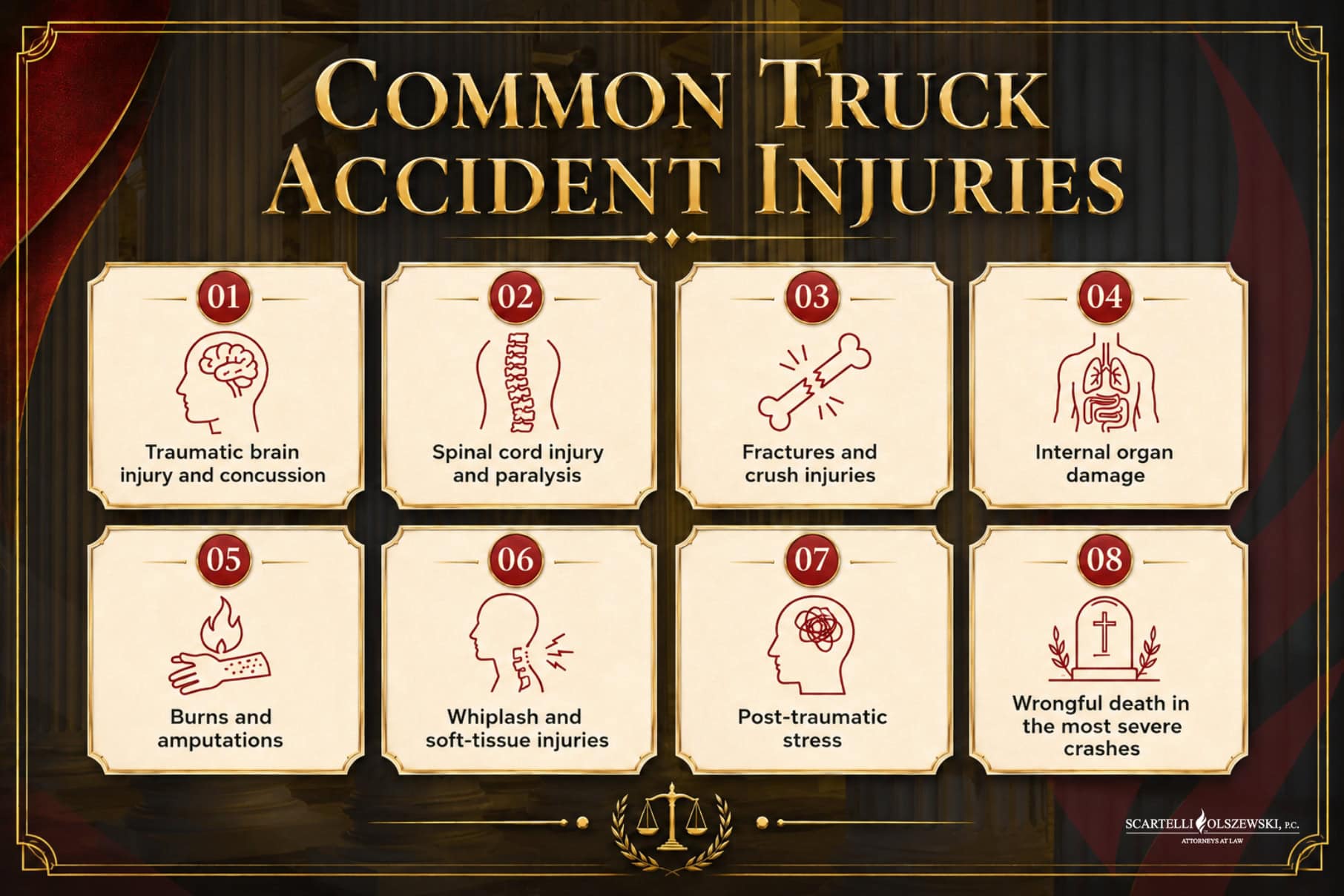
The weight disparity between an 80,000-pound combination vehicle and a 4,000-pound passenger car drives an injury profile that skews toward the catastrophic end of the spectrum.
Scranton sits at the convergence of I-81, I-84, I-380, and the I-476 Northeast Extension of the Pennsylvania Turnpike. The Northeastern Pennsylvania warehousing and distribution corridor along I-81, anchored by major fulfillment centers in Dunmore, Jessup, Olyphant, Pittston, and Hazle Township to the south, drives sustained heavy commercial traffic through the county. The combination of high freight volume, mountain road grades on I-380 and on Route 6, and seasonal weather produces a recurring serious-crash profile.
A wide-turn crash at a downtown intersection, a rear-end on I-81 in fog, and an underride on Route 6 are different cases legally and factually. We evaluate every crash in the context of where it happened, what caused it, and which carrier, broker, loader, and government entity can be held responsible.
Nothing upfront. Scartelli Olszewski works on a contingency fee basis under Pa.R.P.C. 1.5(c). The firm advances all case expenses, including expert fees, accident reconstruction, ELD and EDR downloads, FMCSA records work, and court filings. You pay a fee only if the case results in a settlement or verdict.
Two years from the date of the crash under 42 Pa.C.S. § 5524. For wrongful death claims, two years from the date of death under 42 Pa.C.S. § 8301. Claims against government entities require a written notice of claim within six months under 42 Pa.C.S. § 5522(a). Practically, evidence preservation work needs to start within days.
ELD records, EDR downloads, driver qualification files, drug and alcohol test results, dispatch communications, trip envelopes, weigh station records, dashcam and surveillance footage, maintenance and inspection records, CSA Safety Measurement System data, and driver employment history. Most of this is discoverable only after a formal preservation letter goes out.
Yes. Under respondeat superior, motor carriers are vicariously liable for driver negligence within the scope of employment. Carriers also face direct claims for negligent hiring, retention, training, supervision, and entrustment, and for systemic failures of FMCSA compliance.
Sometimes. A broker or shipper that selected a carrier with documented safety problems may face a negligent selection claim. Following the Supreme Court’s unanimous 2026 decision in Montgomery v. Caribe Transport II, LLC, freight brokers can be held liable for negligent selection of carriers with documented safety problems. We assess broker exposure case by case.
You can still file a civil claim. Police citations address criminal violations, not civil liability. Many trucking-case theories, including Part 391 qualification failures, Part 395 hours-of-service violations, Part 393 cargo securement failures, and negligent hiring, never appear in a police report.
Yes, if you were not more than 50 percent at fault under Pennsylvania’s modified comparative negligence rule at 42 Pa.C.S. § 7102. Your award is reduced by your percentage of fault. If you are 51 percent or more at fault, you recover nothing.
Many of the same principles apply, though FMCSA jurisdiction depends on weight class and operating authority. Delivery truck crashes involving Amazon DSPs, FedEx Ground contractors, UPS, and last-mile carriers each present their own driver-vs-employer-vs-broker framework that we work through case by case.
Case value depends on injury severity, future care needs, lost wages and earning capacity, fault clarity, available coverage, and the strength of the carrier’s safety record (a poor record supports punitive exposure). Catastrophic injury cases in trucking routinely move into seven and eight figures because of the size of the policy stack and the severity of the injuries.
Spouses, children, and parents can file wrongful death claims under 42 Pa.C.S. § 8301 and a survival action under 42 Pa.C.S. § 8302. Learn who can file under Pennsylvania law.
Almost never. Initial offers rarely reflect the full value of the case and typically do not account for future medical needs, future earning capacity, or punitive exposure. We audit carrier offers against the policy stack, the strength of liability proofs, and PA case precedent.
Pennsylvania gives you two years to file most truck accident claims and as little as six months for government claims. Practically, evidence preservation work needs to start within days. The first call is free, and there is no pressure to retain.
We live here, work here, and raise our families in Northeastern Pennsylvania. When you walk into our office, you are not a case number. You are a neighbor, and we handle your case with the seriousness we would bring to one involving our own family.
Call (570) 346-2600. Get a Scranton trial lawyer on your side.
(570) 346-2600 Scranton office | Start your free consultation
Our Scranton office at 411 Jefferson Avenue represents truck accident victims throughout Lackawanna County and Northeastern Pennsylvania, including Scranton, Dunmore, Dickson City, Old Forge, Moosic, Taylor, Throop, Olyphant, Jessup, Archbald, Carbondale, and Clarks Summit. We also serve Wilkes-Barre, Luzerne County, Monroe County, Wayne County, and Pike County.
Meet our attorneys: Melissa A. Scartelli, Peter Paul Olszewski, Jr., Rachel D. Olszewski, and Kristin A. Mazzarella.
Past results do not guarantee a similar outcome. Every case is unique and the value of any claim depends on its specific facts.
I don't think I could have picked a better team to represent my case. My situation was unique and extremely complicated but it was handled with the utmost care and professionalism. The firm's strong and organized representation ultimately brought great results and helped reconcile a tragic event.
- Jeremy S.
Was wrongly accused of a very serious Felony 3 account and hired Peter Paul Olszewski. The entire firm of Scartelli Olszewski worked tirelessly to have the Pike County Assistant District Attorney as well as the District Magistrate Judge Dismiss the charges! Very pleased with the outcome of this Law Firm and recommend this Law Firm.
- Kerry S.Dealing with the attorneys over at Scartelli Olszewski was nothing short of satisfactory. Through the entire 4 year process we had, I was constantly kept updated and cared for. More than doing their job, they truly care for their clients which I felt off the first meeting with Melissa. Both my family and I are forever thankful for them!
- Noah T. Melissa A. Scartelli
Founder & President
Melissa A. Scartelli
Founder & President
Melissa is a respected Pennsylvania trial attorney, firm founder, and board-certified civil trial advocate recognized for compassionate client service, major case results, and longstanding Super Lawyers honors. Deeply active in the legal community and local institutions, she continues to champion injured clients alongside her family-led legal team.
After an accident, who you hire matters. We've spent years fighting for families just like yours – and we're ready to fight for you.