


$
Jury Verdict
$ 10 Million
Medical Malpractice
Luzerne County

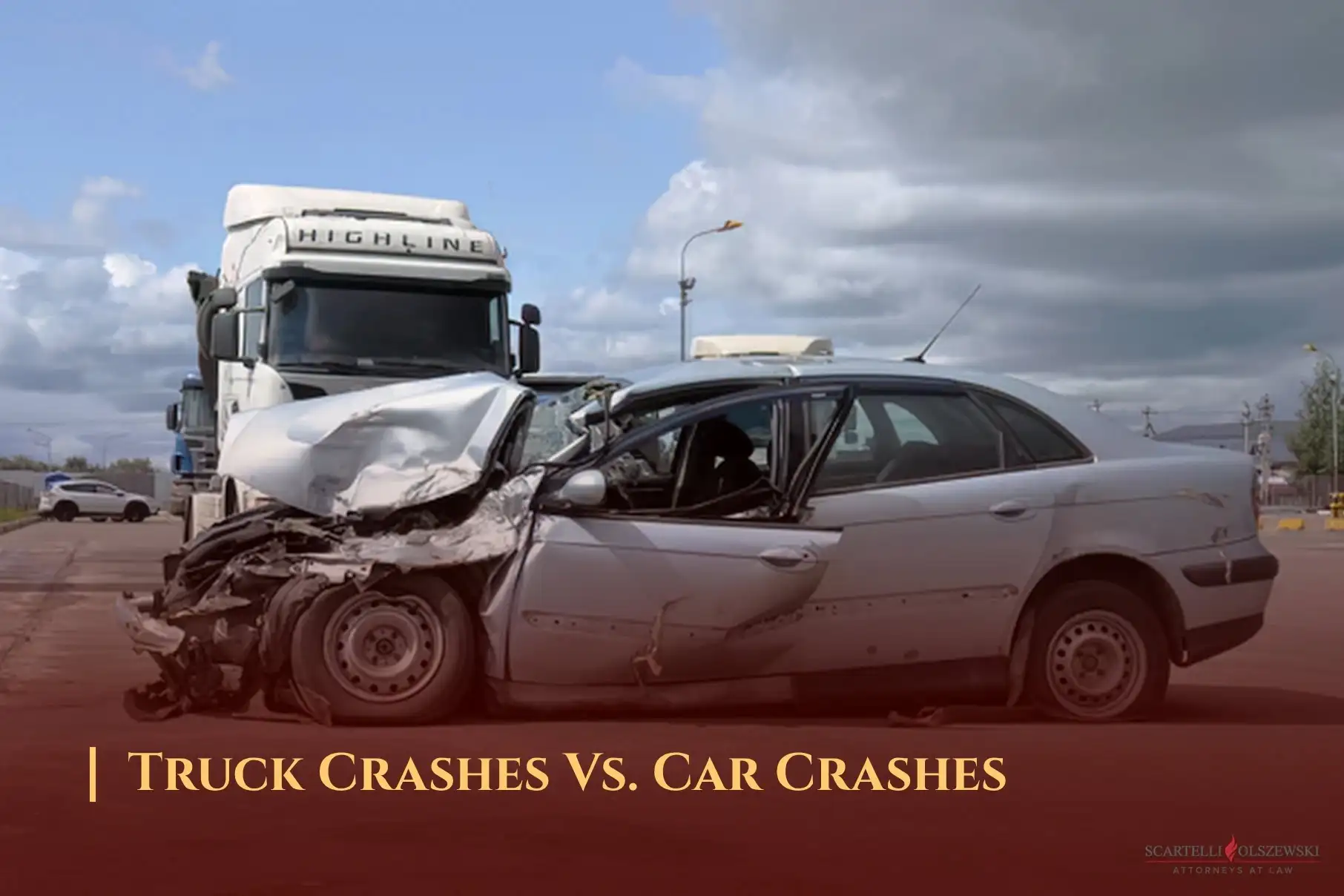
If a crash in Pennsylvania involves an 18-wheeler, the claim in front of you is not a standard car accident case with bigger damage. An 80,000-pound truck hits with a force a passenger vehicle cannot match, and that difference shows up in the property damage, the injuries, and the length of recovery. It also changes who can be held liable: a trucking company, a cargo loader, or a parts manufacturer can share fault alongside the driver. Federal trucking regulations add a layer of law that never applies to a typical car crash claim, and that means a different investigation from day one.
Below is what actually separates truck vs. car crashes in PA and what it means for your injury claim.
Key Takeaways
The danger comes down to weight. A fully loaded commercial truck can weigh up to 80,000 pounds, while the average passenger car weighs 3,000 to 4,000 pounds. When a vehicle that size strikes a passenger car, the smaller vehicle’s crumple zones and airbags absorb force they were never engineered to handle, because they were designed to protect occupants from a collision with another car, not an object twenty times heavier.
In 2025, heavy trucks were involved in 6,922 crashes and were linked to 133 fatalities across Pennsylvania, according to PennDOT’s Crash Facts & Statistics report. Nationally, the threat is rising fast: injury-causing large truck crashes jumped 5.4% in 2024 to over 120,000 cases, according to the National Safety Council Injury Facts.
The two crash types also tend to start from different causes. Car accident lawyers see distracted driving, speeding, and driver inattention behind most car crashes. Truck crashes trace back to causes tied to commercial operation instead:
We break down these patterns in more detail in our piece on the common errors made by truck drivers.
That same weight gap changes what kind of injuries a person walks away with. While any motor vehicle accident can be catastrophic, truck accidents more often produce injuries that change the rest of a person’s life:
A car crash more often leaves whiplash, fractures, or lacerations behind. Closed-head injuries deserve particular attention because insurers routinely try to minimize them when there is no visible wound.
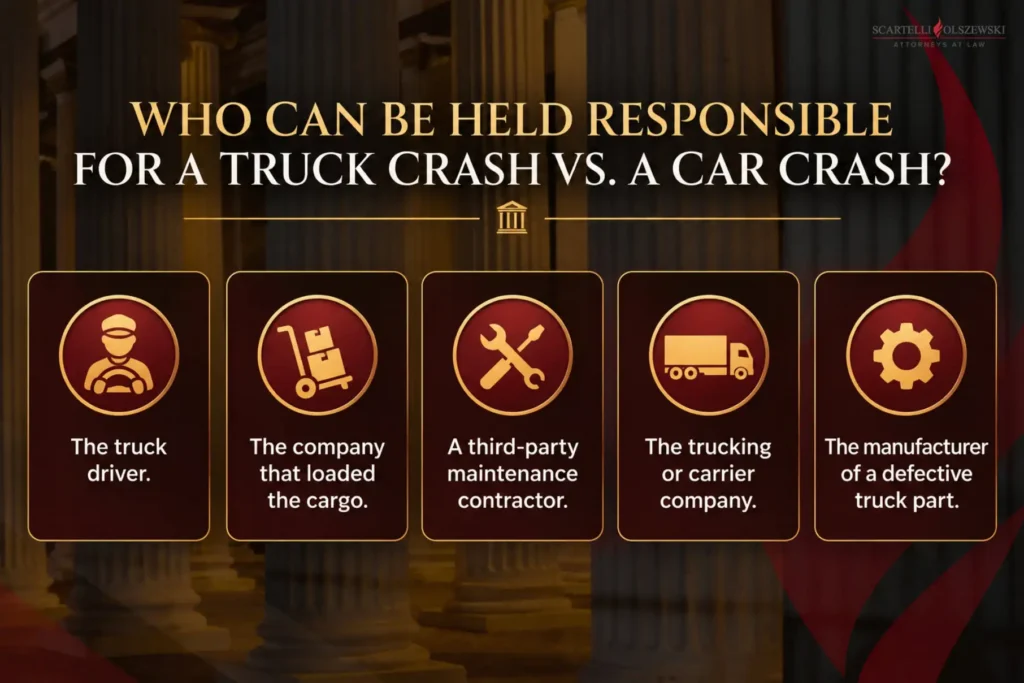
Liability in a truck crash can extend well past the driver, to the carrier, the cargo loader, or the parts manufacturer, because a commercial truck is rarely operated by just one party. Depending on what caused the crash, any of the following can be named:
A car crash narrows that list to one driver in most cases, which is why the investigation our Scranton car accident lawyers run typically centers on a single at-fault motorist. Our Scranton truck accident lawyers instead build the case around every party that touched the truck before it hit the road.
If you’re not sure who’s responsible for your crash, call us at (570) 346-2600, and we’ll walk through it with you at no cost.
Yes. Truck drivers and trucking companies answer to Pennsylvania traffic law and to an added layer of federal regulation enforced by the Federal Motor Carrier Safety Administration. Car drivers are subject to Pennsylvania traffic law alone. That federal layer includes:
A violation of these rules often establishes negligence per se, meaning the violation itself can count as proof of negligence, without the usual burden of proving a driver failed to act reasonably. A blown stop sign is a car driver’s mistake that still has to be proven on a case-by-case basis. A missed hours-of-service log is a documented federal violation with a paper trail, and that record can carry a truck claim in a way a car accident claim has no equivalent for.
Insurance minimums follow the same pattern. Federal rules require most commercial carriers to carry at least $750,000 in liability coverage, compared to Pennsylvania’s $15,000 per-person minimum for a standard auto policy, according to the Federal Motor Carrier Safety Administration.
Federal trucking regulation sits on top of Pennsylvania law, not in place of it. Two Pennsylvania rules control what you can recover, and both function differently once more than one party is at fault.
That distinction shows up on the roads we handle daily. Interstates 81, 84, 380, and 476 carry a disproportionate share of Northeastern Pennsylvania’s commercial truck traffic, feeding freight into hubs like the Humboldt Industrial Park in Hazleton and the CenterPoint Commerce and Trade Park near Pittston. Truck claims arising from those corridors are frequently filed in the Lackawanna County Court of Common Pleas or the Luzerne County Court of Common Pleas at 200 North River Street, Wilkes-Barre.
The distinctions affect more than how a claim gets investigated. They affect the types of damages you can recover. The table below puts the differences in one place.
|
Feature |
Car Crash |
Truck Crash |
|
Average vehicle weight |
3,000 to 4,000 lbs |
Up to 80,000 lbs |
|
Typical liable parties |
The other driver |
Driver, carrier, cargo loader, manufacturer |
|
Governing regulations |
Pennsylvania traffic law |
Pennsylvania traffic law plus FMCSA federal rules |
|
Typical injury severity |
Whiplash, fractures, lacerations |
TBI, spinal cord damage, crush injuries |
|
Insurance coverage |
Standard auto policy limits |
Federal financial responsibility minimums, well above standard limits |
|
Unique evidence |
Police report, photos, witness statements |
ELD driver logs, black box data, maintenance records |
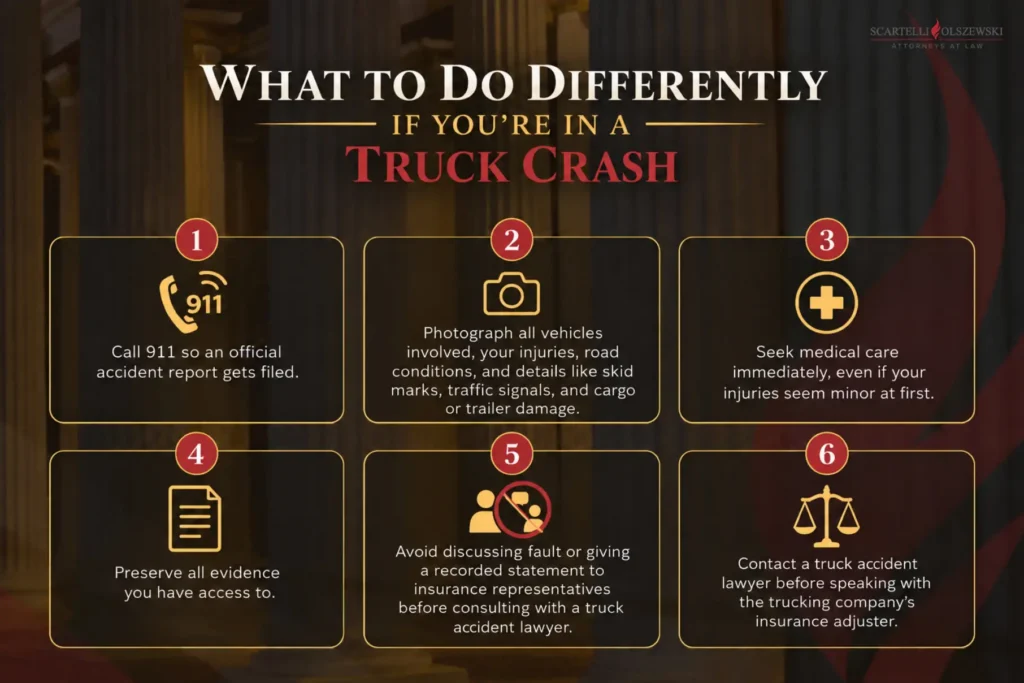
A truck crash calls for a faster, more deliberate response than a car crash, because the evidence that proves your case starts disappearing almost immediately.
Once a carrier’s insurer learns about a crash, its rapid-response team is already working to limit what it pays, and the truck’s electronic logging device and black box data can cycle out within weeks. We walk through this response in full detail in our guide on what to do after an accident with a tractor-trailer.
Yes, in most cases. Truck claims require investigating multiple defendants, federal regulations, and specialized evidence like electronic logging device data, which a general car accident attorney may not routinely handle. An attorney experienced in both crash types can identify which approach your case actually needs.
Truck accident claims are worth more because insurance limits, medical documentation, and long-term care needs are typically larger. Truck claims often require life-care planning for catastrophic injuries and carry federal insurance minimums well above a standard auto policy, both raising claim value beyond a comparable car accident case.
You have two years from the crash date to file, under 42 Pa.C.S. § 5524, for both truck and car claims. Pennsylvania’s discovery rule extends this deadline when an injury was not reasonably discoverable right away, which happens more often in truck cases involving delayed-onset spinal or internal injuries.
No, the same 51% bar under 42 Pa.C.S. § 7102 governs both crash types. In a truck case, fault is apportioned among every liable party based on the evidence, not divided evenly by the number of defendants named. Each party’s share depends on their actual conduct, not a fixed formula.
Yes. Pennsylvania courts typically exercise jurisdiction over an out-of-state carrier that caused a crash within the state, and FMCSA’s federal financial responsibility rules, requiring at least $750,000 in liability coverage, apply regardless of where the company is domiciled.
No, you should not give a recorded statement to the trucking company’s insurance adjuster. Adjusters request these statements quickly, often before you know the full extent of your injuries, and then use them to reduce your claim’s value. Let your attorney handle all adjuster communication instead.
A short conversation tells you whether you have a straightforward car claim or a more complex truck case. Electronic logging device data and black box records disappear within weeks. Early contact preserves that evidence.
At Scartelli Olszewski, P.C., founding attorney Melissa A. Scartelli, a Board Certified Civil Trial Advocate, has tried truck and car crash cases in Lackawanna and Luzerne County courtrooms since 1988. We work on contingency. You owe no attorney fees unless we recover compensation for you.
“Small Enough to Care, Large Enough to Win”
Call our Scranton office at (570) 346-2600 or our Wilkes-Barre office at (570) 822-1400 to schedule your free consultation. Or, you can fill out our online form.

Rachel D. Olszewski, an attorney at Scartelli Olszewski, P.C., is a dedicated advocate for clients who have suffered unjust harm. Following the legacy of her esteemed family members, Rachel specializes in personal injury, medical malpractice, and criminal defense. She is actively involved in professional associations and serves on the board of the Luzerne County Bar Association Charitable Foundation. Rachel is admitted to practice in Pennsylvania state courts and the U.S. District Court for the Middle District of Pennsylvania.
Linked In - https://www.linkedin.com/in/olszewskirachel/
I don't think I could have picked a better team to represent my case. My situation was unique and extremely complicated but it was handled with the utmost care and professionalism. The firm's strong and organized representation ultimately brought great results and helped reconcile a tragic event.
- Jeremy S.
Was wrongly accused of a very serious Felony 3 account and hired Peter Paul Olszewski. The entire firm of Scartelli Olszewski worked tirelessly to have the Pike County Assistant District Attorney as well as the District Magistrate Judge Dismiss the charges! Very pleased with the outcome of this Law Firm and recommend this Law Firm.
- Kerry S.Dealing with the attorneys over at Scartelli Olszewski was nothing short of satisfactory. Through the entire 4 year process we had, I was constantly kept updated and cared for. More than doing their job, they truly care for their clients which I felt off the first meeting with Melissa. Both my family and I are forever thankful for them!
- Noah T.If you’ve been injured in an accident or are researching personal injury law, you may have come across the word...
Read MoreKitchen appliances are meant to make everyday life easier. When something goes wrong, though, the results can be serious. Defective...
Read MoreOne day, everything is normal. Your loved one is smiling, laughing, and going about their life, but then something terrible...
Read MoreAfter an accident, who you hire matters. We've spent years fighting for families just like yours – and we're ready to fight for you.

Wilkes Barre Office (Appointment Only)
Scartelli Olszewski, P.C.
7 Public Square
Wilkes-Barre, PA 18701