



$
Jury Verdict
$ 10 Million
Medical Malpractice
Luzerne County

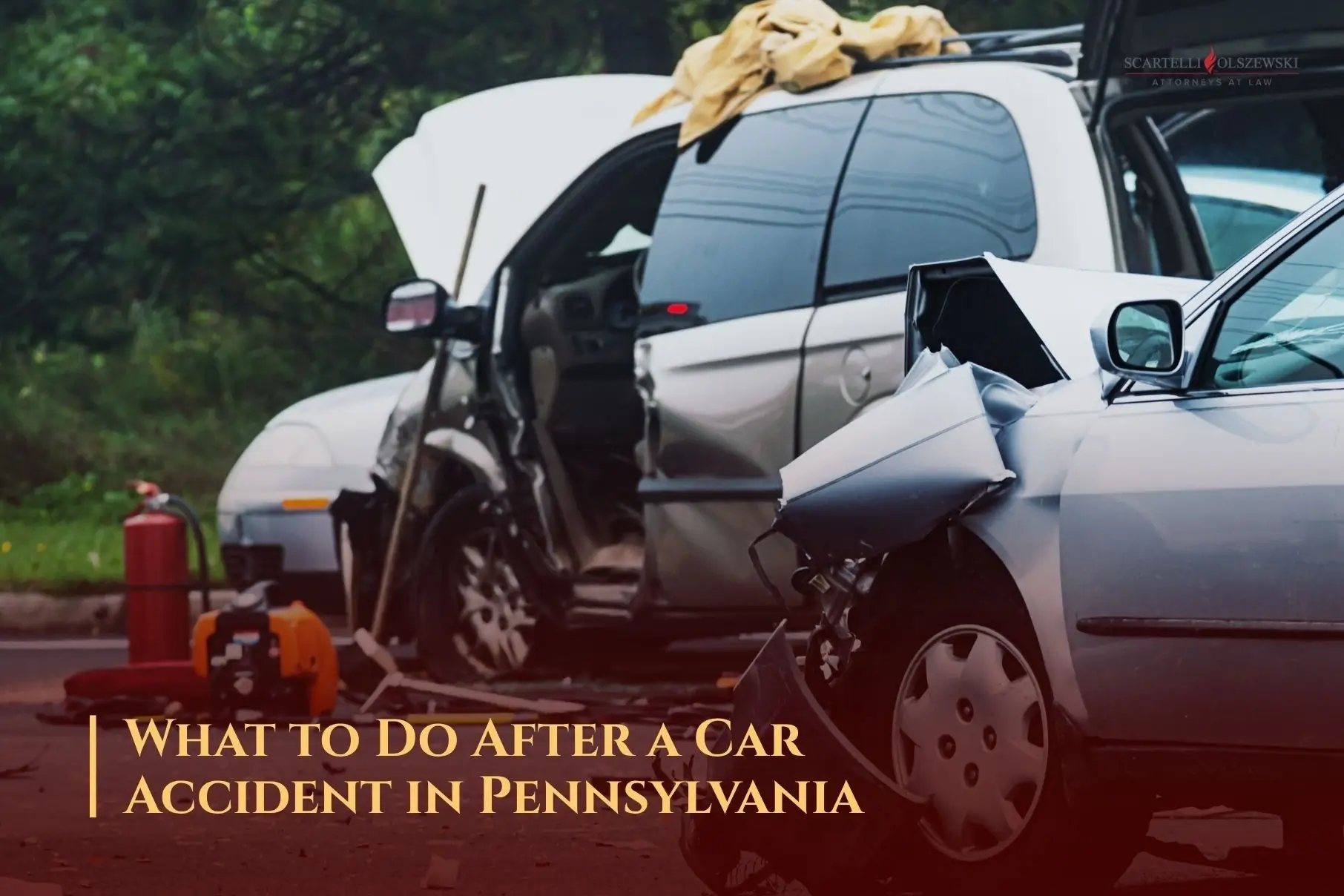
On a Pennsylvania road, a crash can create injuries you don’t yet feel, insurance calls you aren’t prepared for, and decisions that define your recovery for years. The other driver’s insurer has likely already assigned a claims adjuster to your case. That call often comes the same day.
Most people answer it. What you said or signed at the scene, whether you sought medical care in the first 24 hours, and what you say to that adjuster will carry more weight in your case than almost anything that follows. Scartelli Olszewski, P.C. has represented car accident victims across Northeastern Pennsylvania for over two decades. Our Pennsylvania car accident lawyers have seen which early decisions protect a case and which ones cost clients compensation they could not recover. Start at Step 1.
Key Takeaways: Immediate Action Checklist
Check yourself and your passengers for injuries. If your vehicle is drivable, move it as far as possible from the travel lanes and turn on your hazard lights.
If your vehicle cannot move, do not attempt to exit into live traffic. Stay inside with your seatbelt fastened until emergency personnel arrive. If you must exit, move completely off the road behind a guardrail or barrier.
Call 911 for any crash involving injury, possible injury, or a vehicle that cannot be driven. Under Pennsylvania law, you are required to report a crash when it results in injury, death, or damage severe enough to require towing. If no officer investigates and the crash involved injury or a towed vehicle, you must file a Driver’s Accident Report (Form AA-600) with PennDOT within five days under 75 Pa. C.S. § 3747.
Do not apologize or make any statement suggesting the accident was your fault. A comment like “I did not see you” can be used against you later.
When officers arrive, cooperate and give a factual account of what happened. Describe your position, direction of travel, and what you observed without speculating on fault or estimating speeds.
Ask the responding officer for the crash report number before you leave. This number allows you or your attorney to request the official report afterward. We explain exactly how to secure a police report in Scranton, including which office to contact and what the report should contain.
The police report documents the crash scene, records each driver’s statement, identifies potential witnesses, and in many cases assigns preliminary fault. Insurance companies rely on it heavily when evaluating claims, and your attorney will need it if litigation becomes necessary. If no report is filed, insurers may argue the crash was too minor to have caused real injury.
While waiting for police or after they have cleared the scene, collect the following from every driver involved:
| Category | What to Collect |
|---|---|
| Driver details | Full name, phone number, and home address |
| License information | Driver’s license number and state |
| Vehicle details | Make, model, color, and year |
| Insurance details | Insurance company name and policy number |
| Witness contacts | Full name and phone number |
Do not discuss the accident beyond exchanging this information. Avoid admitting fault, accepting blame, or suggesting shared responsibility. Fault is a legal determination, not something to negotiate at the roadside.
Witnesses are especially important. Memories fade quickly, and people leave the scene. If anyone saw the crash, get their contact information before they go. Witness accounts often become the deciding factor when drivers offer conflicting versions of events.
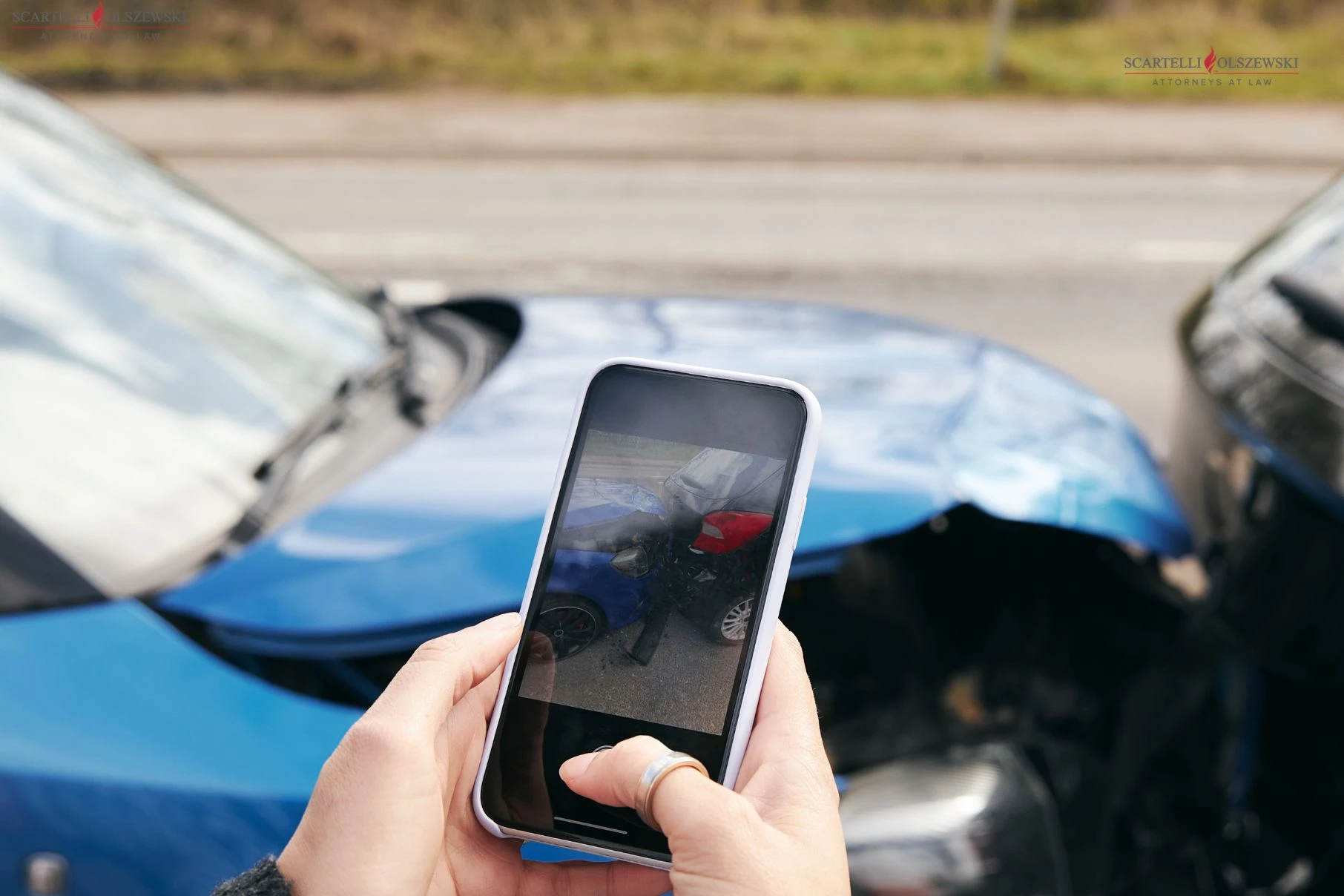
Use your phone to photograph and video the scene while conditions still reflect the crash. Focus on: damage to all vehicles from multiple angles, license plates, skid marks and road debris, relevant traffic signs and signals, weather and road surface conditions, and any visible injuries. Note the exact time, date, and location in writing.
Look for surveillance cameras on nearby businesses, traffic signals, or parking structures. Surveillance recordings can be overwritten within days on some systems, depending on the equipment and settings. If you believe a camera may have captured the crash, flag it for your attorney immediately.
Adrenaline released during a crash is a powerful pain suppressant. You may walk away feeling unaffected and develop serious symptoms 24 to 72 hours later. Injuries that commonly go undetected at the scene include whiplash, soft tissue damage to the neck and spine, concussion symptoms that may not present for days, internal bleeding, fractured ribs, and traumatic brain injuries.
Delayed pain after a car crash does not mean your injuries are minor. Seeking care immediately creates a medical record that links your injuries to this specific crash. Without that connection, insurance companies will argue your injuries were pre-existing. Tell your provider that the injuries resulted from a motor vehicle accident. Correct coding from the start prevents billing disputes later.
Pennsylvania operates under a choice no-fault insurance system, which means you report the accident to your own insurer regardless of who was at fault, and your own policy covers your initial medical expenses. Notify your carrier promptly.
When you call, stick to the facts: date, time, location, vehicles involved, and your current treatment status. Do not speculate about fault, estimate damages, or describe your injuries before you know their full extent.
Pennsylvania’s First Party Benefits coverage, known nationally as Personal Injury Protection (PIP), pays for your medical expenses after a crash regardless of which driver was at fault. Your insurer is responsible for these costs up to your policy limits before any third-party claim against the at-fault driver is considered.
Make sure your healthcare providers bill your auto insurer for crash-related treatment, not your health insurance. The coordination of these two coverages is a common source of confusion that can result in unpaid bills or claim disputes.
When you purchased your Pennsylvania auto insurance policy, you chose between Full Tort and Limited Tort coverage. Most people do not remember making this choice.
Full Tort preserves your unrestricted right to sue the at-fault driver for non-economic damages, including pain, suffering, and emotional distress, regardless of injury severity.
Limited Tort restricts that right. Under a Limited Tort election, you can only pursue non-economic damages if your injuries meet Pennsylvania’s serious injury threshold under 75 Pa.C.S. § 1702, defined as death, serious impairment of body function, or permanent serious disfigurement. For injuries that fall below that threshold, your recovery is generally limited to economic losses such as medical bills and lost wages, unless a separate statutory exception applies.
Pennsylvania law recognizes several exceptions under 75 Pa.C.S. § 1705(d) that restore full recovery rights to limited tort policyholders regardless of injury severity. The most common in NEPA crash cases: the at-fault driver was convicted of DUI or accepted ARD, the at-fault vehicle was registered outside Pennsylvania, or the at-fault driver carried no insurance. If any of these apply, pain and suffering recovery is available even under limited tort.
Review your policy declarations page now, before you need it. Our complete guide on full tort or limited tort coverage in Pennsylvania covers both elections in full.
After a crash, the at-fault driver’s insurance company may contact you within hours. Their adjuster’s goal is to close your claim for as little money as possible. The earlier that contact happens, before you understand your injuries or have spoken with an attorney, the better positioned they are to limit your recovery.
Do not give a recorded statement without first consulting an attorney. Adjusters are trained to ask questions that produce answers that undercut your case.
A check for $1,000 or $2,000 may arrive quickly, accompanied by a release of all claims. Once you sign, your claim is closed permanently, regardless of whether your injuries worsen, whether you need surgery, or whether you miss months of work. Read the most common mistakes drivers make after a crash before you respond to the insurer or accept any payment.
Contact an attorney before giving any statements to insurance companies and before accepting any settlement offer. Early involvement gives your attorney the best opportunity to preserve evidence needed in a personal injury claim before it disappears and identify all liable parties.
You do not have to handle this alone. A car accident attorney handles evidence gathering, insurer communications, and medical record coordination.
Pennsylvania law gives injured crash victims two years from the date of the accident to file a personal injury lawsuit under 42 Pa. C.S. § 5524. Once that window closes, the right to sue is permanently forfeited regardless of injury severity.
Most injured drivers are still in treatment when this clock is running. If you are approaching or uncertain about your deadline, contact us immediately. For exceptions involving minors or delayed injury discovery, see our guide on the statute of limitations for personal injury claims in Pennsylvania.
Not every crash requires an attorney, but most injured drivers benefit from at least an initial consultation. If you suffered injuries that required medical treatment, if there is any dispute about fault, or if the other driver’s insurer is contacting you about a settlement, speak with an attorney before making decisions.
Pennsylvania’s modified comparative negligence law (42 Pa. C.S. § 7102) allows recovery when you share fault. Your compensation decreases by your percentage of fault. At 30 percent fault on a $100,000 award, you recover $70,000. Recovery is barred at 51 percent fault or higher.
Avoid any language that minimizes your injuries or implies responsibility, including “I’m fine,” “I did not see them,” “it was partly my fault,” or “I do not think I need to go to the hospital.” Insurance adjusters log these statements and use them to argue that your injuries are minor. Stick to the factual basics of where and when the crash occurred. Do not give a recorded statement or accept any payment from the other driver’s insurer before consulting an attorney.
Pennsylvania car accident settlement values vary based on injury severity, medical costs, lost income, fault percentage, and tort election. Full tort policyholders recover pain and suffering without a threshold. Limited tort policyholders recover it only above the serious injury standard. Every case turns on its specific facts.
Pennsylvania uninsured motorist (UM) coverage pays your damages when the at-fault driver carries no insurance. If the at-fault driver carries insurance but not enough to cover your full damages, your underinsured motorist (UIM) coverage applies. Both UM and UIM are optional under 75 Pa.C.S. § 1731, but all PA insurers are required to offer them. Your First Party Benefits cover your initial medical expenses regardless. Report the crash to the police immediately.
Contact an attorney before giving any statements to insurance companies and before accepting any settlement offer. Early involvement gives your attorney the best opportunity to preserve evidence needed in a personal injury claim before it disappears and identify all liable parties.
You do not have to handle this alone. A car accident attorney handles evidence gathering, insurer communications, and medical record coordination. If you’re navigating Pennsylvania car accident claims, having experienced legal counsel in your corner from the start can make all the difference.
At Scartelli Olszewski, P.C., founding partner Melissa A. Scartelli is a Board Certified Civil Trial Advocate through the National Board of Trial Advocacy, an ABA-accredited certifying organization. Our Scranton car accident lawyer team and Wilkes-Barre car accident lawyer team serve injured clients across Northeastern Pennsylvania on a contingency fee basis, meaning you pay nothing unless we recover compensation for you. Call us at (570) 346-2600 or schedule a free consultation online.
This article is provided for informational purposes only and does not constitute legal advice or create an attorney-client relationship. Attorney Advertising.

Rachel D. Olszewski, an attorney at Scartelli Olszewski, P.C., is a dedicated advocate for clients who have suffered unjust harm. Following the legacy of her esteemed family members, Rachel specializes in personal injury, medical malpractice, and criminal defense. She is actively involved in professional associations and serves on the board of the Luzerne County Bar Association Charitable Foundation. Rachel is admitted to practice in Pennsylvania state courts and the U.S. District Court for the Middle District of Pennsylvania.
Linked In - https://www.linkedin.com/in/olszewskirachel/
I don't think I could have picked a better team to represent my case. My situation was unique and extremely complicated but it was handled with the utmost care and professionalism. The firm's strong and organized representation ultimately brought great results and helped reconcile a tragic event.
- Jeremy S.
Was wrongly accused of a very serious Felony 3 account and hired Peter Paul Olszewski. The entire firm of Scartelli Olszewski worked tirelessly to have the Pike County Assistant District Attorney as well as the District Magistrate Judge Dismiss the charges! Very pleased with the outcome of this Law Firm and recommend this Law Firm.
- Kerry S.Dealing with the attorneys over at Scartelli Olszewski was nothing short of satisfactory. Through the entire 4 year process we had, I was constantly kept updated and cared for. More than doing their job, they truly care for their clients which I felt off the first meeting with Melissa. Both my family and I are forever thankful for them!
- Noah T.If you’ve been injured in an accident or are researching personal injury law, you may have come across the word...
Read MoreKitchen appliances are meant to make everyday life easier. When something goes wrong, though, the results can be serious. Defective...
Read MoreOne day, everything is normal. Your loved one is smiling, laughing, and going about their life, but then something terrible...
Read MoreAfter an accident, who you hire matters. We've spent years fighting for families just like yours – and we're ready to fight for you.

Wilkes Barre Office (Appointment Only)
Scartelli Olszewski, P.C.
7 Public Square
Wilkes-Barre, PA 18701