

$
Jury Verdict
$ 10 Million
Medical Malpractice
Luzerne County

Hiring a car accident lawyer in Pennsylvania is one of the most consequential decisions you will make after a crash. The state’s choice-no-fault insurance system, modified comparative fault rules, and insurance defense tactics create a legal environment that can work against unrepresented victims.
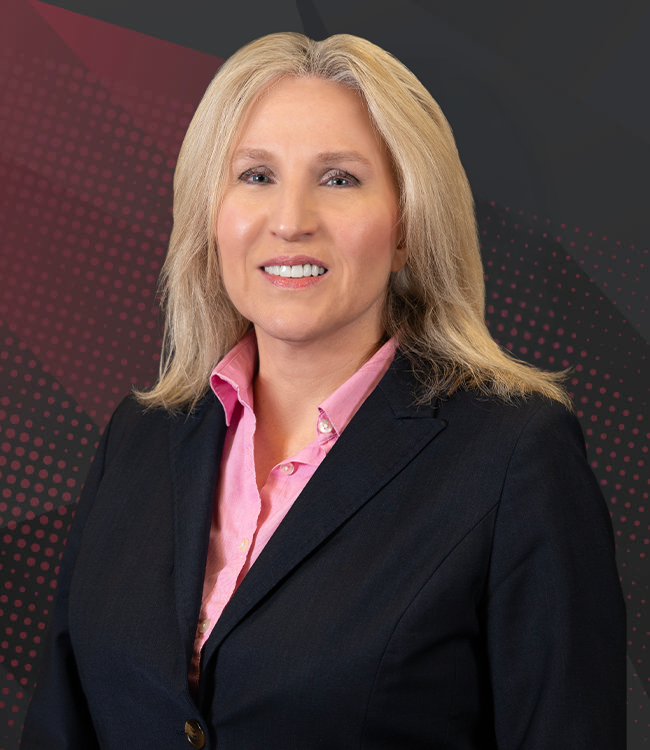
Melissa Scartelli, Board-Certified Civil Trial Advocate and founder of Scartelli Olszewski, P.C., has represented car accident victims across Northeastern Pennsylvania for more than three decades. If you have been in an accident in Scranton, Wilkes-Barre, or anywhere in NEPA, call (570) 346-2600 for a free, confidential case strategy session with a Pennsylvania car accident lawyer.
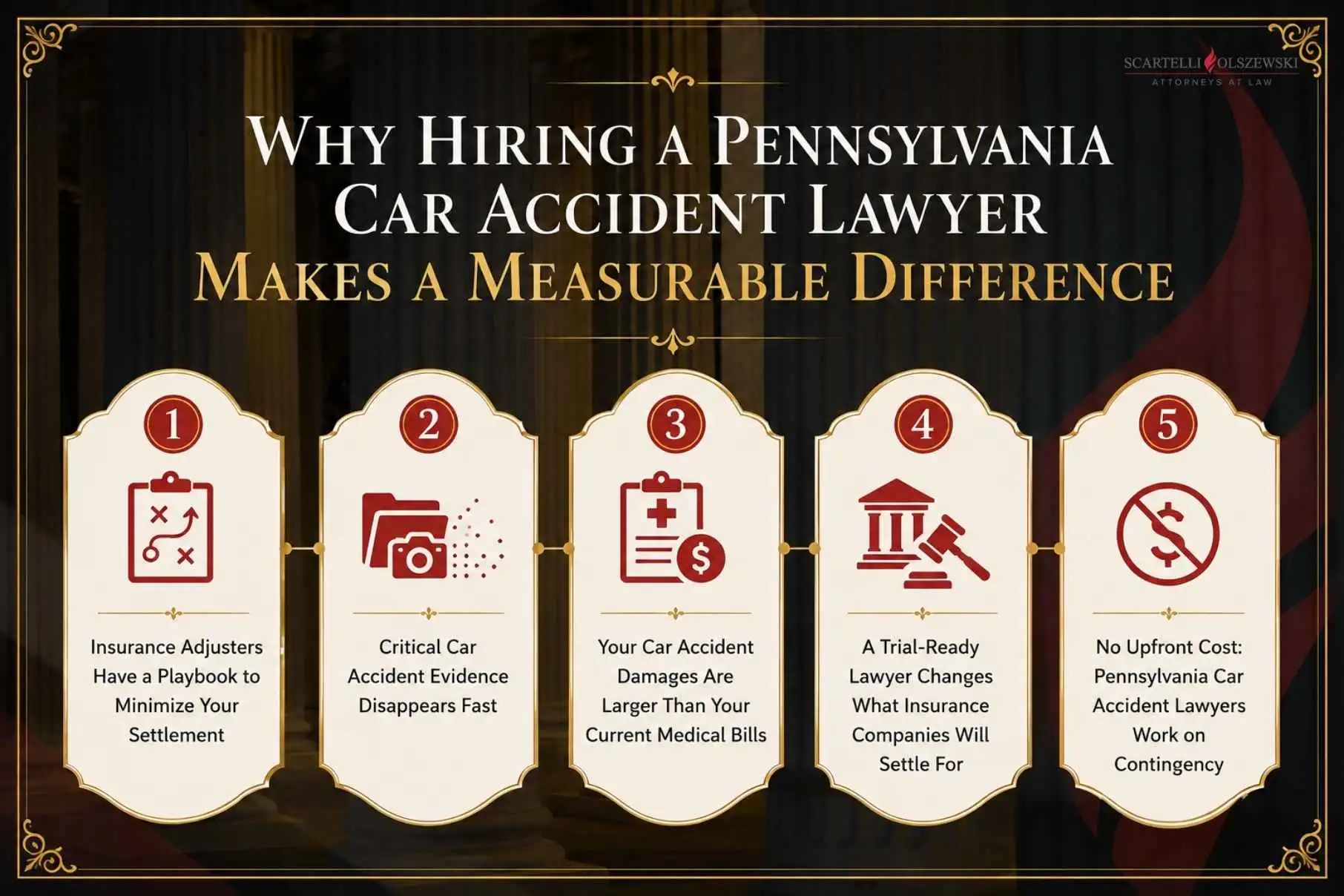
Pennsylvania’s car accident system does not treat represented and unrepresented claimants the same. Insurance companies factor in opposing counsel’s reputation and trial record when calculating their settlement exposure. The five sections below explain where those decisions are made and what changes when a lawyer is present.
Insurance companies assign adjusters to your claim within hours of an accident. Their job is to close your claim for as little as possible, not to help you recover. The playbook is well-established: contact you before you understand the extent of your injuries, request a recorded statement while you are still in shock, and offer a fast settlement that sounds reasonable until your medical bills start arriving. Understanding how insurance companies avoid paying claims helps you recognize these tactics before they drive down your settlement.
Pennsylvania law does not prevent an insurance company from contacting you directly until you have legal representation. The moment our attorneys send a representation letter, that access ends. Every communication goes through us. Every statement, every document request, every settlement offer is reviewed before it reaches you.
Beyond cutting off direct contact, we identify the tactics being used in your specific claim: fault-shifting arguments designed to push your percentage of responsibility above 50%, delays intended to pressure you into accepting less, and early settlement offers designed to close your claim before your injuries are fully documented.
Traffic camera footage on I-81, I-476, Route 6, and Route 11 through Lackawanna and Luzerne Counties can be overwritten in as little as 24 to 72 hours on some systems. Black box data, formally called event data recorder (EDR) data, can be overwritten or lost if the at-fault vehicle is repaired or sold before it is preserved. Witnesses scatter. Physical evidence at the scene is cleared. Police reports contain errors that go uncorrected.
We move immediately after you call. Preservation letters go to businesses with surveillance cameras along NEPA crash corridors. Subpoenas are issued for dashcam and traffic footage before overwrite windows close. EDR data is recovered and analyzed by our experts. Accident reconstruction specialists are engaged when liability is disputed. By the time many unrepresented victims think about gathering evidence, that evidence is gone.
Most car accident victims think about their damages in terms of the bills in front of them: the emergency room charge, the MRI, the week of missed work. Those figures represent a fraction of what your claim is actually worth.
A full damages calculation includes current and projected future medical costs, physical therapy and rehabilitation, lost earning capacity if your injuries affect your ability to work long-term, and out-of-pocket expenses including transportation to medical appointments and property damage. Non-economic damages form the second category: pain and suffering, emotional distress, and loss of enjoyment of life. Whether non-economic damages are recoverable at all depends on your tort election under Pennsylvania law. Our guide on types of personal injury damages in Pennsylvania explains how each category is calculated and valued.
We calculate the full value of your claim before any settlement conversation begins. Accepting an early offer before maximum medical improvement has been reached permanently closes your right to seek additional compensation. That decision cannot be undone.
Insurance companies evaluate opposing counsel. When a firm with a documented trial record represents a claimant, the settlement calculus changes. An insurer weighing a $200,000 offer against the risk of a $600,000 verdict makes different decisions than one facing an attorney they know will not go to court.
Melissa Scartelli is a Board-Certified Civil Trial Advocate certified by the National Board of Trial Advocacy, a distinction held by only a small percentage of trial lawyers nationwide. She has been selected to Pennsylvania Super Lawyers for 17 consecutive years, including Top 50: Women Pennsylvania Super Lawyers in 2024 and 2025. Our firm has secured a $6.5 million settlement in an auto accident case and a $1 million car accident settlement for a 77-year-old car accident victim. That record is not background information. It is leverage. When our name is on the demand letter, insurance companies negotiate differently.
We handle Pennsylvania car accident cases on a contingency fee basis. You pay nothing unless we recover compensation for you. There are no upfront legal fees, no retainer, and no hourly charges. The consultation is free.
Some people hesitate to call an attorney because they worry the fee will outweigh the benefit. The question is not whether you can afford a lawyer. It is whether you can afford to handle this without one.
Each situation below involves specific Pennsylvania legal rules that carry concrete consequences for claimants without representation.
| Situation | Why It Matters Under Pennsylvania Law |
|---|---|
| Injuries beyond minor bruising | Medical costs, lost wages, and pain and suffering require accurate valuation before any settlement is reached. |
| Blame is shifted to you or fault is disputed by the other driver or insurer | Pennsylvania’s 51% comparative negligence bar means a shifted fault percentage can eliminate your recovery entirely. |
| You have limited tort coverage | You must meet the statutory “serious injury” threshold to recover pain and suffering. This requires both legal analysis and medical documentation. |
| The other driver was uninsured or underinsured | UM/UIM claims run against your own insurer, who has the same financial incentive to minimize your payout. |
| The insurer is delaying, denying, or pressuring you | Delay tactics are designed to wear you down before you understand the full value of your claim. |
| A commercial vehicle was involved | Commercial claims involve multiple insurers, federal regulations (FMCSA), and corporate legal teams that move immediately after an accident. |
| A government vehicle caused the crash | Pennsylvania’s government immunity statutes require formal written notice within six months of the accident, not two years. |
| A family member was killed in the crash | Wrongful death claims in Pennsylvania carry specific procedural requirements, damage categories, and eligible claimant rules. |
Three Pennsylvania statutes directly determine how much you can recover and whether you can recover at all.
When you purchased your Pennsylvania auto insurance policy, you made an election that most people do not remember making: you chose either full tort or limited tort coverage under 75 Pa.C.S. §§ 1702 and 1705. That choice controls what you can recover after an accident.
Full tort preserves your unrestricted right to sue the at-fault driver for all damages, including pain and suffering, regardless of injury severity.
Limited tort sharply restricts your right to sue for non-economic damages. Unless your injuries meet Pennsylvania’s statutory definition of “serious injury” (defined under 75 Pa.C.S. § 1702 as death, serious impairment of body function, or permanent serious disfigurement), you generally cannot recover pain and suffering. Many people who selected limited tort do not know it until after an accident, when the insurance company cites it to deny their non-economic damage claim.
Several statutory exceptions can override a limited tort election regardless of injury severity. These include accidents caused by a driver who is convicted of DUI or who accepts Accelerated Rehabilitative Disposition (ARD) in connection with the crash, crashes involving vehicles registered out of state, injuries sustained as a pedestrian or cyclist, and accidents where the at-fault driver had no insurance coverage.
To find out which election you have, check the declarations page of your auto insurance policy and look for the tort option section. If you are not sure, call your insurance agent or call us.
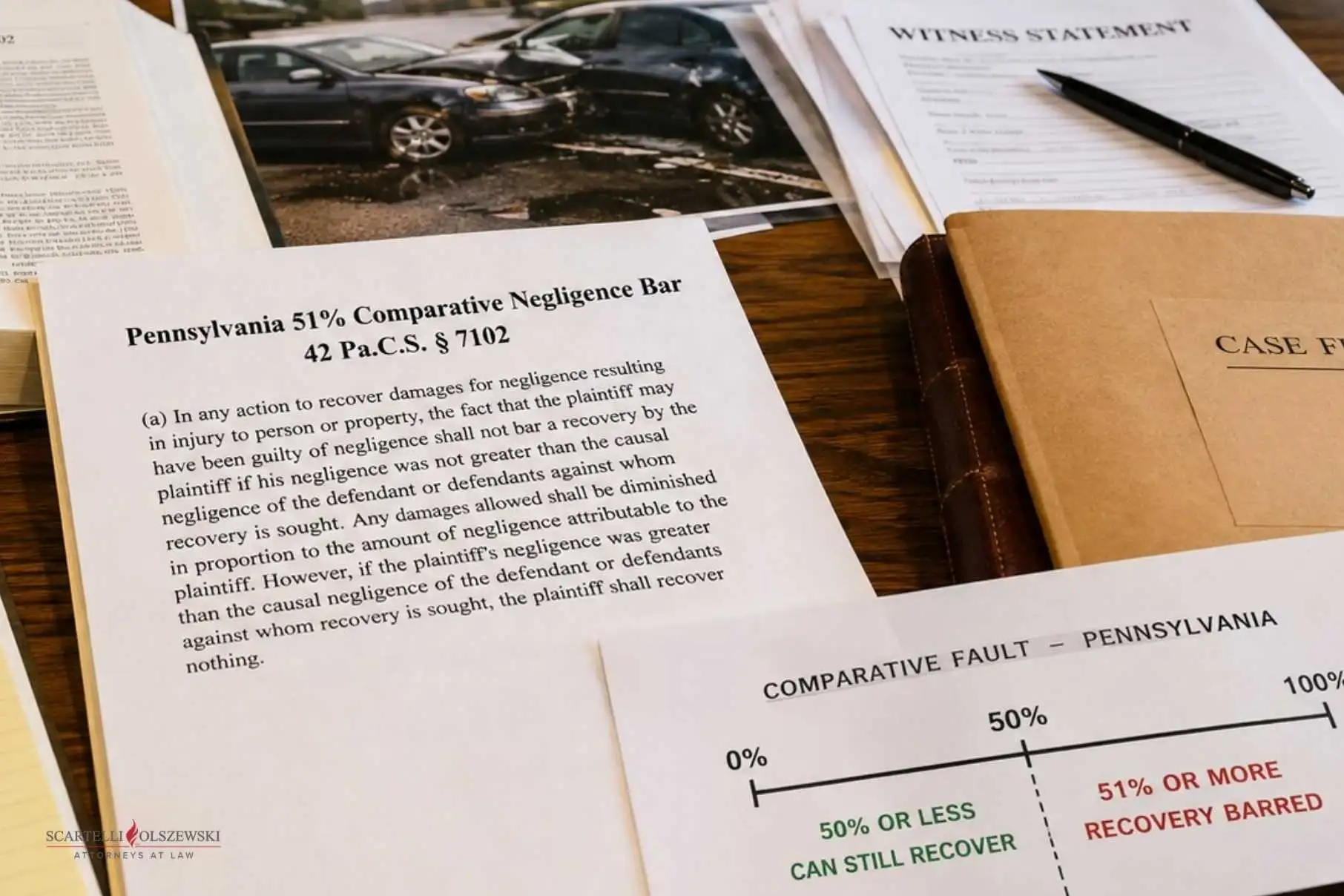
Pennsylvania follows a modified comparative negligence rule under 42 Pa.C.S. § 7102. If you are found 50% or less at fault, your recovery is reduced by your percentage of fault. If you are found 51% or more at fault, you recover nothing.
Insurance adjusters use this rule deliberately. A recorded statement in which you mention you were momentarily distracted, a police report with an error they choose not to correct: each of these is a tool for pushing your fault percentage higher. We gather evidence that establishes the other driver’s liability and minimizes your share: traffic and surveillance camera footage, EDR data, accident reconstruction, and witness statements taken before memories fade.
Under 42 Pa.C.S. § 5524, you have two years from the date of your accident to file a personal injury lawsuit in Pennsylvania. Miss this deadline by a single day and your right to seek compensation is permanently extinguished. The insurance company is not obligated to remind you.
Three exceptions apply.
Do not wait to see if your injuries resolve before calling an attorney. Contact us for a free case review. Our car accident attorney will calculate your exact filing deadline, including any government-notice window that applies to your case, before evidence disappears and witnesses forget what they saw.
Pennsylvania car accident settlements vary by case. Settlement value depends on case-specific factors, such as injury severity, tort election, fault percentage, the at-fault driver’s policy limits, and projected future medical costs. Soft tissue injuries with full recovery settle in the low thousands. Permanent disability and brain injury cases reach hundreds of thousands.
A good settlement offer covers all documented medical expenses, accounts for projected future treatment costs, compensates all lost wages, and arrives after maximum medical improvement. A first offer arriving within days of the crash never meets these criteria. Signing a release closes the claim permanently.
It depends on whether anyone was injured, not on how the accident appeared at the scene. A crash that appears minor can still produce whiplash, soft tissue injuries, or concussion symptoms 24 to 72 hours after impact. Any injury changes the claim entirely. The consultation is free and takes minutes.
A recorded statement does not end your claim. Contact a car accident lawyer immediately. An attorney reviews the statement, identifies damaging language, and builds counter-evidence. The insurer’s goal was to close the claim early. Legal representation stops additional statements from being recorded and limits the damage.
Pennsylvania car accident cases take 6 to 12 months for soft tissue injuries with clear liability. Cases involving surgery, permanent impairment, or disputed liability resolve in 18 months to 3 years. Two factors extend timelines unnecessarily: waiting to retain an attorney and accepting a settlement before injuries are fully documented.
If you were injured in a car accident in Pennsylvania, the decisions you make in the first days after the crash affect every dollar you recover. Our legal team represents car accident victims in Scranton, and Wilkes-Barre. Call our Scranton office at (570) 346-2600 or our Wilkes-Barre office at (570) 822-1400. We are available 24 hours a day, seven days a week. There is no fee unless we recover compensation for you.
“Small Enough to Care, Large Enough to Win.”

Peter Paul Olszewski, Jr., a shareholder and managing partner at Scartelli Olszewski, P.C., brings 37 years of litigation experience. He is a renowned trial lawyer in Pennsylvania, specializing in medical malpractice, personal injury, and criminal defense. Peter's notable achievements include securing multi-million-dollar verdicts and serving as District Attorney and Judge. He is committed to community involvement and is actively engaged in various legal associations.
Linked In - https://www.linkedin.com/in/peter-paul-olszewski-jr-11115b1a/
I don't think I could have picked a better team to represent my case. My situation was unique and extremely complicated but it was handled with the utmost care and professionalism. The firm's strong and organized representation ultimately brought great results and helped reconcile a tragic event.
- Jeremy S.
Was wrongly accused of a very serious Felony 3 account and hired Peter Paul Olszewski. The entire firm of Scartelli Olszewski worked tirelessly to have the Pike County Assistant District Attorney as well as the District Magistrate Judge Dismiss the charges! Very pleased with the outcome of this Law Firm and recommend this Law Firm.
- Kerry S.Dealing with the attorneys over at Scartelli Olszewski was nothing short of satisfactory. Through the entire 4 year process we had, I was constantly kept updated and cared for. More than doing their job, they truly care for their clients which I felt off the first meeting with Melissa. Both my family and I are forever thankful for them!
- Noah T.A snowplow clips your car on a Scranton side street. A police cruiser runs a red light in Wilkes-Barre and...
Read MoreRiding in someone else's car when it crashes leaves you hurt, confused, and often afraid to ask the one question...
Read MoreYour car accident case is worth your economic damages plus pain and suffering, filtered through three Pennsylvania rules: the 51%...
Read MoreAfter an accident, who you hire matters. We've spent years fighting for families just like yours – and we're ready to fight for you.

Wilkes Barre Office (Appointment Only)
Scartelli Olszewski, P.C.
7 Public Square
Wilkes-Barre, PA 18701