


$
Jury Verdict
$ 10 Million
Medical Malpractice
Luzerne County

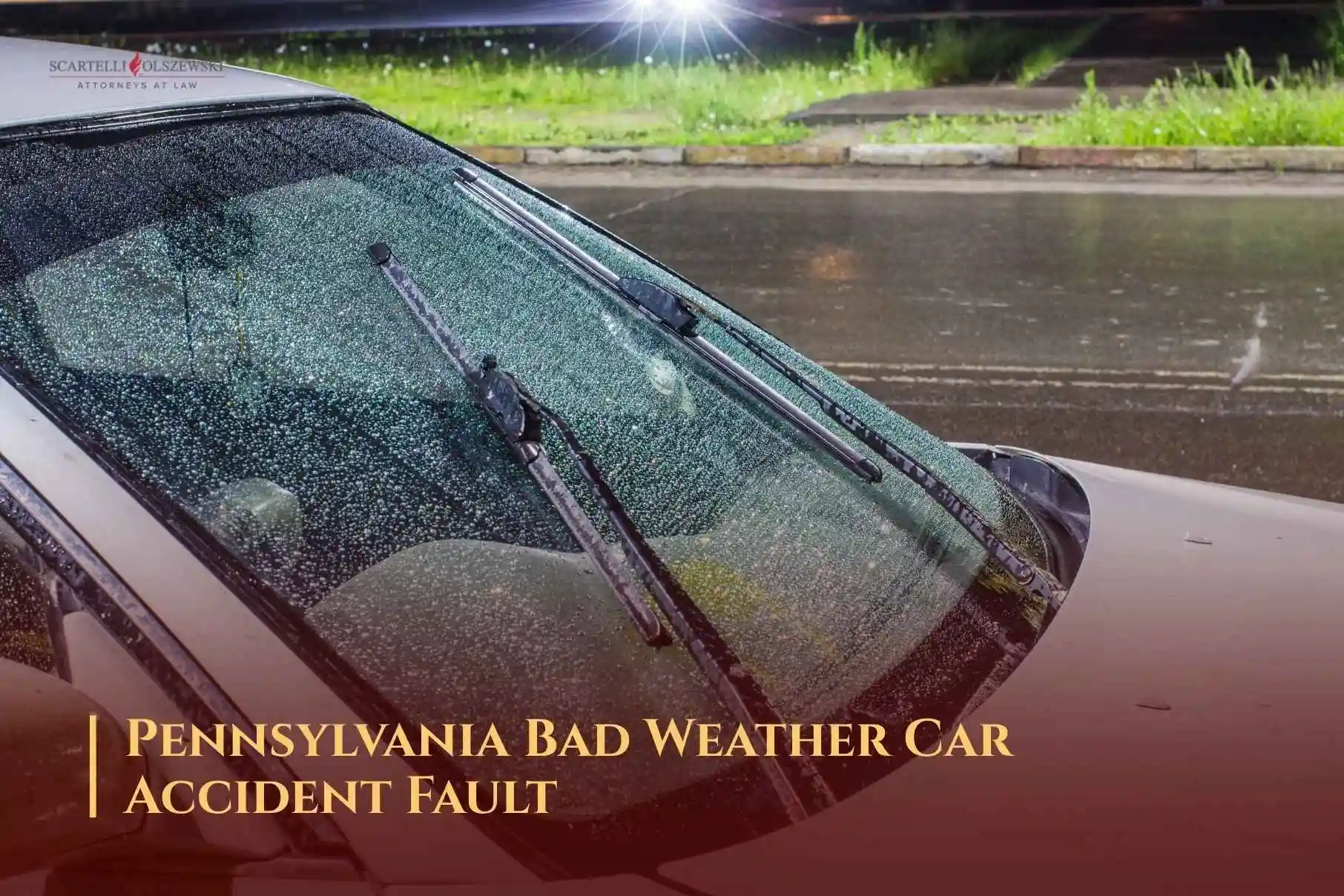
You have probably already heard the other driver’s excuse after a bad weather car accident: the weather was bad, so the crash was unavoidable. Whether they claim black ice, hydroplaning, or blinding fog, this excuse rarely holds up in court.
In Pennsylvania, poor weather conditions do not excuse poor driving. It raises the standard of care. Proving fault comes down to showing the other driver failed to drive reasonably for the conditions that existed. The question is never whether the road was slick or visibility was poor, but whether the driver slowed down, maintained a safe following distance, and kept control of their vehicle.
Drivers on I-81 through Scranton, Route 6 across the Pocono Plateau, and Route 11/15 through the Wyoming Valley must adapt to these hazards year-round. The storm does not dictate safety; the driver’s actions do.
Here is how a Pennsylvania car accident lawyer proves liability and what you must do before critical evidence washes or melts away.
Pennsylvania law requires every driver to reduce speed and exercise caution when weather degrades road conditions. Under Pennsylvania’s safe speed statute (75 Pa.C.S. § 3361), drivers must travel at a speed that is reasonable and prudent for the conditions actually present and must be able to stop within the distance they can clearly see ahead, known as the assured clear distance ahead rule.
This means the posted speed limit is not a defense in a Pennsylvania weather crash. A driver doing 65 mph on I-81 during freezing rain can still violate § 3361 because the posted limit sets a maximum for ideal conditions rather than a safe speed for every condition.
Proving fault still requires the four elements of any negligence claim: duty, breach, causation, and damages. Bad weather is the setting in which those elements are proven. The at-fault driver’s response to the weather is the breach.
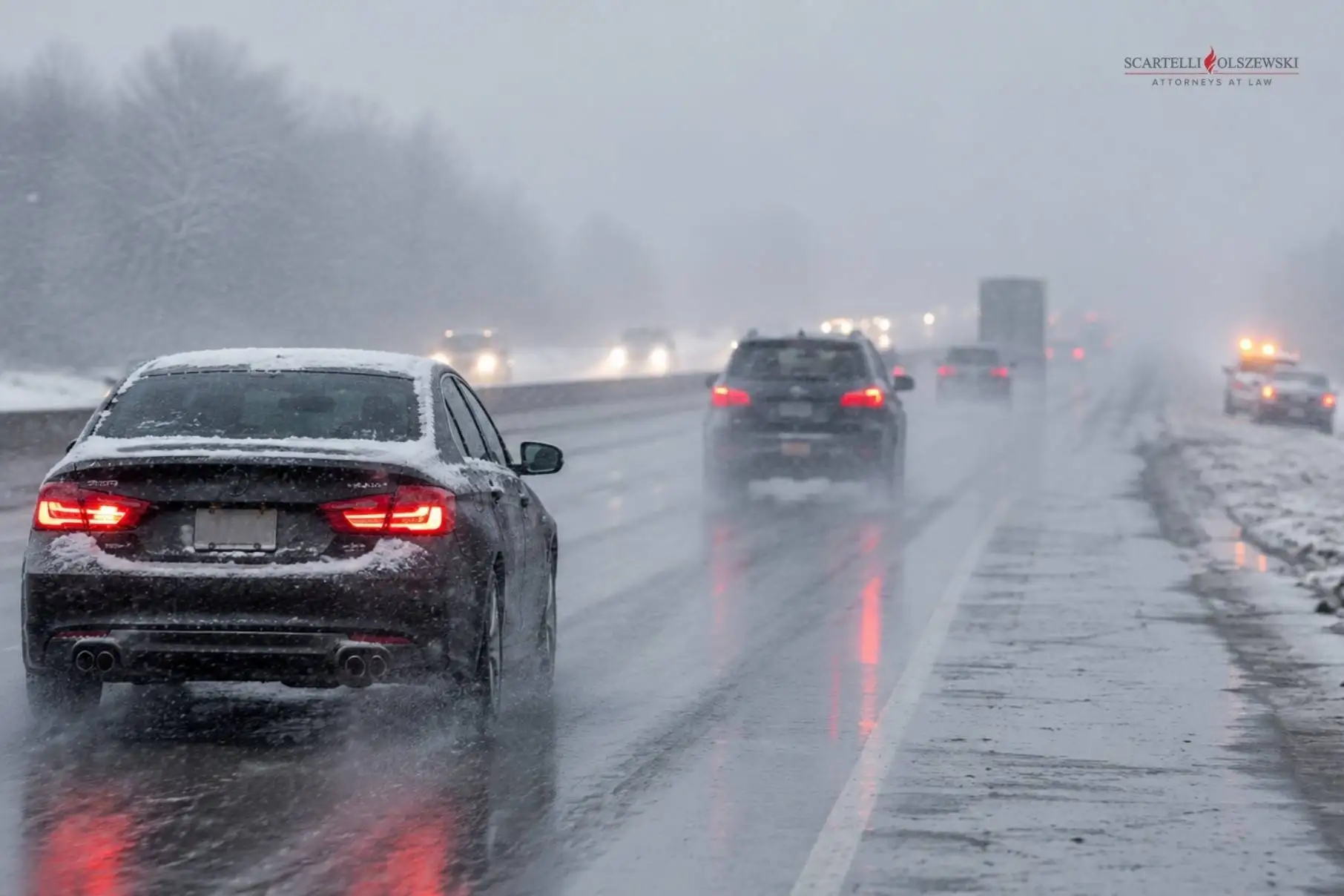
The type of collision determines which driver behaviors get examined and which evidence carries the most weight.
Negligence in a bad weather crash is not a judgment call. It is a set of specific, documentable failures that each represent a breach of the duty of care.
Our car accident attorneys in Pennsylvania examine each of these behaviors when evaluating fault in a weather-related crash claim.
Proving fault in a weather crash requires specific, time-sensitive evidence that must be preserved before it is gone. In most cases, you have 24 to 72 hours.
For a full breakdown of what documentation supports a personal injury claim in PA, see our page covering the evidence needed to file an injury claim in Pennsylvania.
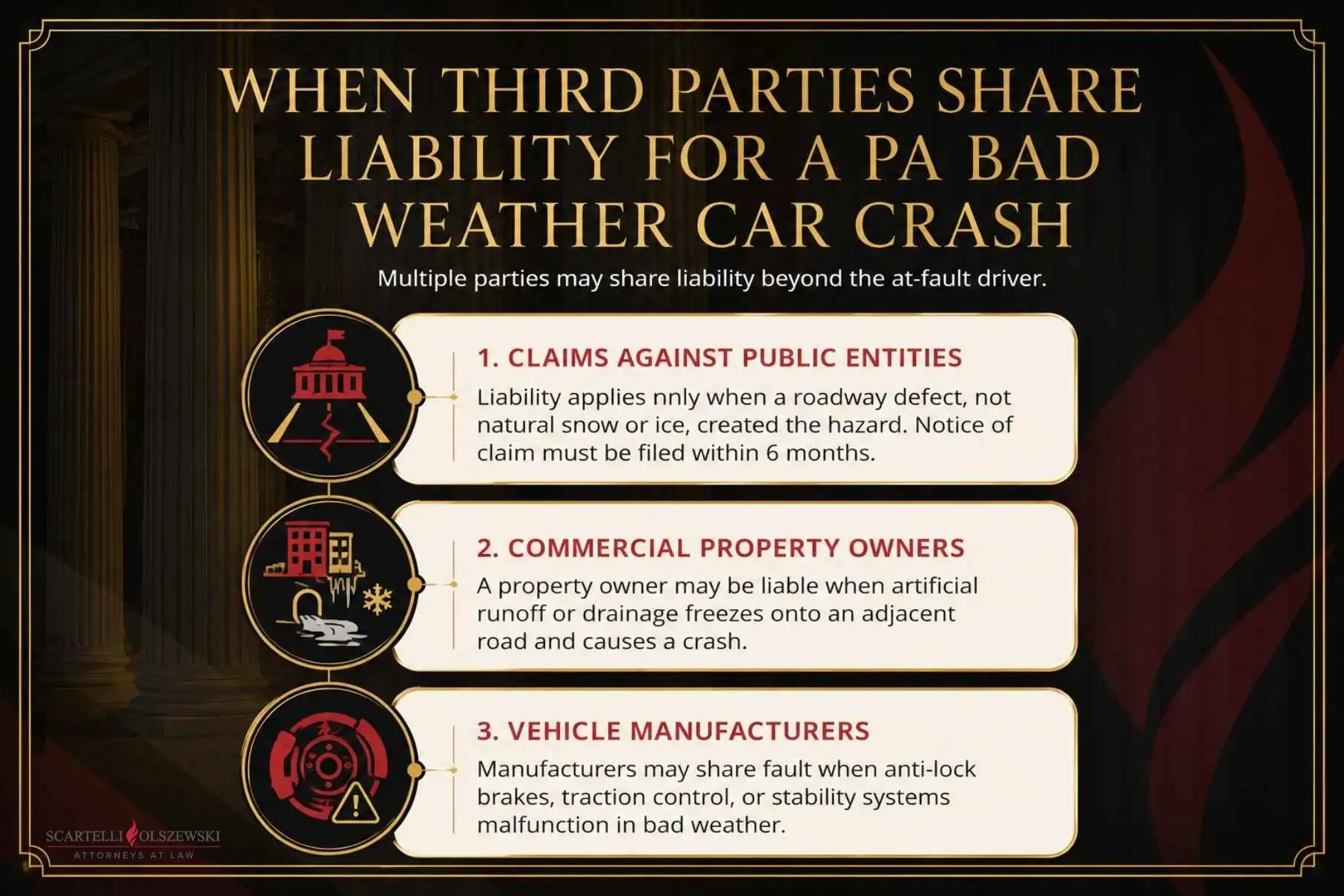
Not every bad weather-related car accident claim is a two-party dispute. PennDOT, local municipalities, commercial property owners, and vehicle manufacturers can each bear independent liability alongside the negligent driver.
These layered questions affect how weather conditions impact a car accident lawsuit and the total compensation available across all responsible parties.
After a bad weather car crash, the at-fault driver’s insurance adjuster will claim the storm caused the crash, not their insured. Because an insurer cannot be sued for an “act of God,” they use weather conditions as a tool to shift comparative fault onto you under 42 Pa.C.S. § 7102.
By arguing that poor visibility, heavy rain, or black ice made the vehicle collision unavoidable, the insurance company attempts to increase your fault percentage. Under Pennsylvania comparative negligence laws, every percentage point of fault they assign to you directly reduces your financial compensation.
Adjusters frequently manipulate recorded statements about your speed, visibility, and braking distance to build this comparative fault defense. Never give a recorded statement or accept a quick settlement offer from an insurance company before consulting a Pennsylvania car accident lawyer.
Knowing what not to do after a car crash in Pennsylvania matters just as much, since statements made in the first hours are the most damaging evidence insurers ever collect.
Not automatically. Fault depends on whether you adapted your driving to existing hazards. If you reduced speed, maintained a safe following distance, used headlights, and maintained properly functioning tires, liability rests with the negligent driver who failed to adjust.
Under 75 Pa.C.S. § 3746, you must notify police immediately if a car accident causes injury, death, or vehicle damage severe enough that the car cannot be safely driven under its own power. Report the crash regardless of weather conditions, as the official police report provides a critical timestamp of the road hazards, visibility, and weather at the exact moment of the accident.
Yes, Pennsylvania is a choice no-fault state. Your Personal Injury Protection (PIP) coverage pays initial medical bills regardless of fault, but your right to sue the negligent driver for pain and suffering depends on your Full Tort or Limited Tort policy election.
Under 42 Pa.C.S. § 5524, Pennsylvania has a two-year statute of limitations for personal injury claims. However, under 42 Pa.C.S. § 5522(a), claims against government entities like PennDOT require a formal notice within six months.
If you were injured in a bad weather crash in Scranton, Wilkes-Barre, or anywhere in Northeastern Pennsylvania, the other driver’s insurer has already opened a file on you.
Melissa Scartelli is a Board Certified Civil Trial Advocate through the National Board of Trial Advocacy. Our firm, Scartelli Olszewski, P.C., has represented injured people across NEPA for more than two decades, and we know how PennDOT records are obtained and how black box data is preserved before it disappears.
“Small Enough to Care, Large Enough to Win”
Your initial consultation is free. Call our Scranton office at (570) 346-2600 or our Wilkes-Barre office at (570) 822-1400. There is no fee unless we recover compensation for you.

Rachel D. Olszewski, an attorney at Scartelli Olszewski, P.C., is a dedicated advocate for clients who have suffered unjust harm. Following the legacy of her esteemed family members, Rachel specializes in personal injury, medical malpractice, and criminal defense. She is actively involved in professional associations and serves on the board of the Luzerne County Bar Association Charitable Foundation. Rachel is admitted to practice in Pennsylvania state courts and the U.S. District Court for the Middle District of Pennsylvania.
Linked In - https://www.linkedin.com/in/olszewskirachel/
I don't think I could have picked a better team to represent my case. My situation was unique and extremely complicated but it was handled with the utmost care and professionalism. The firm's strong and organized representation ultimately brought great results and helped reconcile a tragic event.
- Jeremy S.
Was wrongly accused of a very serious Felony 3 account and hired Peter Paul Olszewski. The entire firm of Scartelli Olszewski worked tirelessly to have the Pike County Assistant District Attorney as well as the District Magistrate Judge Dismiss the charges! Very pleased with the outcome of this Law Firm and recommend this Law Firm.
- Kerry S.Dealing with the attorneys over at Scartelli Olszewski was nothing short of satisfactory. Through the entire 4 year process we had, I was constantly kept updated and cared for. More than doing their job, they truly care for their clients which I felt off the first meeting with Melissa. Both my family and I are forever thankful for them!
- Noah T.A snowplow clips your car on a Scranton side street. A police cruiser runs a red light in Wilkes-Barre and...
Read MoreRiding in someone else's car when it crashes leaves you hurt, confused, and often afraid to ask the one question...
Read MoreYour car accident case is worth your economic damages plus pain and suffering, filtered through three Pennsylvania rules: the 51%...
Read MoreAfter an accident, who you hire matters. We've spent years fighting for families just like yours – and we're ready to fight for you.

Wilkes Barre Office (Appointment Only)
Scartelli Olszewski, P.C.
7 Public Square
Wilkes-Barre, PA 18701