

$
Jury Verdict
$ 10 Million
Medical Malpractice
Luzerne County
If you drive I-81 past Scranton and Wilkes-Barre, you share the road with 80,000-pound commercial rigs every day, especially where I-81 merges with I-476 near Dupont. In 2025, those trucks were involved in 6,922 crashes across Pennsylvania that killed 133 people, according to PennDOT’s 2025 report. Many of these truck accidents happen because a passenger car sat in a blind spot where the truck driver could not see it.
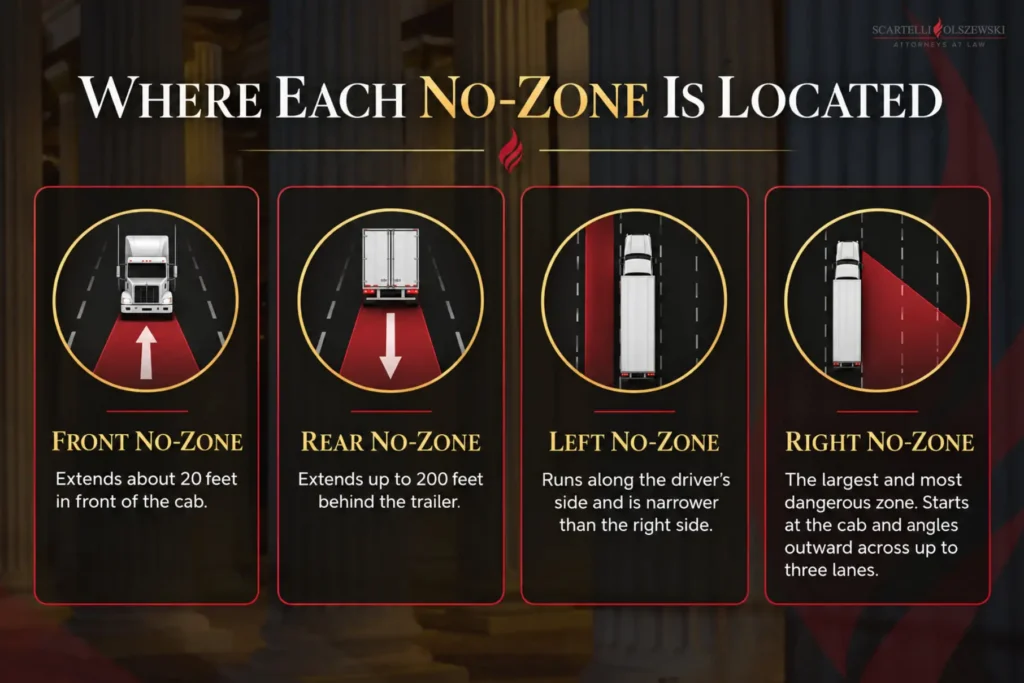
The FMCSA calls these high-risk blind spots “No-Zones,” and every large commercial vehicle has four of them: directly in front of the cab, along the left side, along the right side, and up to 200 feet behind the trailer. A driver caught inside any of these zones stays invisible to the truck driver. Knowing exactly where each No-Zone sits keeps you out of a catastrophic crash.
Data source: PennDOT’s 2025 Crash Facts and Statistics
Key Takeaways
Commercial trucks have four main blind spots where passenger cars completely vanish from a driver’s sightline:
While these zones vary slightly with vehicle size and speed, all four exist on every large truck on the road.
Passing a large truck safely requires limiting the time your car sits inside its No-Zones. To safely share the road with semi-trucks,
A right-turn squeeze happens when a truck swings left before it turns right. The trailer doesn’t track directly behind the cab, so the driver needs that extra room to clear the curb. From behind or beside the truck, the gap that opens on the right looks like room to pass. It isn’t. A car that slides into it gets pinned between the trailer and the curb as the turn finishes. Watch the signal, not the lane position, and wait the whole maneuver out.
A fully loaded truck needs the length of nearly two football fields to come to a full stop at highway speed. This is exactly why following distance matters: FMCSA’s own guidance calls for at least 4 seconds behind a typical tractor-trailer, with one more second added above 40 mph. Cutting in front of a truck and braking removes that room instantly and forces the truck driver into an evasive maneuver at a moment they cannot control.
Winter conditions extend a truck’s stopping distance beyond a dry-road following gap. During severe winter storms, PennDOT’s tiered restriction plan has closed I-81 through Lackawanna County to commercial vehicles. A jackknifed truck on an icy interstate blocks lanes for hours and often needs specialized equipment to clear. Following distance behind a truck should increase substantially on wet, snow-covered, or icy roads, and passing should wait until conditions clear rather than risk a slower stop beside a vehicle that already needs more room to stop than you do.
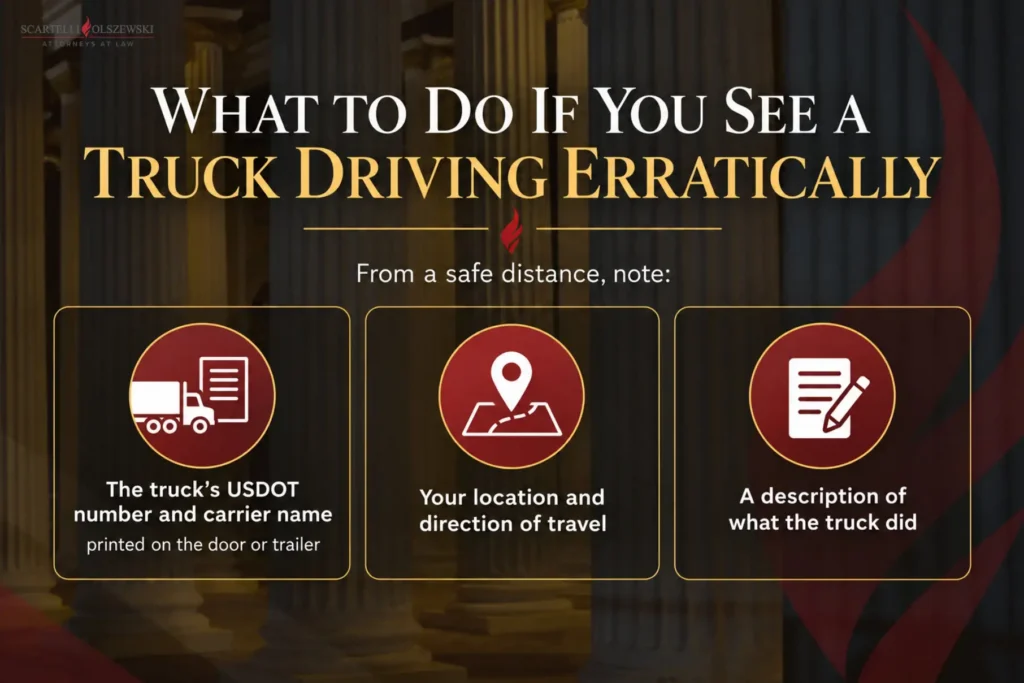
A truck driving erratically in poor conditions isn’t always sliding on ice. Weaving between lanes, drifting onto the shoulder, or following too closely on the highway can point to a driver who is fatigued, distracted, or dealing with a mechanical problem, three of the most common causes of truck accidents. Reporting it starts with distance: fall back out of the truck’s No-Zones before doing anything else.
From a safe distance, note:
File a report with FMCSA’s National Consumer Complaint Database, either online or by calling 1-888-DOT-SAFT. FMCSA uses these reports to decide which carriers to investigate.
No, the truck driver is not always at fault. Fault follows whoever created the hazard. A lane change without a mirror check puts fault on the truck driver. Linger in a known No-Zone, or cut in front of a truck without room to spare, and that fault shifts to the car. Pennsylvania weighs both drivers against the specific facts.
The motor carrier, trailer owner, or maintenance contractor can also be responsible. If the driver works for the carrier, the carrier is liable for the driver’s negligence. Even independent contractor drivers can make the carrier liable under federal rules. A trailer owner or mechanic is responsible for a defect like a broken mirror.
You have two years to file a truck accident claim in Pennsylvania, under 42 Pa.C.S. § 5524. The clock starts on the crash date. Missing that deadline generally forfeits the right to recover, no matter how strong the case is. Certain circumstances can extend it. See our guide on Pennsylvania statutes of limitations for truck accident lawsuits.
A missing blind-spot warning sticker does not affect liability in a crash. These stickers are common on trailers but are not required by federal or Pennsylvania law, and a truck’s No-Zones exist whether or not one is posted. Their absence is not evidence of negligence.
Yes, you can recover damages even if you were partly inside a truck’s blind spot. Pennsylvania’s 51 percent bar rule, codified at 42 Pa.C.S. § 7102, allows recovery as long as your fault does not exceed 50 percent. A driver found 51 percent or more at fault recovers nothing.
Most drivers who follow the safety steps will never need anything past a mirror check and a safe following distance. If a truck crash happens anyway, you’re up against the carrier’s insurer and legal team from day one. You need a truck accident lawyer who has tried and won these cases.
Led by founding attorney Melissa A. Scartelli, Scartelli Olszewski, P.C. has represented injury victims from its Scranton and Wilkes-Barre offices for over two decades, including truck accident claims. Our case results include a $2.2 million settlement in a multi-vehicle commercial truck crash.
“Small Enough to Care, Large Enough to Win”
Call our Scranton office at (570) 346-2600 or our Wilkes-Barre office at (570) 822-1400 to schedule your free consultation. Or, fill out our online contact form.
Prior results do not guarantee a similar outcome. Every case is unique, and the value of any claim depends on its specific facts.

Rachel D. Olszewski, an attorney at Scartelli Olszewski, P.C., is a dedicated advocate for clients who have suffered unjust harm. Following the legacy of her esteemed family members, Rachel specializes in personal injury, medical malpractice, and criminal defense. She is actively involved in professional associations and serves on the board of the Luzerne County Bar Association Charitable Foundation. Rachel is admitted to practice in Pennsylvania state courts and the U.S. District Court for the Middle District of Pennsylvania.
Linked In - https://www.linkedin.com/in/olszewskirachel/
I don't think I could have picked a better team to represent my case. My situation was unique and extremely complicated but it was handled with the utmost care and professionalism. The firm's strong and organized representation ultimately brought great results and helped reconcile a tragic event.
- Jeremy S.
Was wrongly accused of a very serious Felony 3 account and hired Peter Paul Olszewski. The entire firm of Scartelli Olszewski worked tirelessly to have the Pike County Assistant District Attorney as well as the District Magistrate Judge Dismiss the charges! Very pleased with the outcome of this Law Firm and recommend this Law Firm.
- Kerry S.Dealing with the attorneys over at Scartelli Olszewski was nothing short of satisfactory. Through the entire 4 year process we had, I was constantly kept updated and cared for. More than doing their job, they truly care for their clients which I felt off the first meeting with Melissa. Both my family and I are forever thankful for them!
- Noah T.A delivery driver accident feels different from an ordinary fender bender, whether the vehicle belongs to Amazon, UPS, FedEx, Instacart,...
Read MorePeter Paul Olszewski Jr. told Luzerne County Council on August 27, 2026 that Scartelli Olszewski, P.C. would not bill the...
Read MoreIn Pennsylvania, both texting and holding a phone while driving are strictly illegal. Texting while driving has been prohibited since...
Read MoreAfter an accident, who you hire matters. We've spent years fighting for families just like yours – and we're ready to fight for you.

Wilkes Barre Office (Appointment Only)
Scartelli Olszewski, P.C.
7 Public Square
Wilkes-Barre, PA 18701