

$
Jury Verdict
$ 10 Million
Medical Malpractice
Luzerne County
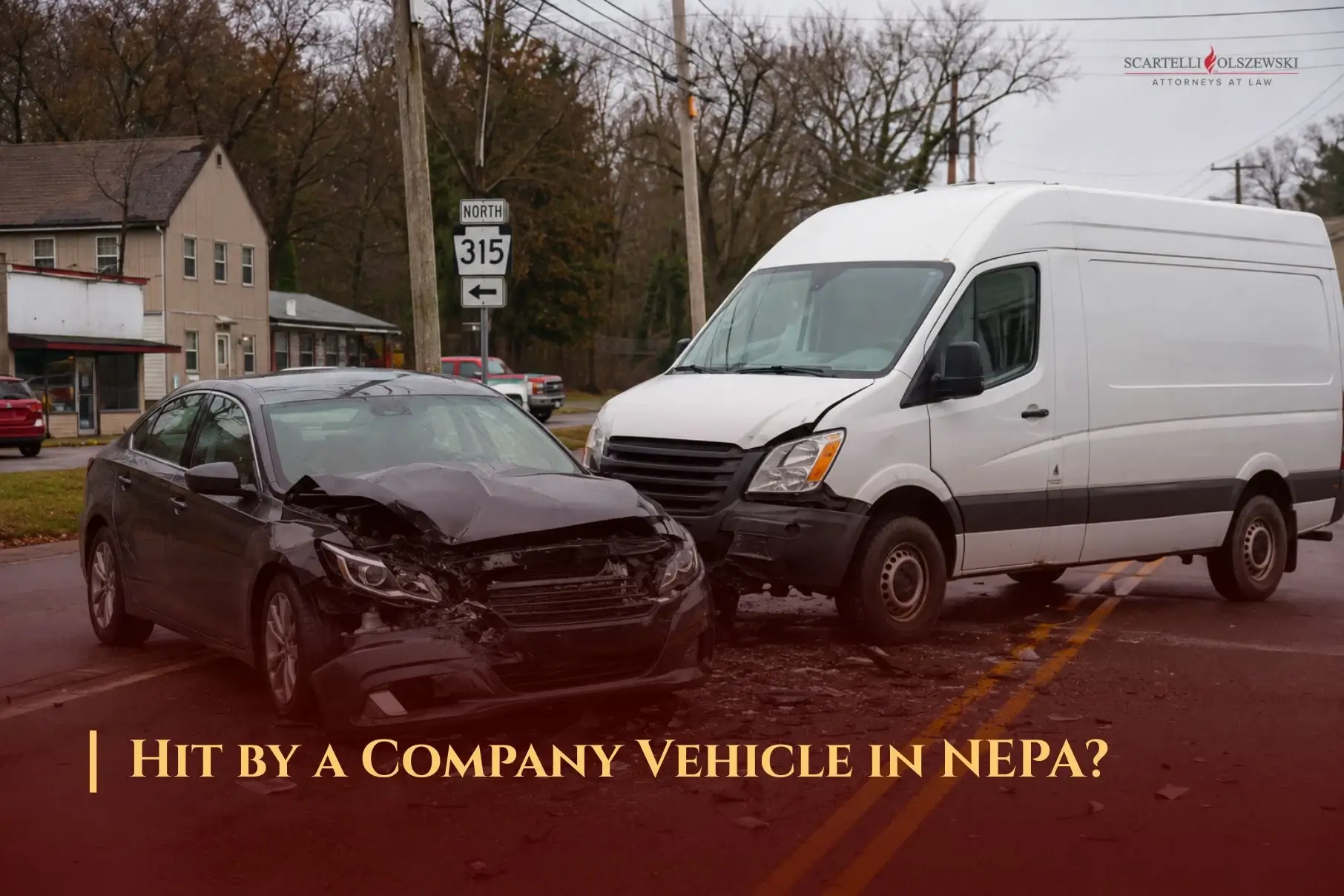
A delivery driver accident feels different from an ordinary fender bender, whether the vehicle belongs to Amazon, UPS, FedEx, Instacart, GrubHub, or a company fleet. There is a business involved, an unfamiliar insurance policy, and a driver at the scene who may not even work for the company whose name appears on the vehicle.
The short answer: liability can fall on the driver, the driver’s employer, or in some cases a third party such as a vehicle manufacturer or a government agency responsible for the road. Which one applies mainly comes down to two facts: whether the driver was working at the moment of the crash, and whether that driver was a direct employee or an independent contractor. Before any of that gets sorted out, Pennsylvania’s own insurance rules already determine who pays your first medical bills, regardless of fault.
Identifying every liable party matters because a single driver’s personal auto policy is rarely enough to cover a serious injury. In Northeastern Pennsylvania, that often means looking past the driver to the delivery company, and sometimes beyond it.
|
Potentially Liable Party |
When They’re Responsible |
|
The Driver |
Always personally liable for careless driving such as speeding, running a light, or texting. If the driver was off duty running a personal errand, their own policy is the primary coverage. |
|
The Employer |
Liable under a legal doctrine called vicarious liability, or respondeat superior, when the driver was acting within the scope of their job, such as an active delivery route. Employer coverage limits are typically far higher than a driver’s personal policy. |
|
A Third Party |
A vehicle or parts manufacturer if a defect, such as faulty brakes, caused or worsened the crash. A government agency if poorly maintained roads or missing signage contributed to it. |
Determining who bears ultimate responsibility requires investigating dispatch logs, employment contracts, and corporate policies, a framework our Pennsylvania car accident lawyers use to hold negligent drivers and their employers accountable.
Pennsylvania is a choice no-fault state. Regardless of who eventually turns out to be at fault, your own auto policy’s Personal Injury Protection, sometimes called first-party medical benefits, pays your initial medical bills up to your policy limit. The state minimum is $5,000, though many drivers carry more. This coverage responds immediately, while the driver’s employment status and the insurance layer described above get sorted out separately, often over weeks or months.
This does not replace a liability claim. It is a short-term bridge that keeps a hospital bill from becoming your problem while your case against the driver, the employer, or both moves forward.
Whether the delivery driver was working at the exact moment of the crash is often the single most contested fact in these cases, because it determines whether the employer’s much larger commercial policy applies.
|
Driver’s Status at Impact |
Coverage That Typically Applies |
|
Actively making a delivery or driving to a pickup |
The employer’s commercial insurance policy, which for large delivery companies is often required to carry $1 million or more in coverage. |
|
Logged into a delivery app, waiting for an assignment |
A reduced, contingent level of coverage some platforms provide: higher than a personal policy but lower than the full commercial policy. |
|
Off the clock, logged out, or running a personal errand |
The driver’s own personal auto policy, with no employer liability. |
Delivery companies frequently dispute which category applies, since it determines whether their higher-limit policy is exposed. This is exactly the kind of factual dispute that GPS data, dispatch records, and delivery app logs can resolve.
UPS package car drivers are direct employees, which means the company can be held vicariously liable for on-duty crashes under respondeat superior. Many app-based platforms, including Amazon Flex, DoorDash, and Uber Eats, classify their drivers as independent contractors, which is one reason those companies are harder to sue directly.
That classification does not end the inquiry. A company can still face direct liability, separate from vicarious liability, if it negligently hired a driver with a poor safety record, failed to train them properly, or knowingly allowed an unsafe vehicle to stay on the road.
Negligent entrustment applies here too. If a company or an individual lent a vehicle to someone they knew, or should have known, was an unsafe driver, that owner can share responsibility regardless of the driver’s employment classification.
Once fault and employment status are established, the applicable insurance layer determines how much is actually available to compensate you.
For the broader Pennsylvania insurance framework behind all of this, including PIP, uninsured motorist coverage, and the full tort versus limited tort election, see our full coverage guide.
Companies typically begin their own internal investigation within days of a crash involving one of their vehicles or drivers, which makes early evidence preservation critical. Our delivery truck crashes post covers the causes behind these collisions in more detail.
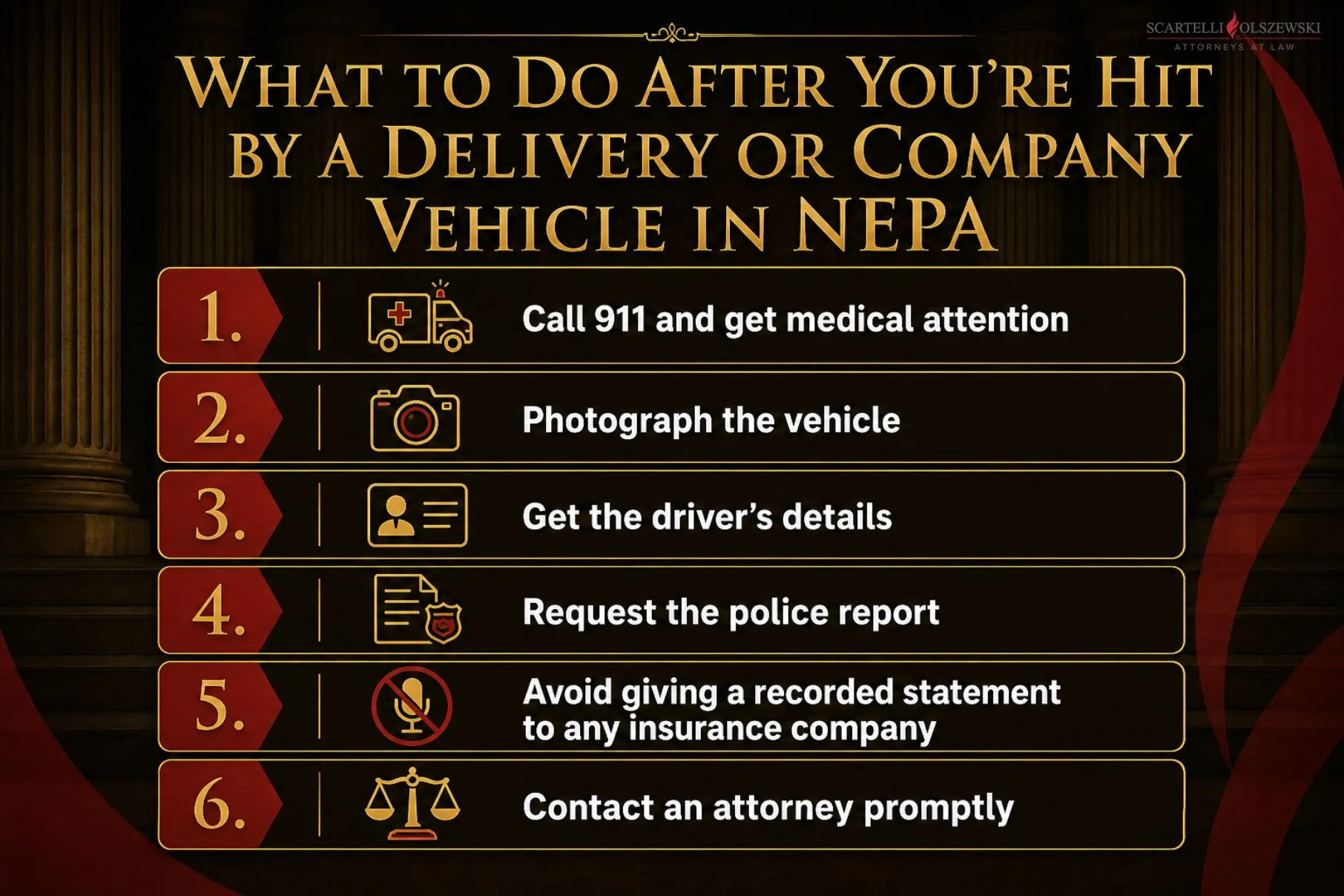
Lackawanna and Luzerne County recorded a combined 5,483 crashes in 2024 according to PennDOT data (see our NEPA car crash data), many of them on the narrow downtown streets around Scranton and Wilkes-Barre’s Public Square where delivery vehicles operate in close quarters with pedestrians and other drivers.
Yes, you can sue Amazon directly. Liability depends on the operational control Amazon exercised over the driver at impact. Amazon Flex drivers are independent contractors. DSP drivers are employed by third-party companies. Courts have found Amazon liable when routing software, delivery windows, and app monitoring demonstrate functional control.
The same liability rules apply to a parked car as to a moving vehicle. If the driver was on an active delivery at impact, the employer’s commercial insurance policy covers your vehicle damage and injuries. Without collision coverage on your own policy, you pursue the at-fault insurer directly for repairs.
Pennsylvania’s personal injury statute of limitations is 2 years from the crash date. State and local government vehicle crashes require written notice within 6 months under 42 Pa.C.S. § 5522. USPS crashes require a Standard Form 95 administrative claim within 2 years under the Federal Tort Claims Act.
Yes, you recover compensation even if you share fault, because Pennsylvania applies modified comparative negligence under 42 Pa.C.S. § 7102. Your recovery is reduced by your percentage of fault. At 20% fault on a $100,000 claim, you recover $80,000. You lose all recovery if your fault exceeds 50%.
USPS crashes require a separate federal process, not a standard Pennsylvania lawsuit. File a Standard Form 95 administrative claim with the Postal Service within 2 years under the Federal Tort Claims Act. USPS has 6 months to respond. Suit goes to federal court after a denial or no response.
Yes. An employer faces liability for a crash in a driver’s personal vehicle when that driver was performing work duties at impact. Personal auto policies contain business-use exclusions that void coverage for delivery work. Proving the work connection without company branding requires GPS records, app logs, or dispatch documentation.
The liability framework for DoorDash and Uber Eats crashes is the same as for UPS or Amazon crashes. Both platforms classify drivers as independent contractors with contingent commercial coverage tied to app status at impact. For the specific steps gig-platform crashes require, see our Uber and Lyft accident guide.
If you were hurt by a delivery driver or a company vehicle anywhere in Northeastern Pennsylvania, sorting out which insurance policy applies should not fall on you while you are recovering. Scartelli Olszewski, P.C. has represented injured clients across Lackawanna and Luzerne County since 2001.
Our Scranton and Wilkes-Barre teams handle these commercial vehicle accident and claims throughout Northeastern Pennsylvania, from PennDOT vehicles to city and county fleets.
Call us at (570) 346-2600 for a free consultation or schedule online. We work on a contingency fee, so you pay nothing unless we recover compensation for you.
Attorney Advertising. This article provides general information about Pennsylvania law and is not legal advice. Past results do not guarantee a similar outcome; every case depends on its own facts.
I don't think I could have picked a better team to represent my case. My situation was unique and extremely complicated but it was handled with the utmost care and professionalism. The firm's strong and organized representation ultimately brought great results and helped reconcile a tragic event.
- Jeremy S.
Was wrongly accused of a very serious Felony 3 account and hired Peter Paul Olszewski. The entire firm of Scartelli Olszewski worked tirelessly to have the Pike County Assistant District Attorney as well as the District Magistrate Judge Dismiss the charges! Very pleased with the outcome of this Law Firm and recommend this Law Firm.
- Kerry S.Dealing with the attorneys over at Scartelli Olszewski was nothing short of satisfactory. Through the entire 4 year process we had, I was constantly kept updated and cared for. More than doing their job, they truly care for their clients which I felt off the first meeting with Melissa. Both my family and I are forever thankful for them!
- Noah T.If you drive I-81 past Scranton and Wilkes-Barre, you share the road with 80,000-pound commercial rigs every day, especially where...
Read MorePeter Paul Olszewski Jr. told Luzerne County Council on August 27, 2026 that Scartelli Olszewski, P.C. would not bill the...
Read MoreIn Pennsylvania, both texting and holding a phone while driving are strictly illegal. Texting while driving has been prohibited since...
Read MoreAfter an accident, who you hire matters. We've spent years fighting for families just like yours – and we're ready to fight for you.

Wilkes Barre Office (Appointment Only)
Scartelli Olszewski, P.C.
7 Public Square
Wilkes-Barre, PA 18701