


$
Jury Verdict
$ 10 Million
Medical Malpractice
Luzerne County


A crash on I-81 or the Turnpike leaves you facing injuries, medical bills, and insurance adjusters calling for statements. Underneath it all sits a choice made on your policy: Pennsylvania’s full tort or limited tort option.
That selection sets the starting point for whether you can recover pain and suffering compensation. Many drivers across NEPA never check their coverage limits until a crash forces the question, usually the point at which they need an experienced Pennsylvania car accident lawyer.
Your declarations page drives more of the outcome: how your medical bills get paid, what your settlement is worth, and whether you have a viable case. Below, our firm answers the questions that come up most often after a crash. Scartelli Olszewski has handled personal injury claims in Lackawanna and Luzerne County courts since 2001, under founding attorney Melissa A. Scartelli.
Pennsylvania is a choice no-fault state, one of three in the country along with New Jersey and Kentucky. Your own policy pays first-party medical benefits regardless of who caused the crash. Your right to sue the at-fault driver depends on the tort option you elected.
That structure sits between the two systems most drivers know.
Pennsylvania runs a hybrid: mandatory first-party medical benefits underneath a tort right whose scope you choose yourself.
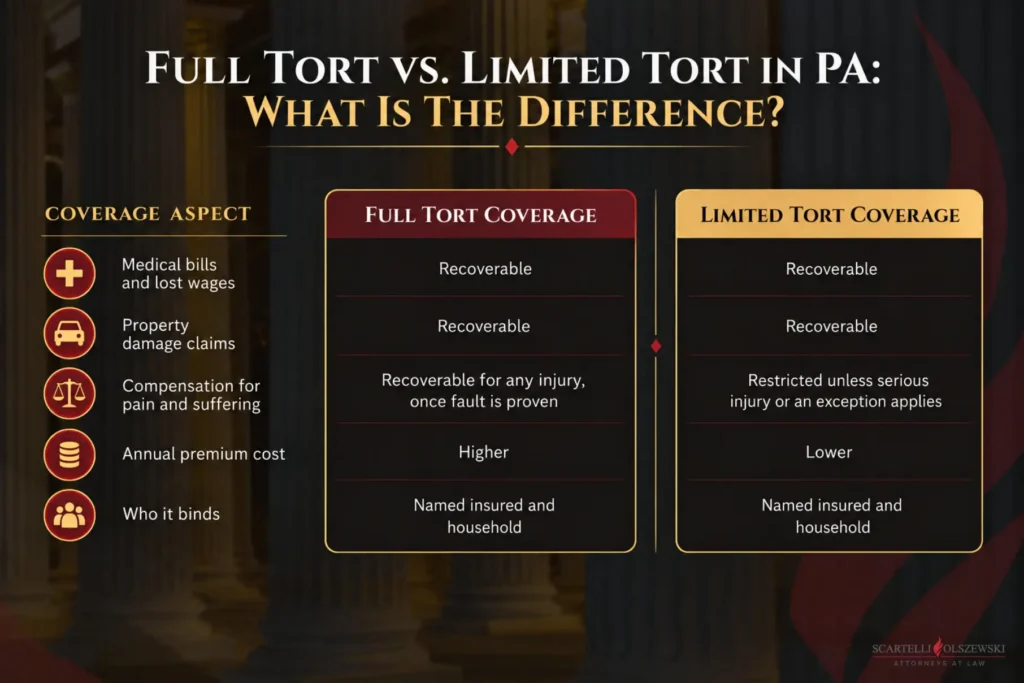
Full tort preserves an unrestricted right to sue for pain and suffering. Limited tort lowers your premium and gives that right up unless your injury is serious or an exception applies. Both options recover medical bills and lost wages identically.
The election binds your whole household. A limited tort choice made by one named insured reaches a spouse, resident relatives, and minors covered under that policy.
Here is how the two options compare on what matters after a crash:
|
Coverage Aspect |
Full Tort Coverage |
Limited Tort Coverage |
|
Medical bills and lost wages |
Recoverable |
Recoverable |
|
Property damage claims |
Recoverable |
Recoverable |
|
Compensation for pain and suffering |
Recoverable for any injury, once fault is proven |
Restricted unless serious injury or an exception applies |
|
Annual premium cost |
Higher |
Lower |
|
Who it binds |
Named insured and household |
Named insured and household |
Pull your policy declarations page. The tort election appears there in writing, and it governs the claim no matter what you remember choosing.
Important legal detail: a limited tort requires an affirmative signature under 75 Pa.C.S. § 1705(a). The statutory notice tells you that to choose limited tort, you must sign and return it, and that if you do not, you are considered to have chosen full tort. If your insurer cannot produce your signed limited tort election form, your coverage defaults to full tort.
One group falls outside that default. Under § 1705(a)(5), an owner of a registered private passenger vehicle who carries no insurance at all is deemed to have chosen limited tort.
Yes. A limited tort restricts pain and suffering damages but does not eliminate your right to sue. Two routes remain open:
Section 1705(d)(3) goes further, preserving full tort for anyone injured as an occupant of a vehicle other than a private passenger car, including buses and most commercial vehicles.
The exceptions matter more than the premium savings ever did. Your tort election is one factor that decides what a Pennsylvania car accident case is worth.
Every registered vehicle in Pennsylvania requires liability coverage of 15/30/5 plus $5,000 in first-party medical benefits.
Pennsylvania’s Motor Vehicle Financial Responsibility Law sets the floor:
|
Coverage |
Minimum Required |
What It Pays |
|
Bodily injury liability |
$15,000 per person / $30,000 per accident |
Injuries you cause to other people |
|
Property damage liability |
$5,000 |
Damage you cause to another vehicle or property |
|
First-party medical benefits |
$5,000 |
Your own medical bills, regardless of fault |
A single serious crash exceeds $15,000 quickly. One ambulance ride, an emergency department workup, and an MRI consume that limit before treatment begins.
Your own automobile insurance pays first, through first-party medical benefits, regardless of who caused the crash. 75 Pa.C.S. § 1713 sets which policy that is: the one naming you, before the one on the car.
First-party benefits are the no-fault half of Pennsylvania’s system. Optional coverage for income loss, funeral expenses, and extraordinary medical costs is available, though no law requires it.
Once your limit exhausts, health insurance usually pays next. Section 1722 then bars recovering those amounts from the at-fault driver. Only the excess nobody covered stays claimable.
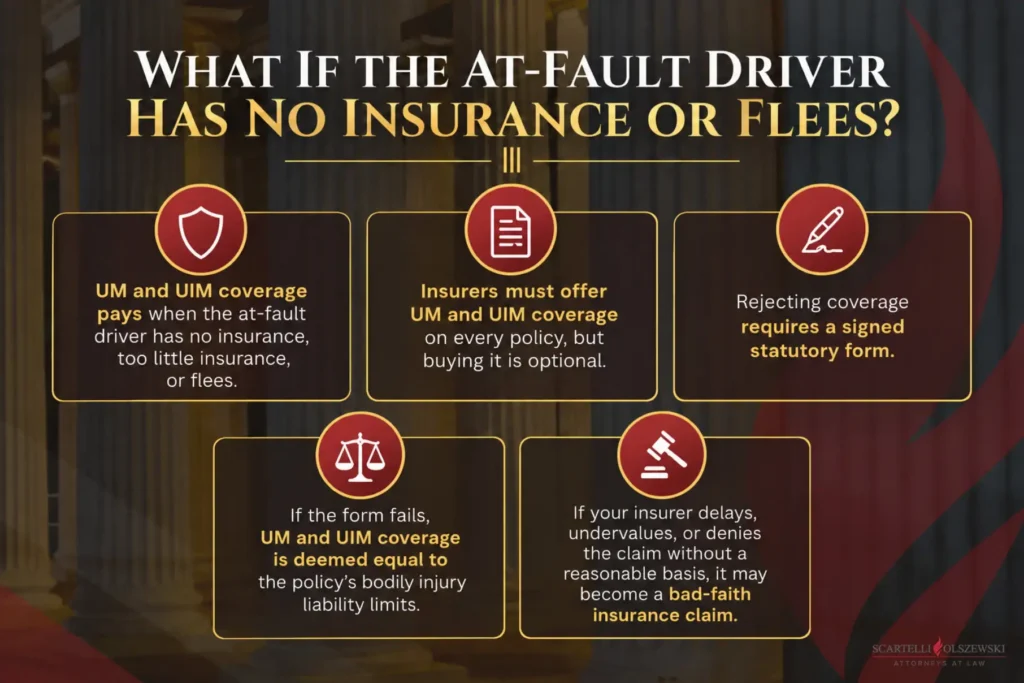
Your uninsured and underinsured motorist coverage pays when the at-fault driver has no insurance, too little of it, or flees and is never identified. Insurers must offer UM and UIM coverage on every policy, though buying it is optional.
Rejecting it takes a signed statutory form. A form that specifically complies with Section 1731 holds up even when it is not word-for-word, but one that fails is void, and UM and UIM coverage is then deemed equal to the policy’s bodily injury liability limits. That is worth checking on any CLR that requires the at-fault driver to have carried minimum limits.
Section 1705(d) restores full tort rights against an uninsured driver, but not under your own coverage. Section 1731(d)(2) bars limited tort claimants from recovering pain and suffering through UM or UIM, so the serious injury threshold is the realistic route.
When your own insurer delays, undervalues, or denies that claim without a reasonable basis, it becomes a bad-faith insurance claim under Pennsylvania law.
You recover as long as your share of fault is not greater than the combined fault of everyone you are suing. Pennsylvania applies modified comparative negligence under 42 Pa.C.S. § 7102, and your award reduces by your percentage of fault.
Example: On $100,000 in damages with 30 percent of the fault assigned to you, you recover $70,000. Cross the line, and you recover nothing.
You have two years from the date of the crash to file a personal injury or property damage lawsuit under 42 Pa.C.S. § 5524.
Two rules change that picture. Any claim against a government unit requires written notice within six months under § 5522, and against a local unit late notice is not fatal if it already knew of the incident. For an injured minor, § 5533(b) pauses the clock until age 18.
Miss the two-year deadline and the merits stop mattering. A court dismisses a late claim no matter how clear the liability was.
No law sets a fixed number of years. Your insurer’s surcharge disclosure plan states how long a surcharge stays in effect, and it must be sent to you annually.
Pennsylvania limits when they can surcharge at all. Under 75 Pa.C.S. § 1799.3, no surcharge or nonrenewal applies unless your claim costs over the preceding three years exceed a threshold the Insurance Department resets periodically, set at $2,350 effective July 1, 2026. Two things can trigger one: an at-fault accident above that threshold, or two point-carrying convictions within 36 months. Never for paying your first-party medical benefits.
Your declarations page tells you which tort option you carry. It does not tell you if a legal exception restores your rights, what your claim is truly worth, or what an insurance adjuster’s initial settlement offer leaves out.
That is where our legal team steps in. Contact Scartelli Olszewski, P.C. today at (570) 346-2600 or fill out our online contact form to schedule your free, no-obligation consultation.
“Small Enough to Care, Large Enough to Win.”
Our Scranton car accident lawyer and Wilkes-Barre car accident lawyer teams work on contingency, so you pay no upfront legal fees unless we secure compensation for you.
This article provides general information about Pennsylvania automobile insurance and auto accident law. It is not legal advice for a specific case. Reading it does not create an attorney-client relationship.
I don't think I could have picked a better team to represent my case. My situation was unique and extremely complicated but it was handled with the utmost care and professionalism. The firm's strong and organized representation ultimately brought great results and helped reconcile a tragic event.
- Jeremy S.
Was wrongly accused of a very serious Felony 3 account and hired Peter Paul Olszewski. The entire firm of Scartelli Olszewski worked tirelessly to have the Pike County Assistant District Attorney as well as the District Magistrate Judge Dismiss the charges! Very pleased with the outcome of this Law Firm and recommend this Law Firm.
- Kerry S.Dealing with the attorneys over at Scartelli Olszewski was nothing short of satisfactory. Through the entire 4 year process we had, I was constantly kept updated and cared for. More than doing their job, they truly care for their clients which I felt off the first meeting with Melissa. Both my family and I are forever thankful for them!
- Noah T.If you’ve been injured in an accident or are researching personal injury law, you may have come across the word...
Read MoreKitchen appliances are meant to make everyday life easier. When something goes wrong, though, the results can be serious. Defective...
Read MoreOne day, everything is normal. Your loved one is smiling, laughing, and going about their life, but then something terrible...
Read MoreAfter an accident, who you hire matters. We've spent years fighting for families just like yours – and we're ready to fight for you.

Wilkes Barre Office (Appointment Only)
Scartelli Olszewski, P.C.
7 Public Square
Wilkes-Barre, PA 18701