



$
Jury Verdict
$ 10 Million
Medical Malpractice
Luzerne County

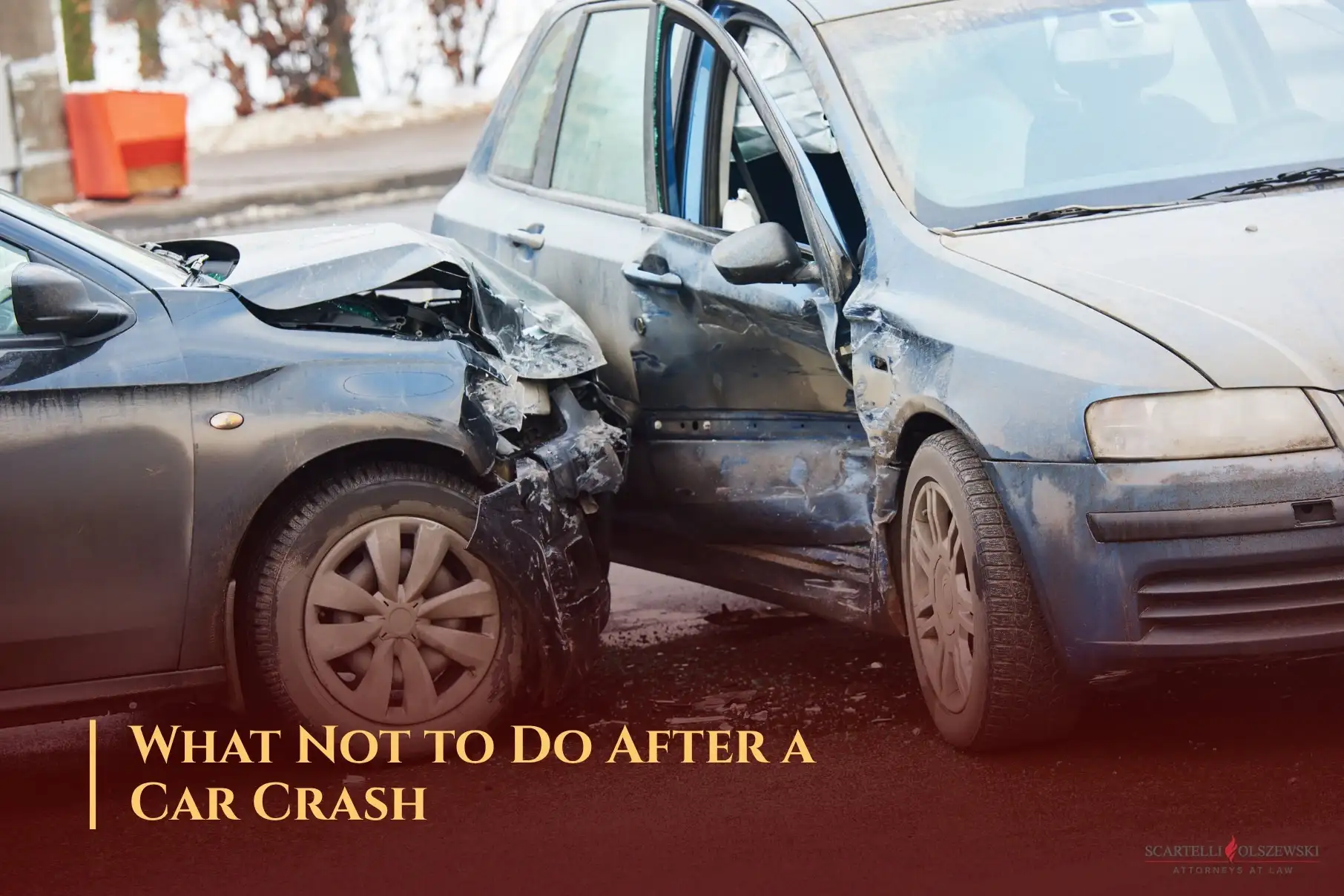
The minutes after a crash are the worst possible time to make decisions that shape your personal injury claim. You are shaken, your car is damaged, and someone is already asking you questions. Yet what you do in that window often matters more than anything that happens later.
The short answer: do not leave the scene, do not apologize, do not skip medical treatment, and do not give the insurance company a recorded statement or accept a settlement before you understand what your claim is worth. Each carries a specific consequence under Pennsylvania law. If your crash involved serious injuries, limited tort issues, or disputes over fault, a Pennsylvania car accident lawyer can explain where your claim actually stands before the insurer does. Here are things that you should not do after a car crash.
Key Takeaways: What to Avoid After a PA Car Crash
Pennsylvania requires you to stop, give your name, address, and vehicle registration to the other driver, and show your license on request. Leaving before you do that is a criminal offense, not a traffic ticket, and the grading rises with the severity of the injuries.
Staying also gets you proof. When police respond, they must investigate and give each driver a signed statement confirming the crash was reported. Drive away, and you have neither the statement nor the report.
How long you have to report a car accident in Pennsylvania depends on one thing: whether an officer investigated. Two separate obligations exist under 75 Pa.C.S. § 3746 and § 3747. Here is how the two obligations divide:
|
Situation |
What Pennsylvania Requires |
Who Files |
|
Injury, death, or a vehicle requiring towing |
Immediate notice to the nearest police department |
You, at the scene |
|
Police investigate the crash |
Nothing further |
The officer |
|
Reportable crash, no officer investigates |
Written report to PennDOT within five days |
You |
The five-day window is a fallback, not the general rule. If police came and gave you that signed statement, your duty is discharged. If nobody came, the clock is running.
Saying “I’m sorry” at the scene isn’t an automatic admission of fault, but it gives the insurance adjuster leverage to lower your payout. Under Pennsylvania’s modified comparative negligence rule, your recovery is reduced by your percentage of fault. You can still recover with a share of 50 percent or less. At 51 percent or more, you recover nothing.
The comparative fault arithmetic makes apologizing costly. On a $100,000 claim, a 30% share of fault costs you $30,000. The insurer doesn’t need to prove you caused the crash, only to push your percentage upward.
Admitting fault or guessing details like speed and distance creates recorded statements the insurer will use against you. Stick strictly to what you know. Unless you are completely certain, do not speculate on speeds, distances, or traffic signals. For complete evidence-gathering steps, read our guide on what to do after a car accident.
Every Pennsylvania auto policy includes at least $5,000 in first-party medical benefits that pay out regardless of who caused the crash.
Delaying care creates two risks. Concussions, soft tissue damage, and internal injuries often surface days later, which makes immediate evaluation a medical priority before it is a legal one. An adjuster will then use any gap in treatment to argue your injuries were unrelated to the crash. If your symptoms developed after you left the scene, review our guide on delayed pain after a car crash.
Adjusters check social accounts, and they are looking for anything that contradicts the injuries you have described. A photograph of you at a wedding, a friend’s tagged post from a hike, a check-in at the gym, none of it needs context to be useful to them.
Private settings help less than people assume, since anything a friend can see can be screenshotted and produced. Deleting posts after a claim is underway carries its own risk, because destroying evidence relevant to litigation can be raised against you. Stop posting. Do not scrub what is already there without asking a lawyer first.
The other driver’s insurer usually calls within a day and will sound helpful. You have no legal obligation to give their adjuster a recorded statement; doing so locks you into an account of the crash before the full extent of your injuries is known.
What not to say to an insurance adjuster comes down to three things: don’t apologize, don’t guess at facts, and don’t describe your injuries as minor. An initial settlement offer arrives early for the same reason. It is priced for today’s convenience, not your long-term medical costs. Signing a settlement release ends your claim permanently, even if your condition worsens.
Always notify your own insurance company promptly. Most policies require timely notice to preserve your Personal Injury Protection (PIP) medical benefits.
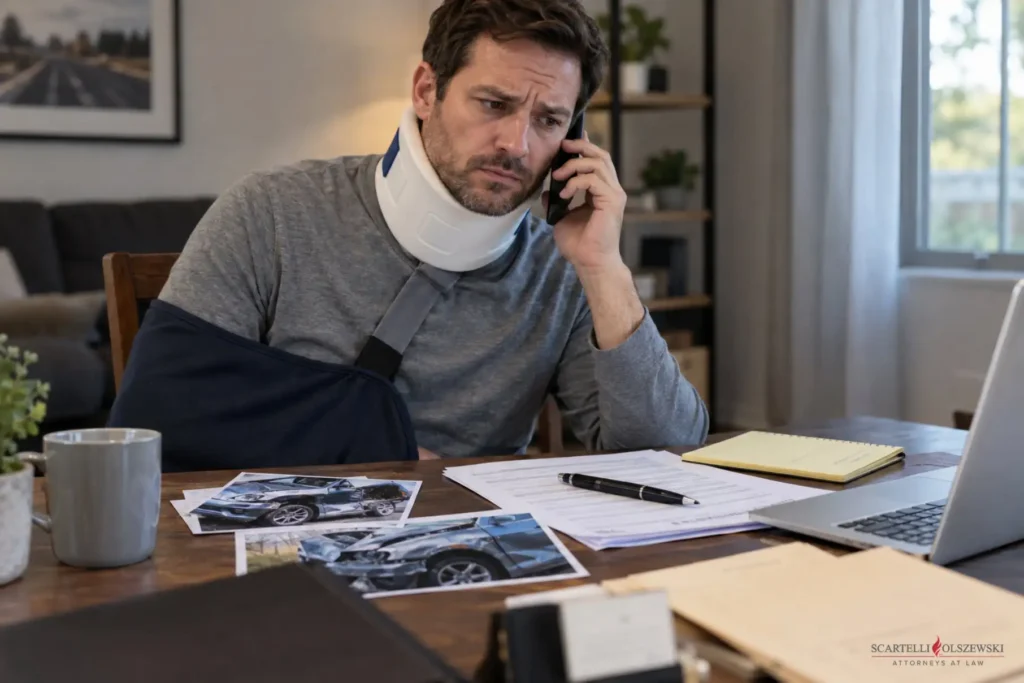
The paperwork an insurance adjuster sends often includes a release for your complete medical history. While presented as routine processing, it is a tactic to undermine your auto accident claim.
A blanket medical release gives the insurer access to your entire medical record, allowing them to scour past treatments, sports injuries, or pre-existing conditions to argue your pain wasn’t caused by the crash. Never sign a broad release; restrict any signed authorization strictly to care related to the accident.
The statute of limitations for personal injury in Pennsylvania is two years from the date of the crash. Miss it, and your claim is barred regardless of how strong it was.
Shorter deadlines apply when a government vehicle or municipal authority is involved, sometimes six months for formal notice. Evidence runs on its own clock: surveillance footage from nearby businesses is routinely overwritten within days, and witnesses stop remembering details within weeks.
Most accident victims read advice after a mistake has already happened. The real question isn’t whether you made an error. It’s whether that error can still be fixed. In most cases, it can.
|
What happened |
Can it be fixed? |
Why |
|
You apologized at the scene |
Usually yes |
An apology is not a legal admission. Fault is decided on evidence, and photos, witnesses, and reconstruction outweigh something you said while shaking |
|
No police came |
Usually yes |
The written PennDOT report exists for exactly this situation |
|
You waited weeks to see a doctor |
Usually yes |
A treatment gap can be documented and explained |
|
You gave a recorded statement |
Usually yes |
A statement is not a confession, and it can be put in context |
|
You signed a settlement release |
Rarely |
Signing generally ends the claim, even if you get worse |
|
The two-year deadline passed |
Rarely |
A missed filing deadline generally bars the claim outright |
The single biggest variable in repairing an accident claim is time. Physical evidence degrades, witnesses lose memory, and the insurance company builds its file while yours stays empty.
Still deciding whether taking action is worth it? Our guide on hiring a lawyer for car crashes in PA covers what representation actually changes for your recovery.
Avoid apologizing, guessing at facts you did not observe, and characterizing your injuries as minor. “I’m fine” on day one becomes an argument on day sixty. Give your name, the date, the location, and the fact that a crash occurred. Decline to speculate about fault or the severity of your injuries.
An at-fault crash is recorded on your PennDOT driving history, and any points assessed for an underlying violation such as careless driving generally come off after three years of violation-free driving. Insurers apply their own surcharge periods, which are typically three to five years and are separate from your PennDOT record.
Your own insurer is owed prompt, truthful notice, and withholding it can cost you coverage. That duty does not extend to speculation. Report what happened without guessing at fault, and be aware that a recorded statement to your own carrier can still surface later if coverage becomes contested.
Yes, provided your share is 50 percent or less. Your award is reduced by your percentage, so a 20 percent share on a 100,000 dollar claim yields 80,000. At 51 percent or above, recovery is barred entirely.
If you were injured on I-81, I-84, Route 6, or any roadway across Northeastern Pennsylvania, a short conversation now can protect your entire recovery.
Founding attorney Melissa A. Scartelli, a Board Certified Civil Trial Advocate, has tried these car accident and injury cases in Lackawanna and Luzerne County courtrooms since 1988. Our Scranton car accident attorneys and Wilkes-Barre car accident attorneys build claims the same way whether the crash happened downtown or off a rural stretch of I-81. In complex claims, hard evidence like accident reconstruction, scene photography, and witness accounts carry the argument, not a comment you made at the roadside while shaking.
Do not let an insurance adjuster dictate what your claim is worth. We offer free case reviews, no-cost calls, and you owe nothing unless we recover money for you.
“Small Enough to Care, Large Enough to Win”
Call Scartelli Olszewski, P.C. today at (570) 346-2600 or schedule a free consultation online to discuss your options with an experienced Pennsylvania car accident lawyer.
This article is provided for informational purposes only and does not constitute legal advice or create an attorney-client relationship. Attorney Advertising.

Peter Paul Olszewski, Jr., a shareholder and managing partner at Scartelli Olszewski, P.C., brings 37 years of litigation experience. He is a renowned trial lawyer in Pennsylvania, specializing in medical malpractice, personal injury, and criminal defense. Peter's notable achievements include securing multi-million-dollar verdicts and serving as District Attorney and Judge. He is committed to community involvement and is actively engaged in various legal associations.
Linked In - https://www.linkedin.com/in/peter-paul-olszewski-jr-11115b1a/
I don't think I could have picked a better team to represent my case. My situation was unique and extremely complicated but it was handled with the utmost care and professionalism. The firm's strong and organized representation ultimately brought great results and helped reconcile a tragic event.
- Jeremy S.
Was wrongly accused of a very serious Felony 3 account and hired Peter Paul Olszewski. The entire firm of Scartelli Olszewski worked tirelessly to have the Pike County Assistant District Attorney as well as the District Magistrate Judge Dismiss the charges! Very pleased with the outcome of this Law Firm and recommend this Law Firm.
- Kerry S.Dealing with the attorneys over at Scartelli Olszewski was nothing short of satisfactory. Through the entire 4 year process we had, I was constantly kept updated and cared for. More than doing their job, they truly care for their clients which I felt off the first meeting with Melissa. Both my family and I are forever thankful for them!
- Noah T.If you’ve been injured in an accident or are researching personal injury law, you may have come across the word...
Read MoreKitchen appliances are meant to make everyday life easier. When something goes wrong, though, the results can be serious. Defective...
Read MoreOne day, everything is normal. Your loved one is smiling, laughing, and going about their life, but then something terrible...
Read MoreAfter an accident, who you hire matters. We've spent years fighting for families just like yours – and we're ready to fight for you.

Wilkes Barre Office (Appointment Only)
Scartelli Olszewski, P.C.
7 Public Square
Wilkes-Barre, PA 18701